How this article was made: Research-based comparison. It draws on published information from makers, retailers, and reference sources, not on hands-on testing.
- The Core Difference: One Steel, No Compromise
- Defining Honyaki: Forging from a Single Steel Billet
- Honyaki vs. Kasumi: Understanding the Structural Contrast
- Why Honyaki Knives Are Rare and Expensive
- Handling and Maintenance: What Honyaki Demands from Its User
- Honyaki Is Not for Beginners — and That Is by Design
- FAQ: Common Questions About Honyaki Knives
- The Significance of One Material, Fully Committed
The Core Difference: One Steel, No Compromise
Honyaki knives are forged entirely from a single piece of high-carbon steel — no soft iron jacket, no layered composite, no cladding of any kind. That single distinction separates them from virtually every other traditional Japanese kitchen knife, and it shapes everything about how they perform, how they fail, and who should use them.
Most serious Japanese knives, including professional tools, are built from two materials bonded together. Honyaki abandons that construction entirely. The same steel that forms the edge also forms the spine, the heel, and every surface in between. There is nowhere to hide imperfection, and no secondary material to absorb the stresses of forging and heat treatment.
That is not a flaw in the design. It is the point.
Defining Honyaki: Forging from a Single Steel Billet
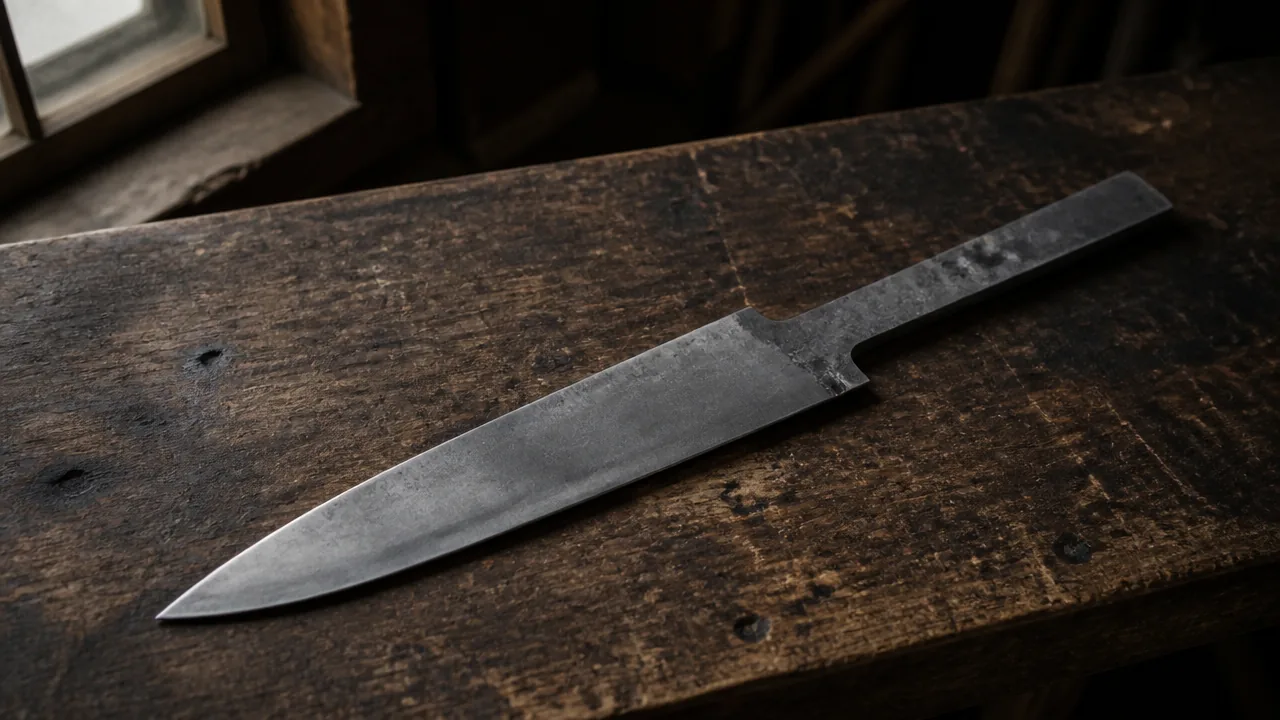
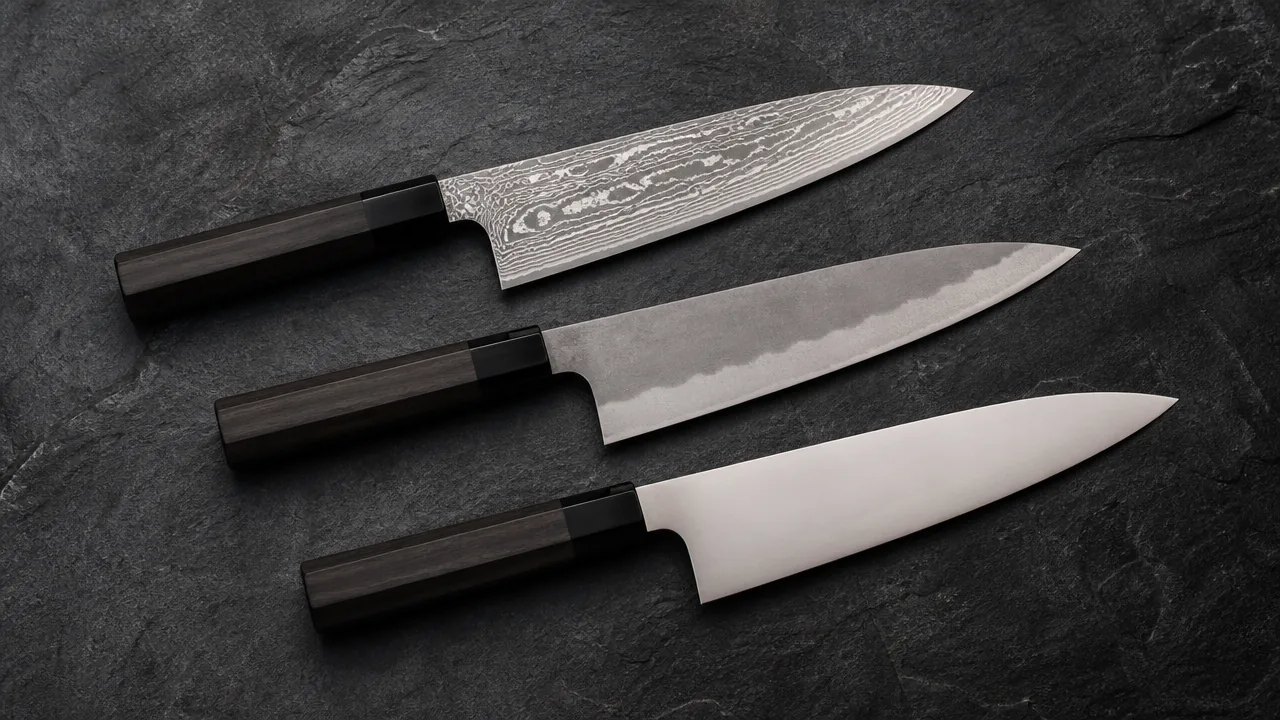
The term honyaki translates roughly as ‘true-fired’ or ‘genuine quench,’ and both readings point to what defines the process: the entire blade is shaped and heat-treated from one uniform piece of high-carbon steel. There is no jigane — the relatively soft iron that wraps or backs the harder steel hagane in most traditional knife construction. The hagane is the whole blade.
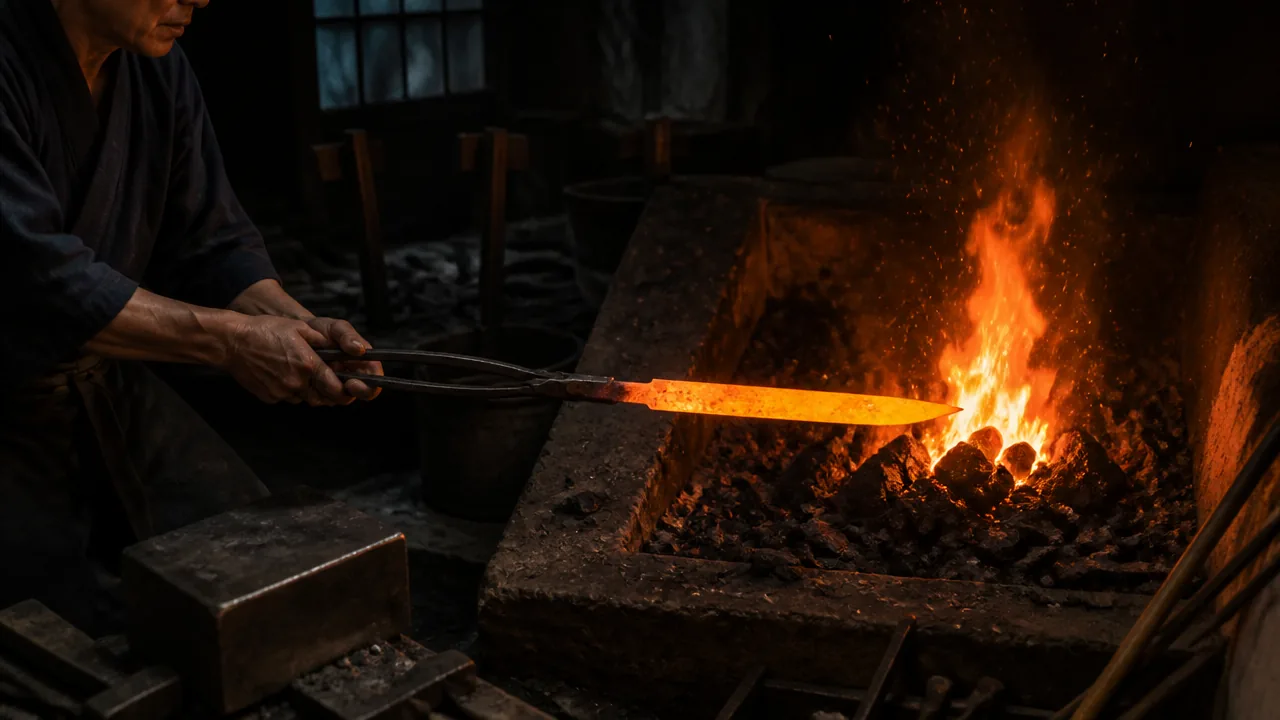
This approach is technically close to the forging and quenching methods used in traditional Japanese sword-making. Bladesmiths working in the honyaki tradition apply differential hardening techniques — selectively cooling the edge faster than the spine during quenching — which can produce a visible line along the blade similar in character to the hamon seen on katana. It would be an overstatement to call the connection identical, since kitchen knife forging operates under different constraints and scales, but the technical lineage is generally acknowledged within the craft.
The steel used is typically a high-carbon variety such as Shirogami or Aogami, materials known for their capacity to take an extremely fine edge. Because there is no softer backing material to moderate the blade’s behavior during heat treatment, the properties of that steel — its carbon content, its grain structure, its response to temperature — determine everything about the finished knife. The smith has no secondary layer to compensate for or correct with.
Honyaki vs. Kasumi: Understanding the Structural Contrast
To understand what honyaki represents, it helps to place it directly against the kasumi construction that defines most traditional Japanese knives — and to connect that contrast to the broader framework of how Japanese knife steels actually work.
As our guide Japanese Knife Steel Types Explained: VG-10 vs Damascus vs Aogami and Shirogami explains, Damascus cladding functions as a decorative and protective outer layer — it does not determine the cutting properties of the knife. What determines edge performance is the core steel: VG-10, Shirogami, Aogami, and so on. The cladding supports and protects that core.
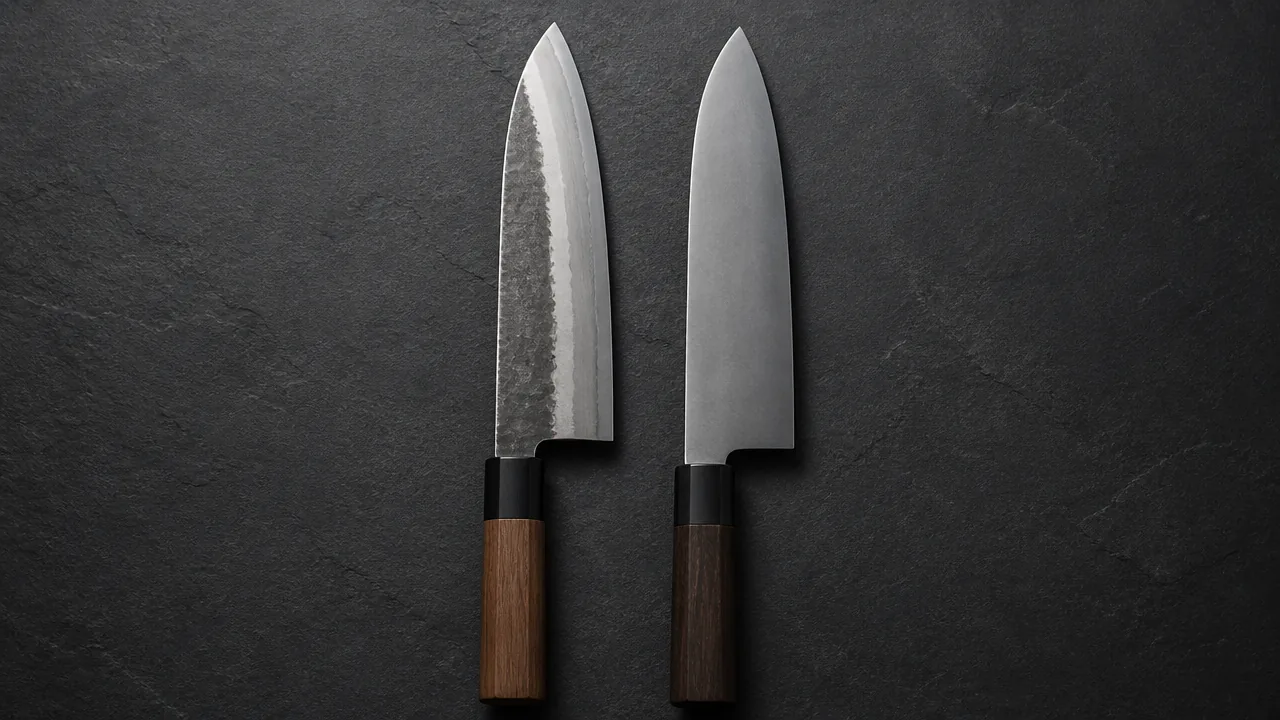
Kasumi construction works on a related logic. The soft iron jigane provides structural support and absorbs shock, while the harder hagane forms the cutting edge. Honyaki removes the jigane entirely. There is no cladding, no backing layer, no shock-absorbing partner material. The core steel is not the center of the blade — it is the entire blade.
| Feature | Kasumi (Traditional) | Honyaki |
|---|---|---|
| Steel construction | Two materials: jigane (soft iron) + hagane (hard steel) | Single high-carbon steel throughout |
| Cladding / backing | Jigane wraps or backs the hagane | None |
| Edge material | Hagane only | Same steel as the full blade |
| Shock absorption | Jigane absorbs lateral stress | No secondary material to buffer impact |
| Quenching risk | Lower — jigane moderates stress | Higher — full steel exposed to thermal shock |
| Visual indicator | Kasumi (misty) line between jigane and hagane | May show hamon-like differential hardening line |
| Typical user profile | Professional to enthusiast | Experienced enthusiast and specialist |
The kasumi line that gives the construction its name — that soft, misted boundary visible on the blade face — is literally the interface between the two bonded materials. In a honyaki knife, that line does not exist, because there is only one material.
Why Honyaki Knives Are Rare and Expensive
The price and scarcity of honyaki knives are not simply the result of prestige marketing. They reflect something more concrete: the process is harder to execute: SharpEdge’s guide to honyaki says many blades warp or crack during differential quenching, and that high failure rates are common even for highly experienced blacksmiths.
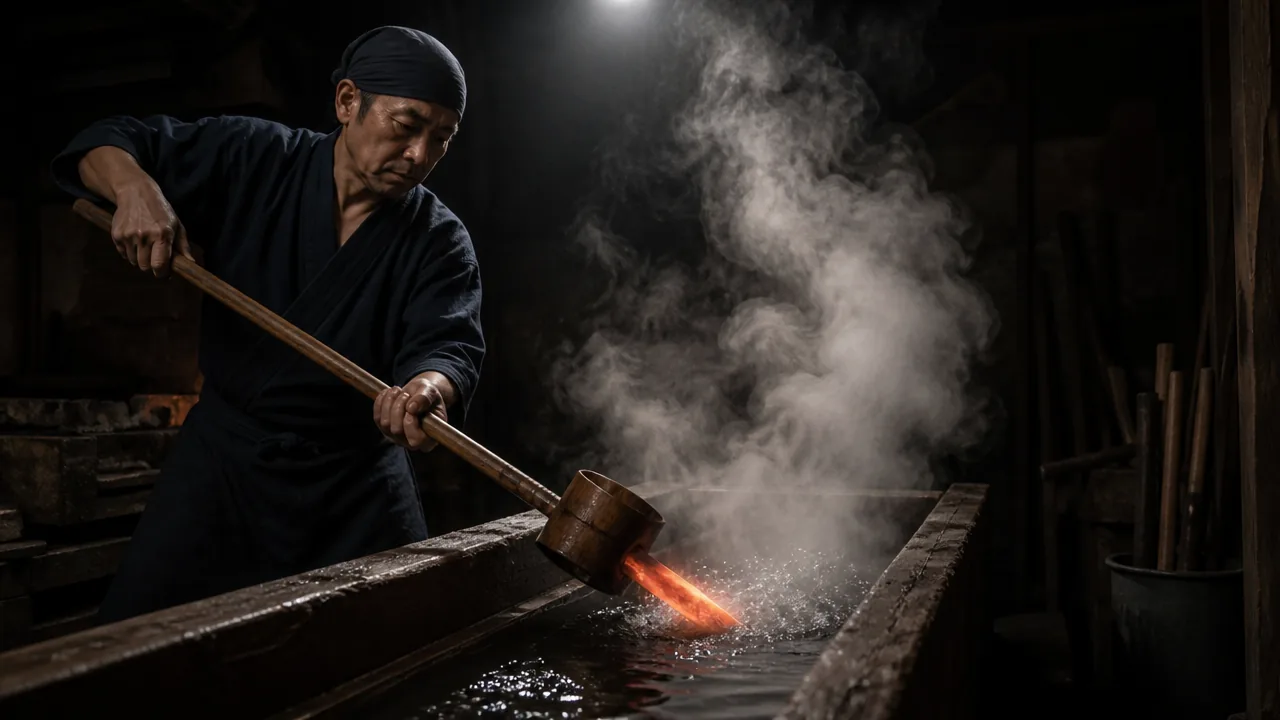
In kasumi forging, the jigane layer serves a practical function during heat treatment, not just in use. The soft iron moderates the thermal stresses that build up when the blade is quenched — plunged rapidly from high heat into water or oil to harden the steel. That buffering effect reduces the likelihood of the blade cracking or warping during what is already the most critical and least forgiving stage of knife-making.
Honyaki removes that buffer entirely. The full blade — spine to edge, heel to tip — is a single piece of high-carbon steel responding uniformly to an extreme thermal event. Controlling the rate and distribution of cooling across the whole blade, while inducing differential hardness along the edge, requires a level of judgment and skill that takes years to develop. Even experienced smiths working at a high level can lose a blade at this stage. The failure rate is not a closely published figure, but it is generally understood within the craft to be significantly higher than in kasumi work.
That reality compounds at every step. The forging itself demands precision because there is no secondary material to redistribute or absorb inconsistencies in the steel. The geometry must be right before quenching. The temperature judgment must be right during quenching. A mistake at any point typically means the blade is lost.
The craft traditions behind this kind of demanding, high-stakes work are explored in depth in What Is Shokunin Spirit? The Philosophy Behind Japan’s Blacksmiths — which offers important context for why honyaki production remains concentrated among a relatively small number of highly experienced practitioners.
Handling and Maintenance: What Honyaki Demands from Its User
Owning a honyaki knife is not simply a matter of buying a better tool. It is a commitment to a different relationship with a blade — one that requires more attentiveness, more skill, and a clearer understanding of the knife’s limits.
Honyaki blades, particularly those ground to a single bevel, are generally considered more prone to chipping than equivalent kasumi knives. The same hardness that allows the edge to reach exceptional sharpness also makes it more brittle under lateral stress or impact. For a detailed look at how single-bevel geometry shapes edge behavior and maintenance demands, Single Bevel vs Double Bevel Japanese Knives: What’s the Real Difference? covers those distinctions thoroughly.
Practical care considerations that are commonly recommended for honyaki knives include:
- Avoid twisting or prying motions against hard ingredients — the blade is not designed for lateral force
- Do not use the knife on hard-frozen foods, bones, or similarly unyielding materials
- Protect the blade from sudden temperature changes, which can introduce stress into the steel
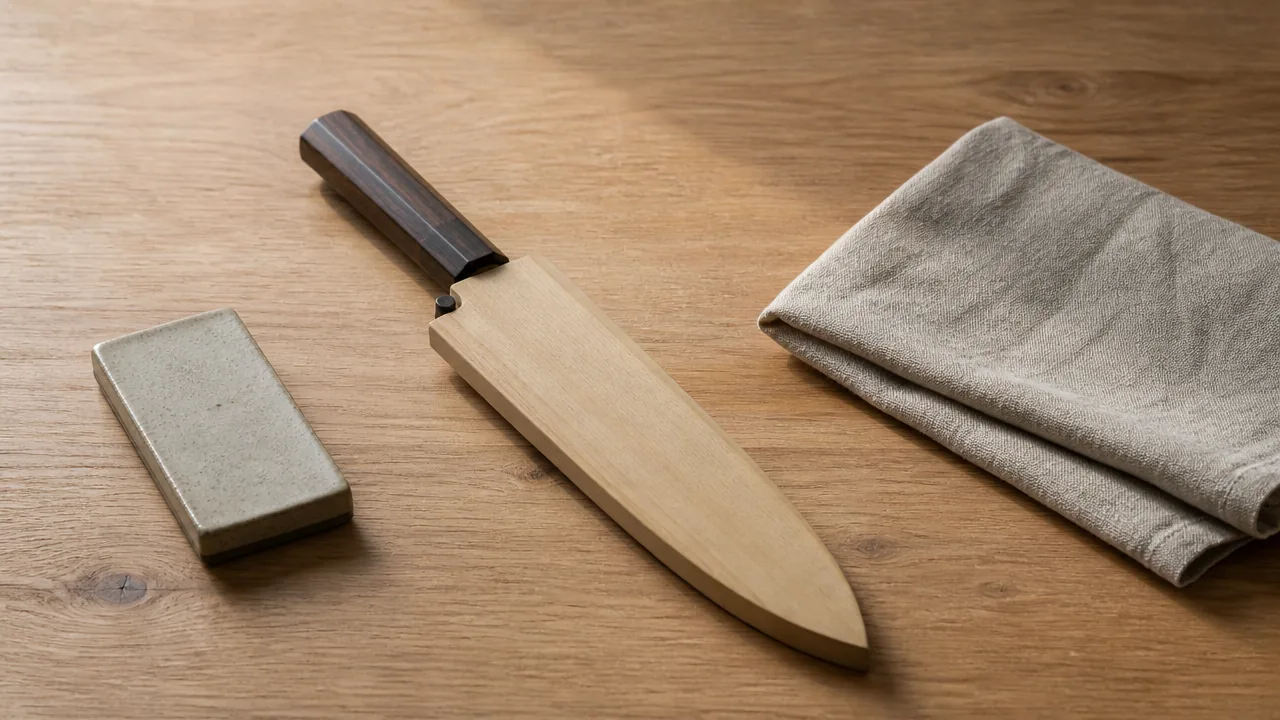
- Store the knife in a dedicated saya (wooden sheath) or on a magnetic rack where the edge will not contact other metal
- Dry the blade immediately after use; high-carbon single-steel blades are particularly susceptible to oxidation compared to stainless-clad alternatives
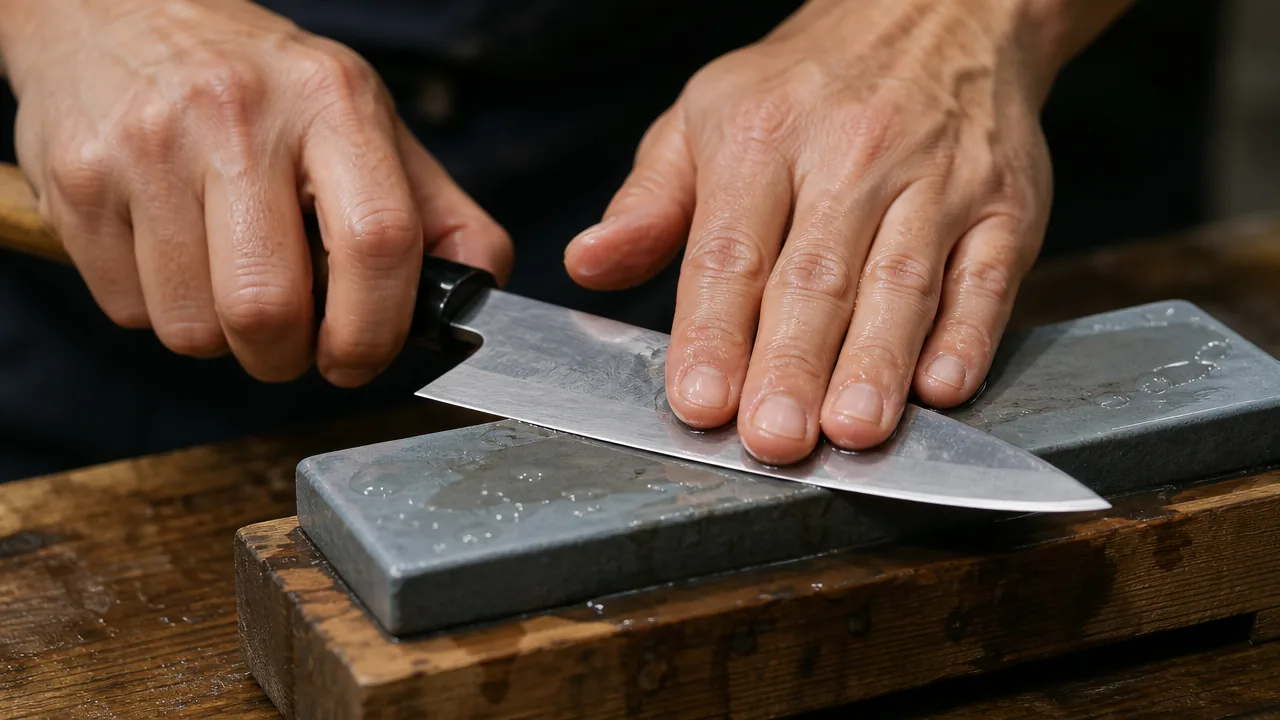
- Sharpen on appropriate whetstones, and understand that the blade geometry may require more careful angle maintenance than a double-bevel knife
None of this is meant to discourage serious users. It is simply an accurate description of what the knife asks of you in exchange for what it offers.
Honyaki Is Not for Beginners — and That Is by Design
It is worth stating plainly: honyaki knives are not recommended for cooks who are still developing their knife skills, and this is not a matter of gatekeeping. It is a practical assessment of how these blades respond to technique.
A beginner is more likely to apply lateral pressure inadvertently, to use incorrect cutting angles on a board, or to reach for a knife when a cleaver or a different tool would be more appropriate. Any of those habits can chip or damage a honyaki blade in ways that are difficult and time-consuming to correct. The margin for technique error is simply narrower than with a more forgiving kasumi knife.
Beyond the physical demands, honyaki knives often require sharpening skills that most beginners have not yet developed. Restoring a chipped edge on a hard single-steel blade, or maintaining the correct ura (the hollow back surface) on a single-bevel honyaki, are tasks that presuppose familiarity with Japanese whetstone sharpening at a fairly advanced level.
The appropriate user for a honyaki knife is someone who already has consistent knife technique, already sharpens their own knives competently, and is deliberately seeking the particular qualities — the edge refinement, the character of the steel, the connection to a very specific craft tradition — that honyaki offers. For that user, the knife rewards the investment. For anyone else, a well-made kasumi knife in the same steel type will almost certainly serve better.
FAQ: Common Questions About Honyaki Knives
Is honyaki worth the extra cost?
For the right user, yes — but ‘worth it’ depends entirely on what you are trying to get from the knife. Honyaki offers a level of edge refinement and a directness of steel character that is genuinely difficult to replicate in composite construction. If you are an experienced cook who sharpens regularly, appreciates the nuances of high-carbon steel, and wants a knife that rewards precise technique, the investment can be justified on its own terms. If you are looking for a workhorse kitchen knife that holds up to daily use without careful handling, a well-made kasumi knife in the same steel will almost certainly serve you better and require less from you in return.
Can beginners use a honyaki knife?
SharpEdge’s guide to honyaki describes these knives as generally suited to experienced users. The combination of higher chip risk, stricter technique requirements, and demanding maintenance — particularly the sharpening demands of single-bevel honyaki — makes these knives a poor fit for developing cooks. That is not a judgment about ambition; it is a recognition that the knife performs best in hands that already have consistent skills and sharpening experience.
What steel is typically used in honyaki knives?
Honyaki knives are most commonly associated with traditional high-carbon steels such as Shirogami (white steel) and Aogami (blue steel). These steels are generally chosen for their ability to reach very fine edges and their responsiveness to skilled heat treatment. Because there is no cladding or soft iron backing to moderate the blade’s behavior, the choice of steel and the precision of the heat treatment carry more consequence than in composite constructions.
How does a honyaki knife differ from a Damascus-clad knife?
The contrast is almost total. As explored in Japanese Knife Steel Types Explained: VG-10 vs Damascus vs Aogami and Shirogami, Damascus cladding is a layered outer material — it protects the core steel and creates visual pattern, but the core remains a distinct, separate element. A honyaki knife has no cladding and no core: the single steel is both. There is no layer boundary, no composite interface, and no secondary material of any kind. The two represent almost opposite ends of the structural spectrum in Japanese knife-making.
The Significance of One Material, Fully Committed
Honyaki is not simply a more expensive version of a standard Japanese knife. It is a fundamentally different object, built on a different logic, asking different things of the smith who makes it and the cook who uses it.
The absence of jigane is not an omission — it is a deliberate choice that removes every structural compromise the composite construction provides. What remains is a blade in which the steel itself must do everything: hold the edge, survive the quench, absorb the use, and respond to the sharpening stone. Nothing is hidden behind a softer material. Nothing is moderated by a backing layer. The steel is exposed fully, and so is the skill of the person who made it.
For experienced enthusiasts who understand what they are working with, that directness is precisely the appeal. Honyaki occupies a specific and demanding position within Japanese knife culture — not universally better, but genuinely distinct, and worth understanding clearly on its own terms.
If this look at honyaki has deepened your interest in how Japanese knife construction shapes performance, the comparison between single-bevel and double-bevel geometry is a natural next step — and one that changes how you think about edge maintenance entirely.