How this article was made: Research-based comparison. It draws on published information from makers, retailers, and reference sources, not on hands-on testing.
The Short Answer: Bunka vs Santoku
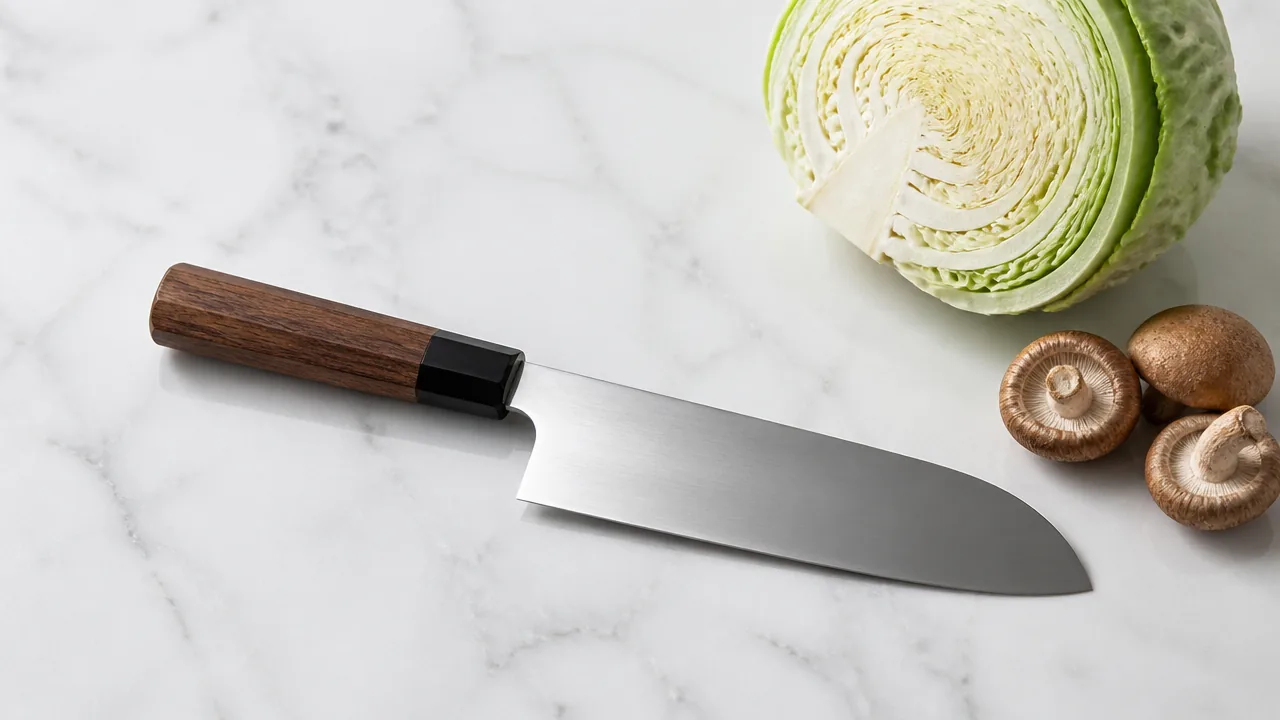
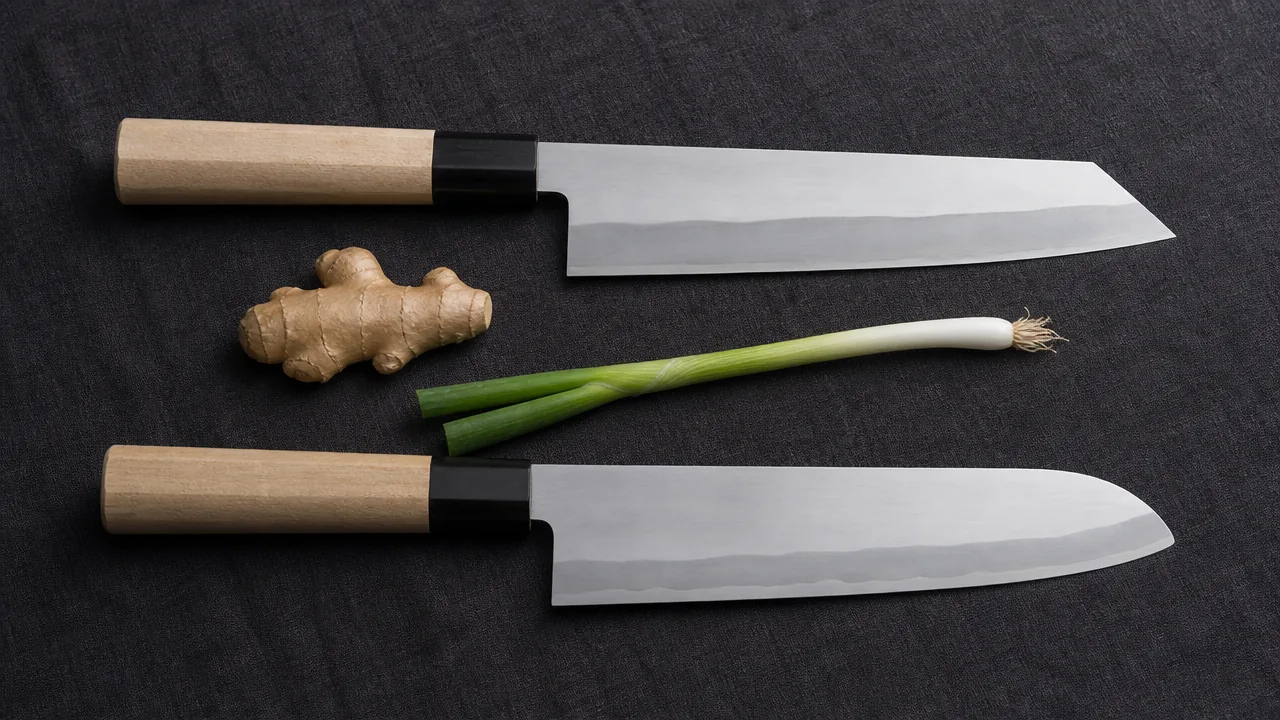
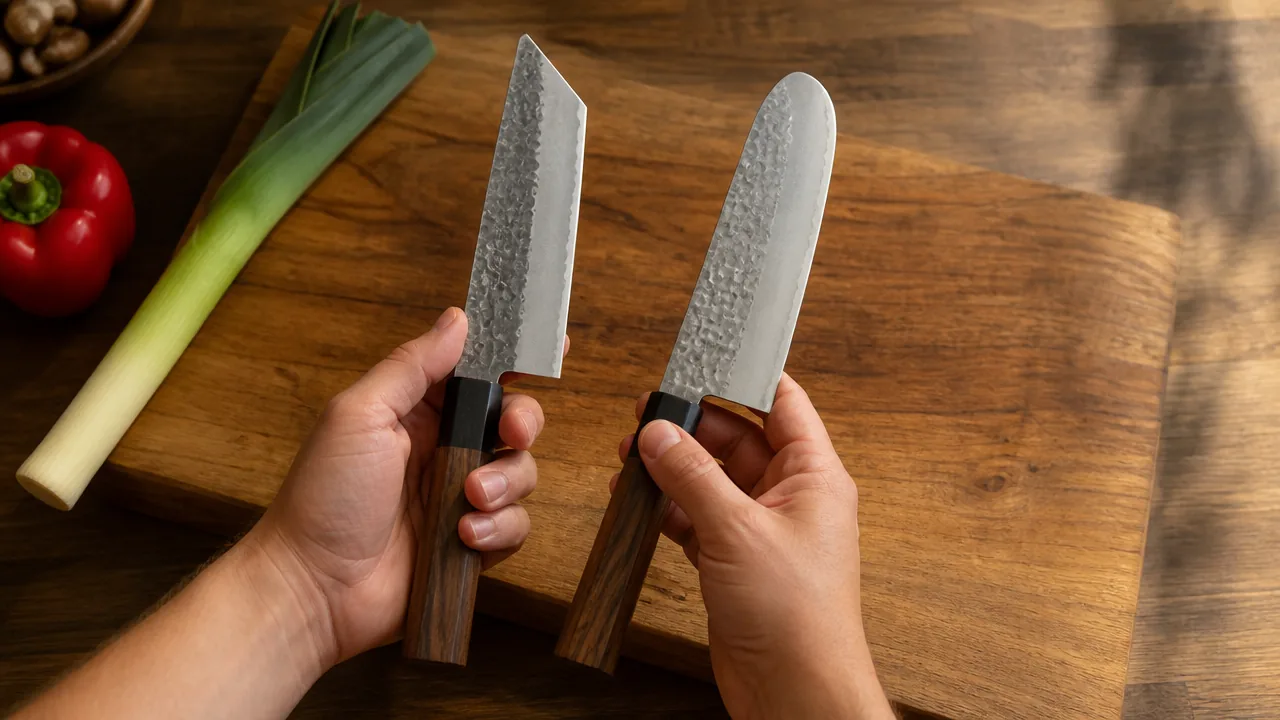
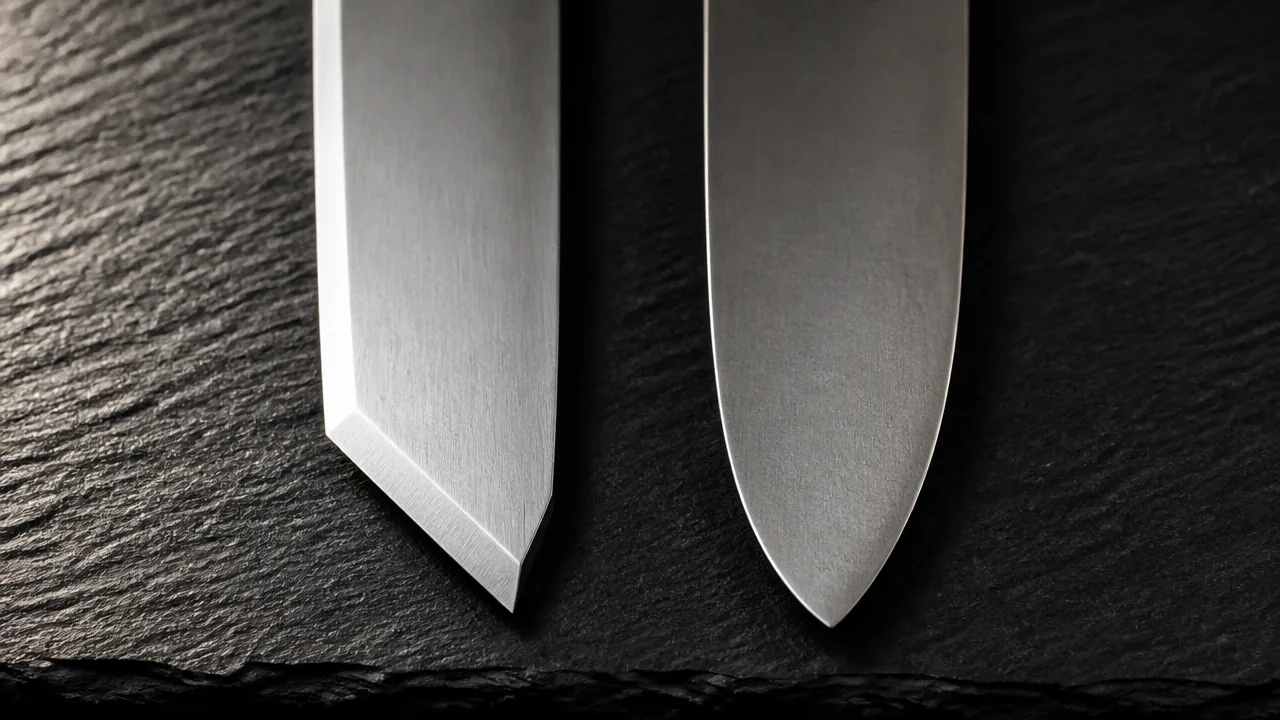
A bunka and a santoku are both double-bevel, all-purpose Japanese knives of about 165–180mm; the difference is the tip. A bunka’s spine drops in a straight, angular line to a defined point, often called a reverse-tanto or K-tip. A santoku’s spine curves gently down to a rounded tip.
- Bunka: suited to work with the tip, such as scoring, piercing and detail cuts
- Santoku: the tip stays out of the way during push-cutting and up-and-down chopping
Neither is better in every way; it depends on how often you use the front of the knife. If you settle on a santoku, Best Japanese Santoku Knife 2026 compares models by budget, steel and handle.
The One Shape That Changes Everything
Bunka and Santoku are both double-bevel, all-purpose Japanese knives built for everyday home cooking — meat, fish, and vegetables alike. What separates them is not size or steel, but the shape of the tip. That single difference in geometry affects how each knife handles in practice, and which one feels more natural depends entirely on how you cook.
If you have ever picked up a Santoku and wondered whether a Bunka might suit you better — or vice versa — this guide breaks down exactly what distinguishes the two, without declaring one superior to the other.
What Is a Bunka Knife?
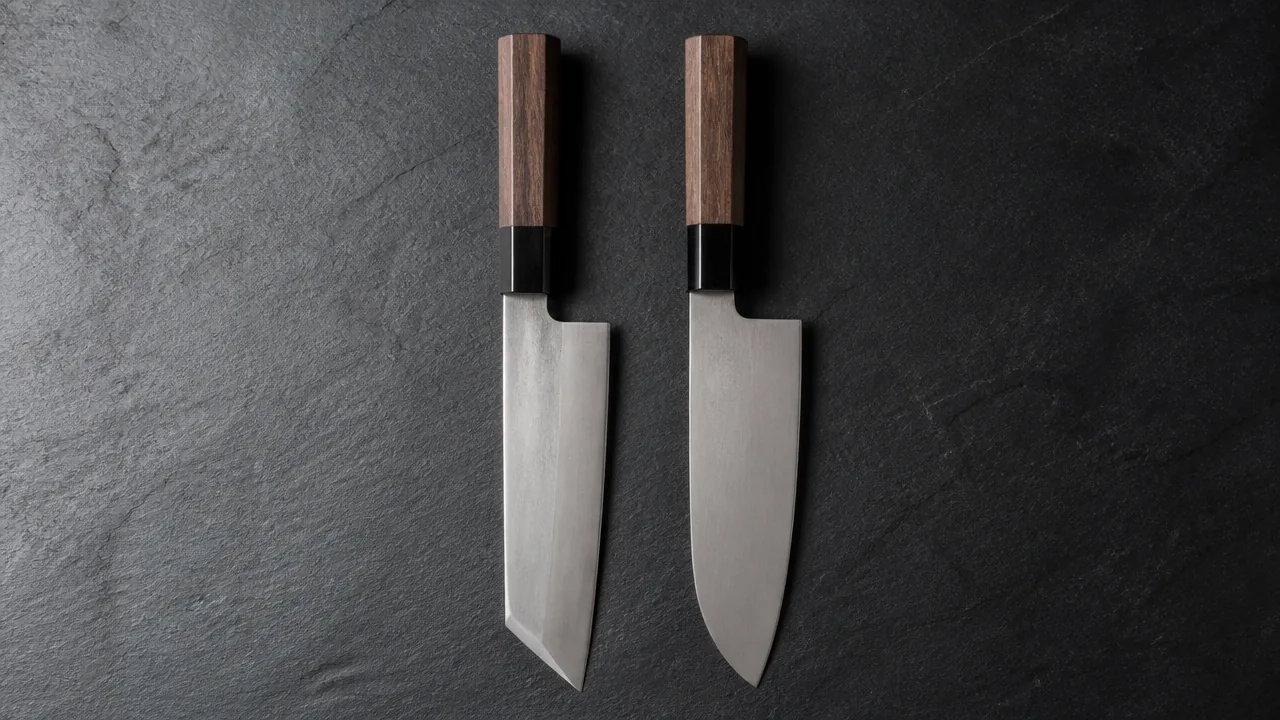
The Bunka is a Japanese all-purpose kitchen knife often described as having developed alongside broader changes in home cooking in postwar Japan. Like the Santoku, it was designed to handle a wide range of everyday kitchen tasks rather than specializing in a single ingredient or technique.
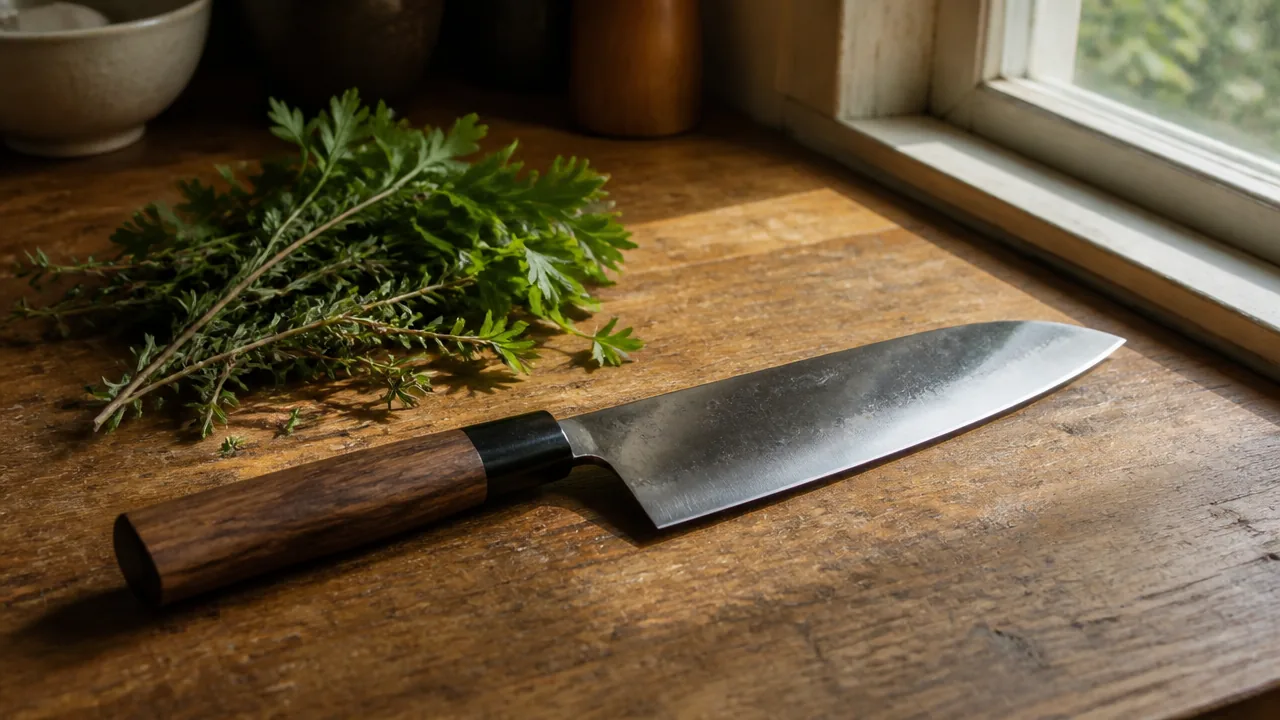
What makes the Bunka visually and functionally distinctive is its tip. Rather than curving smoothly downward, the spine of the blade drops sharply toward the edge in a straight, angular line near the front of the knife. In English-speaking communities, this style of tip is often described as a “reverse-tanto” or “K-tip” profile — though the exact terminology varies depending on the source, so neither label should be taken as a single definitive name.
This angular tip geometry is not just aesthetic. It creates a defined point that can be directed with precision, which tends to make the Bunka a preferred choice among cooks who regularly use the tip of a blade — for scoring, piercing, or working close to bone. The rest of the blade profile shares a broadly similar silhouette to the Santoku, which is why the two are so often compared.
The Bunka is not harder to use overall, but its pointed tip rewards intentional, deliberate cutting motions, so it suits cooks who use the tip on purpose.
What Is a Santoku Knife?
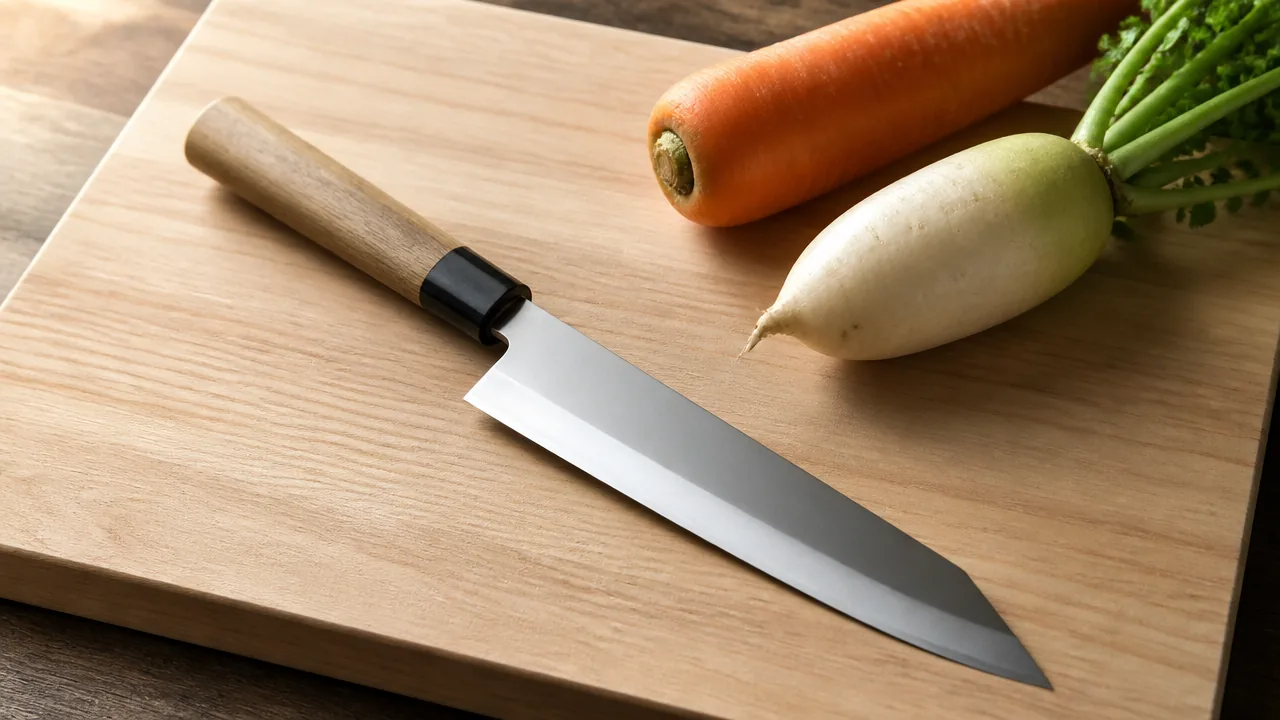
The Santoku — whose name is often translated as “three virtues” in reference to its ability to handle meat, fish, and vegetables — is one of the most recognized Japanese kitchen knives in home kitchens worldwide. It typically ranges from around 165mm to 180mm in blade length, and its overall profile is shorter and more compact than a Gyuto.
The defining shape of the Santoku tip is its gentle curve: the spine follows a soft downward arc toward the front of the blade, resulting in a rounded tip that stays relatively neutral in position. This rounded geometry means the tip is less likely to snag or catch during a push-cut or simple up-and-down chopping motion, which makes the Santoku an easy shape for cooks who are newer to Japanese knives. There is nothing demanding about where the tip ends up — it simply follows the motion of the cut.
Some Santoku models feature a Granton edge (a series of hollow ground dimples along the flat of the blade), which is intended to reduce food sticking during slicing, though this is a feature that varies by individual knife rather than being universal to the style.
For a deeper look at how the Santoku compares to other Japanese knives — including differences in steel, blade geometry, and intended use cases — Santoku vs Gyuto vs Nakiri: Which Japanese Knife Do You Actually Need covers those details in full. This article focuses specifically on what changes when you swap the Santoku’s rounded tip for the Bunka’s angular one.
Bunka vs Santoku: A Side-by-Side Comparison
The table below summarizes the key structural and practical differences between the two knives. Keep in mind that both fall within the same general category — double-bevel, all-purpose Japanese kitchen knives — so the contrasts here are matters of degree and preference rather than fundamental incompatibility.
| Feature | Bunka | Santoku |
|---|---|---|
| Tip shape | Angular, clipped (often called reverse-tanto or K-tip) | Gently rounded, soft curve from spine |
| Blade length | Typically around 165–180mm | Typically around 165–180mm |
| Bevel | Double bevel | Double bevel |
| Primary use | All-purpose: meat, fish, vegetables | All-purpose: meat, fish, vegetables |
| Tip usability | Suited to precise tip work: scoring, piercing, detail cuts | Less emphasis on tip work; tip naturally stays out of the way |
| Chopping motion | Push-cutting and tip-involved cuts; less natural for rocking | Push-cutting and up-down chopping; comfortable for most motions |
| Beginner-friendliness | Approachable overall, though the pointed tip requires some awareness | Generally considered easier to pick up for first-time users |
| Visual character | Angular, purposeful silhouette | Smooth, familiar profile |
One detail worth noting: because both knives share a similar overall length range, the choice between them rarely comes down to reach or weight. The tip shape is the real deciding factor.
Which One Should You Choose?
The honest answer is that neither knife is objectively better. Both are capable, well-designed all-purpose tools, and most everyday cooking tasks — slicing onions, breaking down a chicken breast, chopping herbs — can be handled comfortably by either one. The question is which one suits the way you actually cook.
The Bunka tends to be a stronger fit if:
- You frequently use the tip of your knife for scoring meat, opening a fish’s belly, or making precision cuts near bone
- You enjoy detail work like decorative vegetable cuts or fine garnishes
- You find yourself drawn to angular, purposeful aesthetics and prefer a knife that feels designed for deliberate technique
- You already have some experience with kitchen knives and want a blade that rewards focused use of the tip
The Santoku tends to be a stronger fit if:
- You want a reliable, low-fuss all-purpose knife that handles the full range of home cooking without requiring much adjustment to your existing habits
- You are newer to Japanese knives and prefer a tip that stays safely out of the way during repetitive chopping
- You do a lot of push-cutting or simple up-and-down cuts and rarely need the tip for precise work
- You are shopping for a first Japanese knife for yourself or someone else and want something immediately comfortable
For anyone still weighing where to start, Best Japanese Knife for Beginners: How to Choose by Use and Budget offers a broader framework for matching knife style to cooking habits and experience level.
It is also worth saying: some cooks own both. The Bunka and Santoku are similar enough in size and purpose that owning one does not exclude the other, and experienced home cooks sometimes find that having both available makes it easier to reach for the right geometry depending on the day’s prep.
Frequently Asked Questions
Is a Bunka knife good for beginners?
Generally, yes — with a small caveat. The Bunka is a double-bevel all-purpose knife, which means there is no unusual sharpening angle or single-bevel technique to learn. Most of the blade handles exactly like a Santoku. The one area where beginners may want to be slightly more mindful is the angular tip: because it is more defined and pointed than the Santoku’s rounded tip, it is worth developing awareness of where that tip is during quick, repetitive cuts. If the look and geometry appeal to you, it is not a reason to avoid it — just something to be aware of early on.
Can a Bunka knife do everything a Santoku can?
For the vast majority of home cooking tasks, yes. Both knives cover the same core territory: vegetables, boneless or semi-boned meat, and fish. The Santoku’s rounded tip gives it a slight edge in pure ease-of-use during repetitive up-and-down chopping, while the Bunka’s angular tip gives it a slight edge in tasks that require deliberate tip work. Neither is a complete substitute for specialist knives like a Yanagiba for thin sashimi slicing or a Deba for breaking down whole fish — but within the domain of everyday all-purpose cooking, the Bunka handles the same workload as the Santoku.
Which knife has a sharper tip?
The Bunka’s tip comes to a more defined, angular point due to the way the spine drops toward the edge. This makes it more usable as a precision tool for tasks like scoring or piercing. The Santoku’s tip is rounded and softer in profile, which means it is less suited to tip-focused techniques but also less likely to catch or direct unintended pressure during broad cutting motions. “Sharper” in terms of edge sharpness depends on how each individual knife is ground and maintained — not on tip shape — but in terms of tip geometry, the Bunka is the more pointed of the two.
Do Bunka and Santoku knives require different maintenance?
Not in any meaningful way. Both are typically double-bevel knives, which means they are sharpened on both sides of the blade — the same approach applies to both. The edge angle and steel type vary by individual knife, not by whether the knife is labeled Bunka or Santoku. General care practices — hand washing, drying promptly, and sharpening on a whetstone suited to the blade’s steel — apply equally to both styles.
What is a bunka knife?
A Japanese all-purpose, double-bevel kitchen knife for meat, fish and vegetables, typically about 165–180mm long. Its spine drops in a straight, angular line near the front to a defined point, which suits scoring, piercing and other work with the tip.
Is a bunka or a santoku better?
Neither is better in every way. The bunka’s angular tip suits cooks who often score, pierce or make detail cuts; the santoku’s rounded tip stays out of the way during repetitive chopping, which suits cooks who rarely use the tip.
The Bottom Line
Bunka and Santoku occupy the same corner of the Japanese knife world — both are double-bevel, all-purpose blades built for the full range of home cooking. The difference between them is not a matter of quality or capability. It comes down to one question: how do you use the front of your knife?
If you reach for the tip often — for scoring, piercing, or detail work — the Bunka’s angular geometry will likely feel like a natural extension of that habit. If you prefer a knife that stays quiet and forgiving through repetitive prep work, the Santoku’s rounded tip offers exactly that kind of uncomplicated reliability.
Neither answer is wrong. The best knife is the one that matches the way you already think about cutting — or the way you want to learn.
Still deciding which Japanese knife fits your kitchen best? Explore our broader guide to Japanese knife styles — you might find the answer is simpler than you think.