This article contains affiliate links. If you buy through them, we may earn a commission at no extra cost to you.
How this article was made: Research-based comparison. It draws on published information from makers, retailers, and reference sources, not on hands-on testing.
Quick picks
- King KW-65 — $29.50: medium and finishing grits in one stone; soak first
- Shapton Kuromaku 1000 — $39.88: no soaking; case doubles as a stone holder
- Naniwa Chosera 1000 — $67.00: splash-and-go; base and dressing stone included
Prices on Amazon.com, checked October 5, 2026; the King KW-65 and the two Shapton stones were checked again on October 10, 2026.
- The Short Answer: Which Japanese Sharpening Stone to Buy
- Why Sharpening Stones Matter More Than You Think
- What Makes Japanese Whetstones Different
- Understanding Grit Levels: A Practical Overview
- How to Choose: Key Factors Beyond Grit
- Keeping the Stone Flat
- Beginner-Friendly Sharpening Stones by Price Range
- Quick Comparison: Top Picks at a Glance
- Common Beginner Mistakes (and How to Avoid Them)
- Frequently Asked Questions
- Do I really need a whetstone, or can I use a pull-through sharpener?
- How often should I sharpen my Japanese knife?
- What grit should a total beginner start with?
- Do all whetstones need to be soaked in water?
- What grit whetstone for Japanese knives?
- What is the difference between a #1000 and a #6000 whetstone?
- What is the best whetstone for a beginner?
- How many whetstones does a beginner need?
- Where to Buy and What to Expect
- Sources
The Short Answer: Which Japanese Sharpening Stone to Buy
For a first stone, this guide suggests a #1000 stone or a 1000/6000 combination stone, because #1000 sits in the class King describes as being for a knife that has gone dull (#700–1200) and that Shapton labels medium (1000–2000). The stones covered below, by maker:
- King (Matsunaga Stone): the KW-65, a 1000/6000 combination stone, and the #6000 finishing stone. King says to soak its stones before sharpening. The KW-65 is the pick here for two grits in one stone
- Shapton: the Kuromaku #1000 and the Glass 1000. Shapton says its stones do not need to be soaked, so these are the picks for skipping the soaking step
- Naniwa: the Chosera #1000, listed as splash-and-go and sold with a base and a dressing stone; the Goken #1000; and the Professional #2000, covered below as the step after a #1000
- Suehiro: the Cerax 1000, a single-grit #1000 stone
By the job to be done, using King’s classes: a medium stone (#700–1200) for a knife that has gone dull, a finishing stone (#3000–8000) for a keener edge afterwards, and a coarse stone (#80–400) only for an edge that is chipped. Whichever stone you choose, both King and Shapton say it has to be kept flat; the section on flattening below covers that.
This guide is about choosing the stone. For how to use a whetstone once you have one, step by step, see How to Sharpen a Japanese Knife with a Whetstone: Step-by-Step Guide.
Why Sharpening Stones Matter More Than You Think
A sharp knife is safer, more precise, and simply more enjoyable to use — yet most beginners underestimate how much the sharpening stone itself affects the result. Pull-through sharpeners and electric gadgets are convenient, but they set the angle for you, while a whetstone lets you choose the angle and the grit for Japanese blades like Gyuto or Nakiri knives. Japanese makers write their care guides around the whetstone. If you are still building your knife collection, Best Japanese Knife for Beginners is a good starting point before investing in sharpening gear.
The makers also publish the angles they expect: Tojiro’s maintenance guide says to hold the knife at 10–15 degrees to the stone when sharpening. As for the edge itself, Shun gives 16 degrees per side for its knives. A stone is the tool that lets you keep to those numbers. Starting with the right one — a medium stone for a dull edge, a coarse one only for a chipped edge — saves both time and money in the long run.
What Makes Japanese Whetstones Different
The stones in this guide are water stones: they are used wet, with water on the surface. King (Matsunaga Stone) describes two kinds of bench stone, man-made stones that are formed and fired from manufactured abrasive, and natural stones. Every stone below is man-made. What changes from maker to maker is how the stone is prepared and looked after:
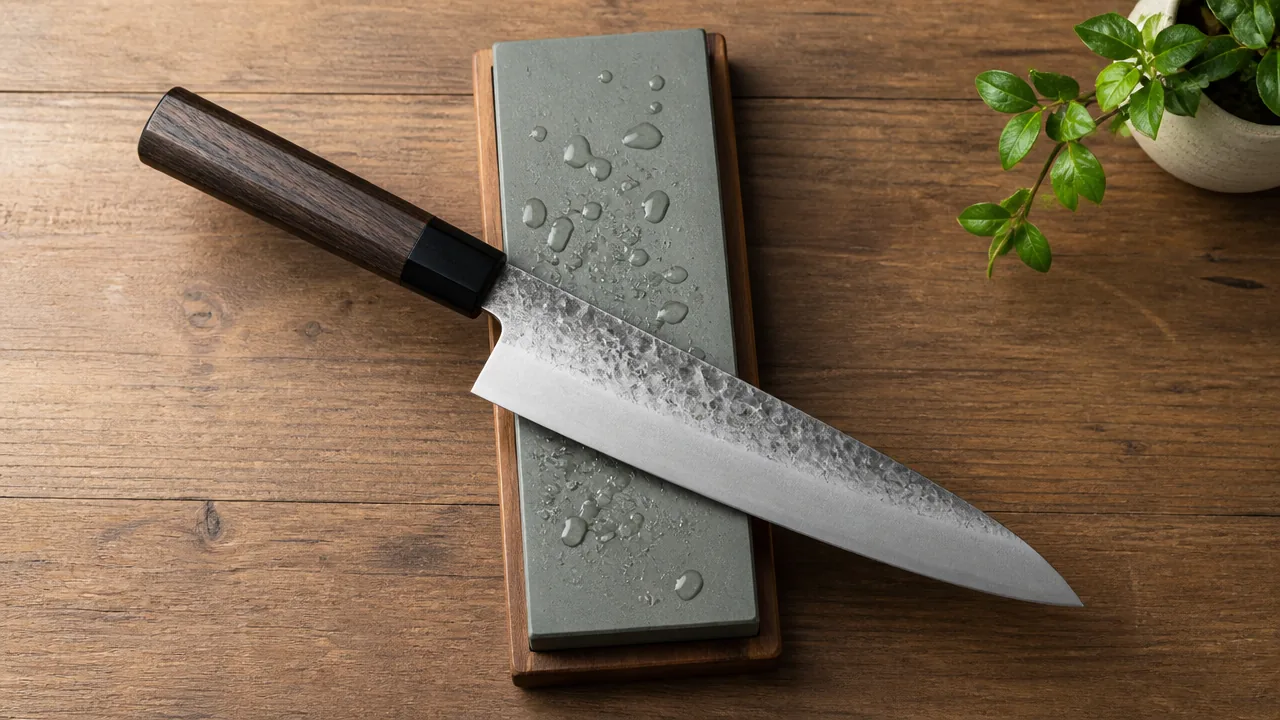
- Soaking: King says to soak the stone until it has taken up plenty of water before sharpening, and to put a damp cloth under it so it does not move. Shapton says its stones do not need to be soaked: splash on some water and start.
- Slurry: King’s guide says the slurry that forms on the stone is needed for sharpening. Move the knife through it, and add a little water when it gets thick.
- Wear: King says a stone hollows in the middle as it is used. Shapton says the stone changes shape every time a blade is sharpened on it, which is why it has to be kept flat (see Keeping the Stone Flat, below).
Understanding Grit Levels: A Practical Overview
Grit numbers are the single most important spec to understand before buying a sharpening stone. Makers sort them into broad classes. King (Matsunaga Stone) describes three:
- Coarse stones, #80–400: for an edge that is chipped. Most beginners should avoid starting here unless a blade is genuinely damaged.
- Medium stones, #700–1200: for a knife that has gone dull. A #1000 stone sits in this class.
- Finishing stones, #3000–8000: for a keener edge after the medium stone.
Shapton groups its Kuromaku stones a little differently: coarse is 120 to 320, medium is 1000 to 2000, fine is 5000 to 12000, and a 30000 stone sits above that as “super”. A #2000 stone is therefore a medium stone at Shapton but falls between King’s medium and finishing classes, so the exact boundaries depend on the maker.
A 1000/6000 combination stone pairs one stone from King’s medium class with one from its finishing class, so a beginner can sharpen a dull knife and then refine the edge without buying two stones. Once you have the right stone, technique matters just as much as equipment — How to Sharpen a Japanese Knife with a Whetstone: Step-by-Step Guide walks through the actual motions in detail.

Grit classes are from the makers’ own pages: King (Matsunaga Stone) and Shapton (read on October 5, 2026).
How to Choose: Key Factors Beyond Grit
Grit is only part of the equation. Before spending money, consider these practical factors that often get overlooked.
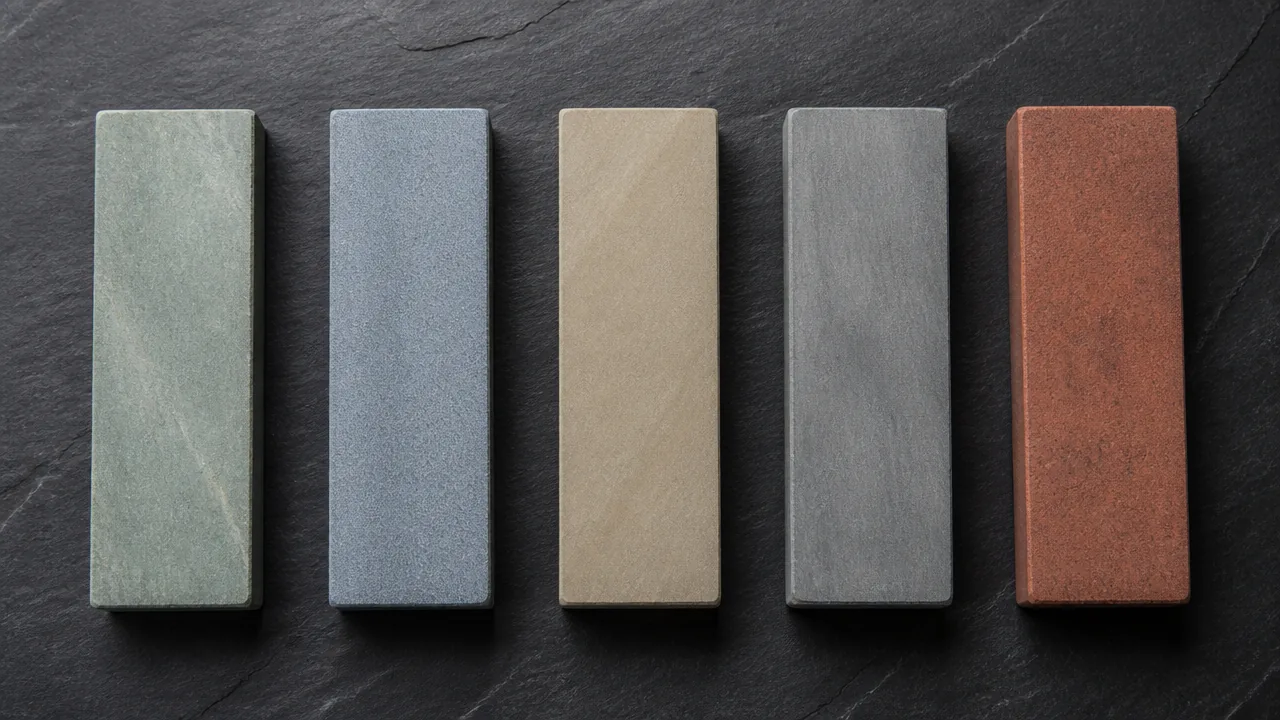
Stone type is how sellers describe what a man-made stone is built from: alumina oxide, ceramic, magnesia-bonded, or an abrasive layer on a glass plate. The comparison table below lists each stone the way its listing describes it. Natural stones are a separate subject and are not covered in this guide.
Size matters too. The Naniwa Chosera and the Shapton Kuromaku below are both 210 × 70 mm, which gives a longer stroke for a blade like a 240 mm Gyuto than a compact stone does. The King KW-65 is smaller, at 185 × 63 mm.
Flattening is something many beginners forget entirely: whetstones wear unevenly and have to be flattened from time to time. Factor the cost of a flattening stone into your budget from the start; the section below covers what the makers say and one stone made for the job.
Finally, consider whether the stone needs to be soaked in water or simply splashed (splash-and-go). Soaking stones have to take up water before use (King’s guide says to let the stone absorb water fully), while splash-and-go stones are ready as soon as they are wetted.
Keeping the Stone Flat
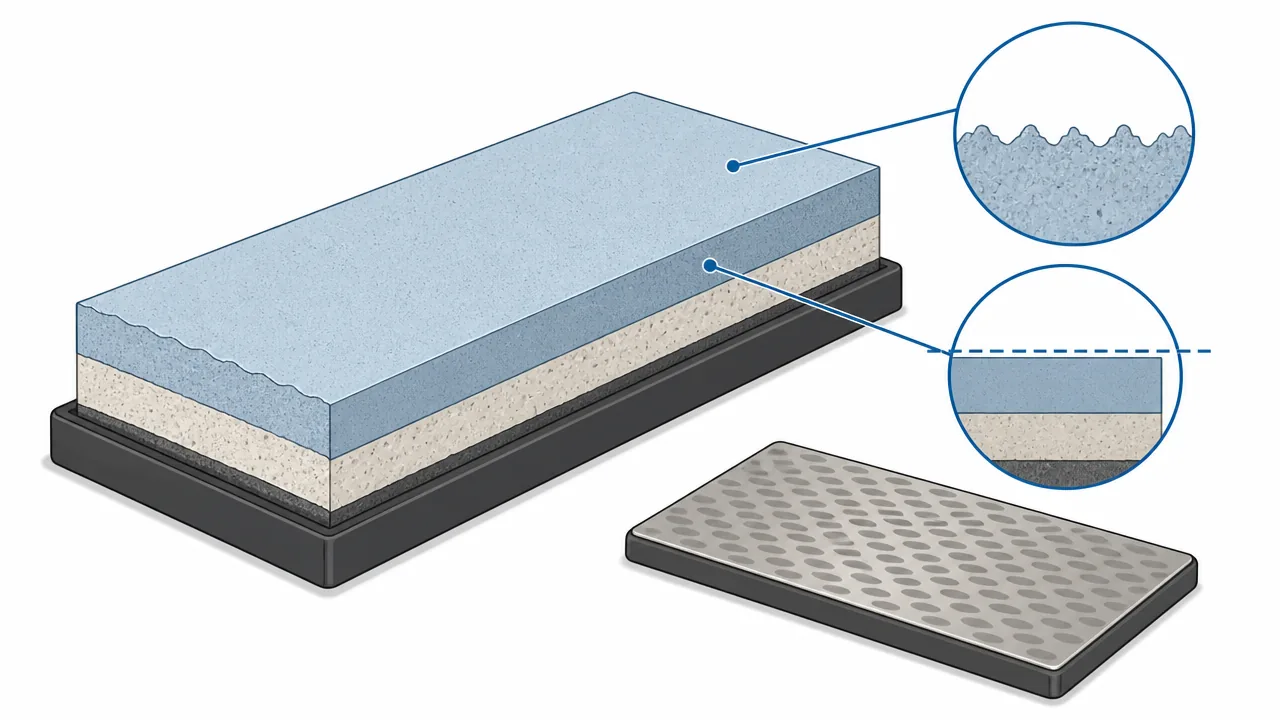
King’s care guide says a bench stone hollows in the middle as it is used, and that it becomes easier to sharpen on if the face is flattened from time to time with a correction stone, or with waterproof paper or sandpaper of about #100 grit. Shapton makes the same point about its own stones: every time a blade is sharpened, the stone itself changes shape, so the stone has to be kept flat. Shapton sells diamond lapping plates for the purpose. After sharpening, King says to rinse the residue off the stone and let it dry in the shade before putting it away.
A stone made for this job: the Naniwa Straightening Stone IO-1142 (#220) — $23.40 — is a coarse #220 stone from Naniwa, the maker of the Chosera covered below, sold for truing the face of a whetstone.
Japan Check
Made in: Not disclosed (maker: Naniwa, a Japanese company)
Grit: #220
Sold by: a third-party seller on Amazon.com
Checked Against: amazon.com
Last Checked: 2026-10-05
Beginner-Friendly Sharpening Stones by Price Range
The market for whetstones ranges from under $50 to well over $200. Here is what each price range offers. Prices were checked against the listings on the dates shown.
Under $50 — Budget picks: the King KW-65 (1000/6000 combination) — $29.50 — pairs a #1000 side, in King’s medium class, with a #6000 side, in its finishing class. It is a soaking stone from King (Matsunaga Stone, Osaka) and comes with a plastic base.
Japan Check
Made in: Not disclosed
Material: Alumina oxide, 1000/6000 combination grit
Stone Size: 185 x 63 x 25mm, plastic base included
Checked Against: amazon.com
Last Checked: 2026-10-02
Still under $50, the Shapton Kuromaku #1000 (K0702) — $39.88 — is a single-grit stone that Shapton places in its medium class. Shapton says its stones do not need soaking, and the plastic case the Kuromaku comes in can be used as a sharpening base. Only a few were left on this listing when it was checked.
Japan Check
Made in: Not disclosed (maker: Shapton, a Japanese company)
Grit: #1000, medium (Shapton’s class), no soaking
Stone Size: 210 x 70 x 15mm, plastic case usable as a stone holder
Checked Against: shapton.co.jp, amazon.com
Last Checked: 2026-10-05
To add a finishing stone later, the King #6000 finishing stone — $37.04 — is a single-grit stone in King’s finishing class (#3000–8000), the class King describes as being for a keener edge after the medium stone.
Japan Check
Made in: Japan (per retailer)
Grit: #6000, finishing (King’s class)
Stone Size: 210 x 73 x 22mm (per the listing)
Checked Against: amazon.com
Last Checked: 2026-10-05
$50–$80 — Single-grit stones with a base: The Naniwa Chosera #1000 with base — $67.00 — is a splash-and-go stone, so there is no soaking step, and it comes with a base and a small dressing stone. The Shapton Glass 1000 in the table below also falls in this range.
Japan Check
Made in: Japan (per retailer)
Material: Ceramic, #1000 grit, splash-and-go (no soaking required)
Stone Size: 210 x 70 x 25mm, base and dressing stone included
Checked Against: amazon.com
Last Checked: 2026-10-02
$80–$150 — Semi-professional territory: Stones in this tier suit people who sharpen regularly and want a finer edge. The Naniwa Professional Stone #2000 (P-320) — €100.00, approximately $112 at the ECB reference rate of 1 EUR = 1.1206 USD on October 9, 2026, shipping not included — is a #2000 stone that works well as the step after a #1000. The retailer describes the Professional line as magnesia-bonded and very hard, so it wears slowly, and it is splash-and-go. US orders are charged a tariff at checkout (10–15% on non-knife items, per SharpEdge’s shipping page).
![Naniwa Sharpening Stone - #2000 [Professional Stone series / P-320]](https://japan-craft-finds.com/wp-content/uploads/2026/10/naniwa-sharpening-stone-2000-professional-stone-series-photo.webp)
Japan Check
Made in: Not disclosed (maker: Naniwa, a Japanese company)
Material: Magnesia-bonded stone, #2000 grit, splash-and-go
Checked Against: sharpedgeshop.com
Last Checked: 2026-10-02
Over $150 — Natural and specialty stones: Typically suited to collectors or professionals working with single-bevel knives and Wa handle blades where edge refinement is paramount. If you are curious whether your knife is even single or double bevel, Single Bevel vs Double Bevel Japanese Knives covers the distinction in depth. Not necessary for most beginners.
Quick Comparison: Top Picks at a Glance
The table below lists the stones covered in this guide. Amazon.com prices were checked on October 4 and 5, 2026; the King KW-65 and the two Shapton stones were checked again on October 10, 2026.
| Stone | Price | Grit | Type | Best For |
|---|---|---|---|---|
| King KW-65 | $29.50 | 1000/6000 | Alumina oxide | Two grits; soak first |
| Shapton Kuromaku 1000 | $39.88 | 1000 | Waterstone | No soaking needed |
| Naniwa Chosera 1000 | $67.00 | 1000 | Ceramic | Splash-and-go; base included |
| Naniwa Goken #1000 | $46.00 | 1000 | Alumina oxide | Single-grit #1000 |
| Suehiro Cerax 1000 | $36.17 | 1000 | Ceramic | Single-grit #1000 |
| Shapton Glass 1000 | $56.70 | 1000 | Glass-bonded | Splash-and-go |
| King 6000 | $37.04 | 6000 | Man-made stone | Finishing stone; soak first |
| Naniwa Professional 2000 | ~$112 (€100.00) | 2000 | Magnesia-bonded | Step up after a #1000 |
A few notes on the table: the two King stones need soaking, so allow time for the stone to take up water before use. The Shapton Kuromaku and the Naniwa Chosera are ready once they are wetted. Stock on both Shapton listings was limited when checked — confirm availability before planning a purchase around them. “Type” is given as each listing or maker describes the stone.
Common Beginner Mistakes (and How to Avoid Them)
Even a great stone produces poor results if the technique is off. These are the mistakes that come up most often when beginners start sharpening Japanese knives.
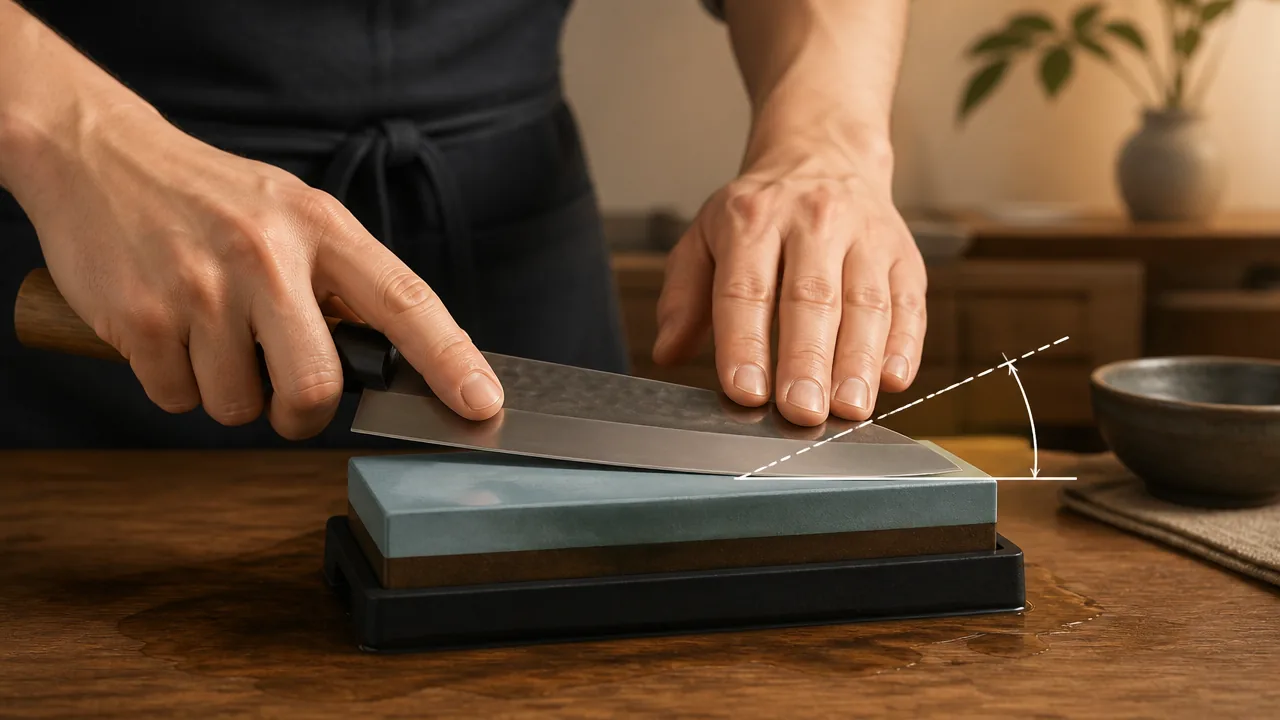
- Inconsistent angle: Tojiro’s sharpening guide says to hold the knife at 10–15 degrees to the stone and to keep that angle steady. The edge angles themselves differ by knife: Shun gives 16 degrees for its knives, compared with the 20–25 degrees per side Shun cites for Western knives. Holding a higher angle than needed creates a thick, less effective edge. An angle guide clip can help during the learning phase.
- Skipping the burr check: Run a finger lightly across the opposite side of the blade — you should feel a thin wire burr forming as you sharpen. If you do not feel it, you have not removed enough metal yet. Beginners often move to the next step too early.
- Pressing too hard: King’s guide says to relax, put the force into the push stroke, and that excessive force is not needed. Keep water on the stone and let the slurry do the work.
- Neglecting to flatten the stone: As mentioned earlier, this is probably the most overlooked step among beginners. King notes that a stone hollows in the middle with use; see Keeping the Stone Flat above.
- Using the wrong stone for double vs single bevel: Most home knives are double-bevel (sharpened on both sides), but traditional Japanese single-bevel knives like Yanagiba or Deba require a completely different sharpening approach. Single Bevel vs Double Bevel Japanese Knives explains how to tell which one you own before starting.
Frequently Asked Questions
Do I really need a whetstone, or can I use a pull-through sharpener?
A pull-through sharpener is faster, but it sets the angle for you. Shun gives an edge of 16 degrees per side for its knives. For sharpening by hand, Tojiro says to hold the knife at 10–15 degrees to the stone, and the makers’ care guides describe sharpening on a whetstone. A whetstone takes more practice, but you choose the angle and the grit. For a Gyuto, Santoku, or Nakiri, learning the whetstone is worth the initial learning curve.
How often should I sharpen my Japanese knife?
There is no fixed schedule. King’s guidance goes by the condition of the edge rather than the calendar: a medium stone when the knife has gone dull, and a coarse stone only when the edge is chipped. How soon that happens depends on how often you cook and what you cut on.
What grit should a total beginner start with?
A #1000 stone, or a 1000/6000 combination stone. #1000 falls in the class King describes for a knife that has gone dull (#700–1200) and that Shapton labels medium (1000–2000). Skip coarser grits unless a blade is genuinely chipped or damaged.
Do all whetstones need to be soaked in water?
No. Traditional stones like the King KW-65 need to be soaked until they have taken up water before use, while splash-and-go stones such as the Naniwa Chosera are ready as soon as they are wetted. Check the product description before buying if prep time matters to you.
What grit whetstone for Japanese knives?
A #1000 stone covers routine sharpening. King places #700–1200 in its medium class, for a knife that has gone dull, and Shapton labels 1000–2000 medium. King’s finishing class, #3000–8000, is for a keener edge afterwards, and its coarse class, #80–400, is for an edge that is chipped.
What is the difference between a #1000 and a #6000 whetstone?
In King’s classes, a #1000 stone is a medium stone, for a knife that has gone dull, and a #6000 stone is a finishing stone, for a keener edge after the medium stone. A 1000/6000 combination stone such as the King KW-65 has one side of each.
What is the best whetstone for a beginner?
This guide suggests a #1000 stone or a 1000/6000 combination stone, because #1000 sits in the class King describes as being for a knife that has gone dull. Of the stones covered here, the King KW-65 is the pick for two grits in one stone, and the Shapton Kuromaku #1000 is the pick if you do not want to soak the stone first.
How many whetstones does a beginner need?
One to start: a medium stone, the class King gives as #700–1200, for a knife that has gone dull. A finishing stone (#3000–8000 in King’s classes) can be added later for a keener edge, and a coarse stone is only for an edge that is chipped. Both King and Shapton say a stone has to be kept flat, so allow for a flattening stone as well.
Where to Buy and What to Expect
The Amazon.com listings checked on October 5, 2026 (the King KW-65 and #6000, the Shapton Kuromaku, the Naniwa Chosera and the Naniwa flattening stone) were all sold by third-party sellers rather than by Amazon itself, so check the seller, the delivery estimate and the return terms on the listing before ordering. The Naniwa Professional stone ships from SharpEdge in Europe, and US orders are charged a tariff at checkout, as noted above.
When buying, check whether a flattening stone or nagura conditioning stone is included or sold as an add-on — some starter kits bundle these, which improves overall value. Also confirm the return policy: a stone that arrives cracked or visibly warped should be replaceable without hassle.
Once your knife is sharp again, How to Store and Maintain a Japanese Knife: Preventing Rust and Chips covers how to keep it that way between sharpenings.
Sources
- Matsunaga Stone (King), Whetstone basics (man-made and natural stones; grit classes #80–400, #700–1200, #3000–8000 and what each is for; soaking the stone before use; the slurry; flattening and care)
- Shapton, product lineup (Kuromaku classes: coarse 120–320, medium 1000–2000, fine 5000–12000, super 30000; no soaking; the Kuromaku case as a stone holder; why a stone has to be kept flat)
- Tojiro, knife maintenance (10–15 degrees to the stone)
- Shun, FAQ (16 degrees per side; 20–25 degrees for Western knives)
Maker pages read on October 5, 2026.
Ready to buy? Every stone covered above is linked directly to its retailer, with the date each price was checked.