How this article was made: Research-based comparison. It draws on published information from makers, retailers, and reference sources, not on hands-on testing.
- Why Japanese Knives Have a Bevel Problem Worth Understanding
- The Structural Difference: What the Cross-Section Actually Tells You
- Which Knife Shape Goes with Which Bevel — and Why
- How to Choose: Dominant Hand, Sharpening Skill, and Maintenance Commitment
- Common Misconceptions: Single Bevel Is Not Automatically Superior
- Frequently Asked Questions
- Conclusion: Match the Bevel to the Task, Not the Other Way Around
- Sources
Why Japanese Knives Have a Bevel Problem Worth Understanding
If you’ve been reading comparisons of Gyuto, Santoku, or Nakiri knives and kept stumbling over the terms ‘single bevel’ and ‘double bevel’ without a clear explanation, you’re not alone. These two grinding styles represent genuinely different philosophies about what a knife should do — and choosing the wrong one for your needs can lead to real frustration at the cutting board.
A single bevel knife is ground on one side only. The other side remains flat (or very slightly concave, a hollow called the ‘ura’). A double bevel knife, by contrast, is ground on both sides, and the two bevels meet to form the cutting edge. Most Western knives are double bevel by default, which is part of why Japanese knives differ so fundamentally from their Western counterparts — the single bevel construction is a distinctly Japanese structural tradition.
The single bevel style is closely associated with washoku (traditional Japanese cuisine), where ultra-precise cuts through fish, tofu, and vegetables are not just aesthetic preferences but functional requirements. Double bevel knives, on the other hand, prioritize versatility and ease of use — which is why the majority of knives sold globally, including most Japanese knives marketed to home cooks, use this approach. Understanding which camp your knife falls into is the first step toward using it correctly and sharpening it without damage.
The Structural Difference: What the Cross-Section Actually Tells You
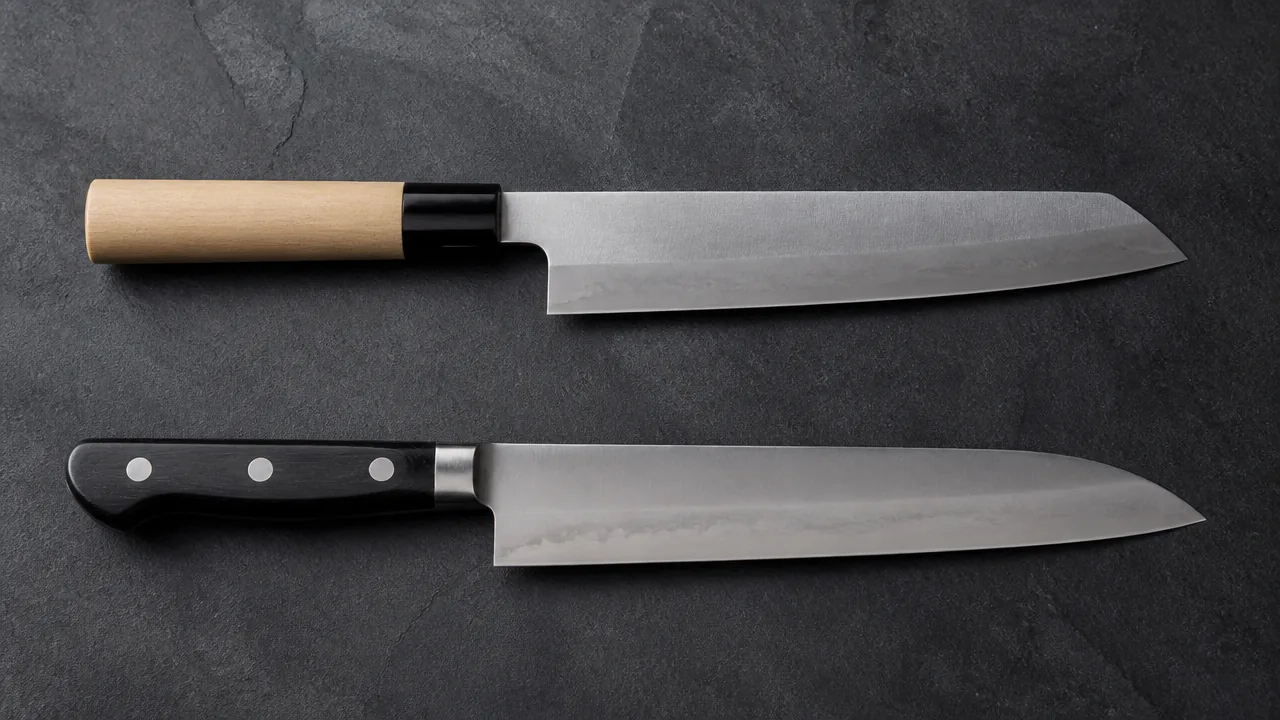
The clearest way to understand bevel types is to imagine slicing through a knife blade horizontally and looking at the resulting cross-section. According to Yoshihiro Cutlery, a single bevel blade forms an asymmetric wedge: one face is angled to create the edge, while the opposite face is ground flat or slightly hollow. A double bevel blade, in contrast, looks like a V in cross-section. Whether the two bevels are equal depends on the maker: Tojiro’s sharpening guide has you sharpen both sides the same way and Shun gives the same 16 degrees for each side, while MAC describes its own edge as slightly off-center.
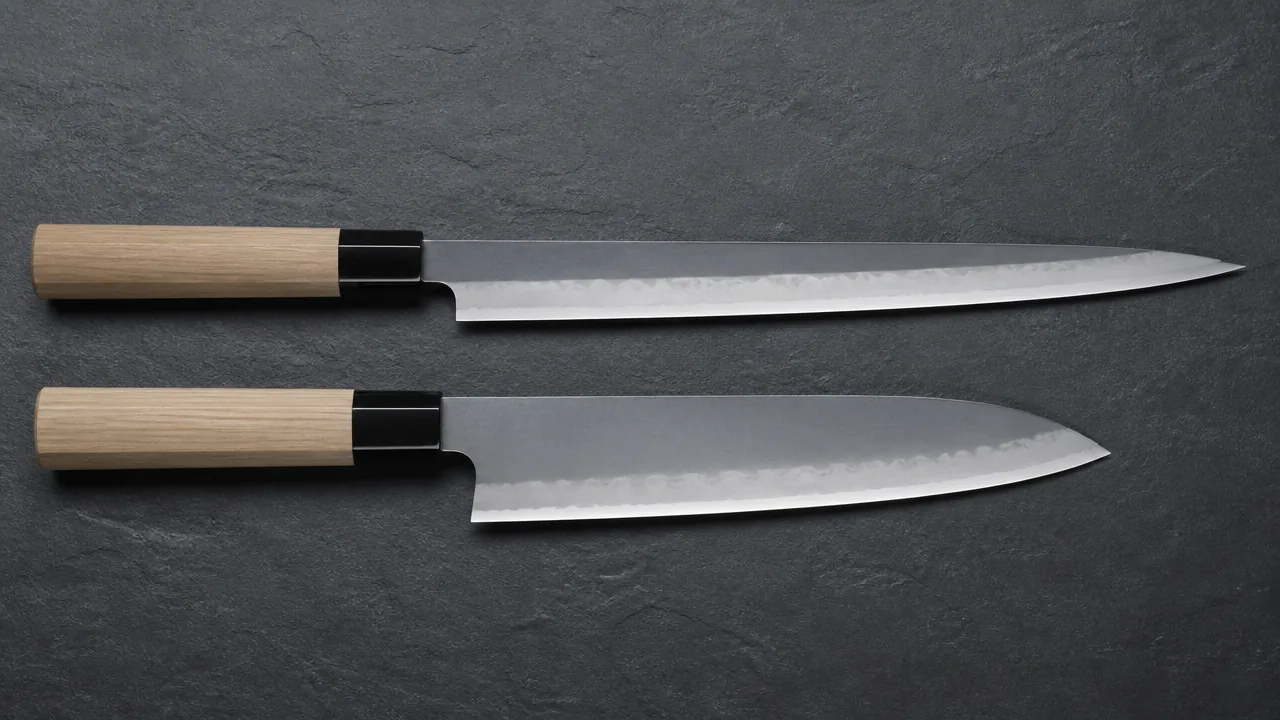
This geometry has direct consequences for cutting performance. Because a single bevel blade presents only one angled surface to the food, it tends to cleave through soft, delicate ingredients cleanly and then guide the cut slice away from the blade naturally. Professional sushi chefs rely on this for sashimi cuts — the flat back of a Yanagiba knife, for instance, pushes the sliced fish away from the blade rather than compressing it. That said, the asymmetric geometry also means that single bevel knives naturally pull slightly to one side during a cut, which requires a compensating hand technique that takes time to learn.
Double bevel knives push food away from both sides of the blade equally, which makes them more intuitive to use for most cutting tasks. Some makers publish edge angles for double bevel knives: Shun sharpens its knives to 16 degrees on each side, MAC describes an edge of about 30 degrees in total (15 per side), and Tojiro’s sharpening guide says to hold the knife at 10 to 15 degrees to the stone. For single bevel knives, Shun and MAC give no figure; Yoshihiro Cutlery gives typically about 10°–15° on one face and notes that the number cannot be compared directly with a double bevel’s per-side angle. Tojiro’s guide says to lay the existing bevel flat on the stone and follow its angle.

Which Knife Shape Goes with Which Bevel — and Why
Once you understand the geometry, the logic behind traditional Japanese knife design starts to make sense. Single bevel construction appears almost exclusively in specialized professional knives:
- Yanagiba (柳刃): the long slicing knife used for sashimi and sushi preparation, where clean pull-cuts through raw fish are essential
- Deba (出刃): a thick, heavy single bevel knife designed for breaking down whole fish, including cutting through small bones
- Usuba (薄刃): a thin, rectangular vegetable knife used in professional kitchens for paper-thin cuts of vegetables, distinct from the Nakiri
- Kiritsuke: a multi-purpose single bevel knife traditionally reserved for senior chefs in Japanese kitchens
The Yanagiba and Deba in particular come up constantly in discussions of Japanese fish preparation; our guide to how the Deba and Yanagiba divide the work of breaking down and slicing fish shows how their single bevel geometry serves two very different jobs. For how these knives are built from steel and iron, and what the finish names on them mean, see Hongasumi vs Kasumi.
Double bevel construction, on the other hand, dominates the all-purpose and home-cooking segment. The Santoku, Gyuto, and Nakiri — the knives most beginners encounter first — are all double bevel. As explored in our comparison of Santoku, Gyuto, and Nakiri knives, each serves a different niche in terms of food type and cutting style, but all three share the approachable double bevel that works well for a wide range of ingredients and techniques.
For most home cooks preparing a mix of vegetables, proteins, and herbs, a double bevel knife will cover the majority of tasks without requiring the specialized hand technique that single bevel knives demand. Single bevel knives shine in dedicated professional contexts — particularly anywhere raw fish or extremely precise vegetable work is at the core of the cuisine.
How to Choose: Dominant Hand, Sharpening Skill, and Maintenance Commitment
Three practical factors should guide your decision more than aesthetics or price:
Handedness matters far more with single bevel knives than with double bevel ones. Because the bevel exists on only one side, a right-handed single bevel knife will actually cut incorrectly — and potentially dangerously — in a left-handed grip. Most single bevel knives sold outside Japan are ground for right-handed users. Left-handed versions exist: Yoshihiro Cutlery says most single bevel knives are ground for the right hand and asks left-handed buyers to request a left-handed version. If you are a southpaw weighing a single bevel purchase, our guide to what left-handed cooks need to know about Japanese knives covers the trade-offs in detail. Double bevel knives can be used in either hand: GLOBAL, for example, describes its double-bevel knives as usable by everyone and offers left-handed versions only of its single-bevel knives.
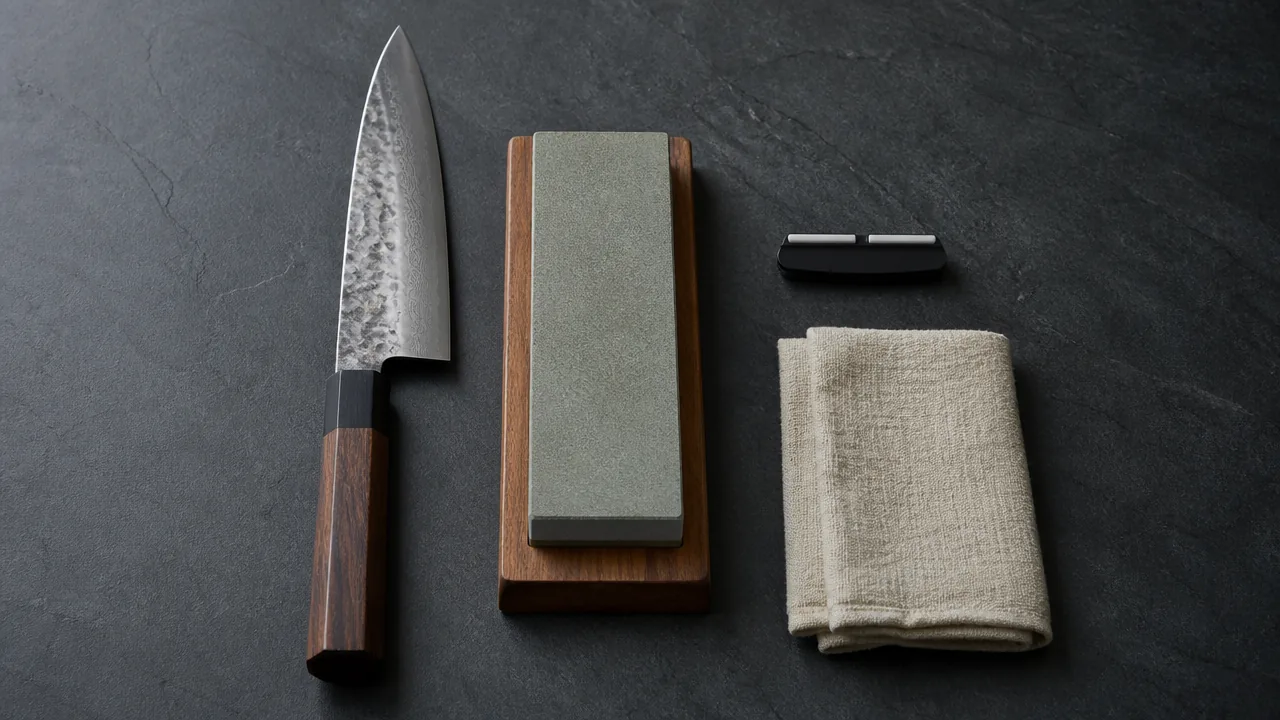
Sharpening complexity is the second factor. Double bevel knives can be sharpened on a whetstone using the same angle on both sides — a process that is learnable in a few sessions, and one our step-by-step whetstone sharpening guide walks through in full. Single bevel knives require a different technique: you sharpen primarily on the bevel side, then lightly flatten any burr from the ura (flat back) side without introducing a new angle. Getting this wrong can permanently alter the knife’s geometry. If you are still building your sharpening skills, checking out a guide to Japanese knife sharpening stones for beginners before committing to a single bevel knife is a worthwhile step.
Finally, consider how often you are willing to sharpen. Yoshihiro Cutlery describes the single bevel edge as very fine, and lists bones, frozen food and hard squash as jobs a single bevel knife is not for. If you cook daily but sharpen infrequently, a robust double bevel knife will likely serve you better in practice. For a first double bevel knife, Best Japanese Knife for Beginners goes through the choices by price.
Common Misconceptions: Single Bevel Is Not Automatically Superior
The idea that single bevel knives are inherently higher quality than double bevel knives is a misunderstanding, and it deserves a direct correction.
Single bevel construction is not a marker of premium craftsmanship — it is a design choice suited to specific tasks. A master-made double bevel Gyuto from a Sakai or Seki workshop, forged from high-carbon White Steel (Shirogami) or a quality stainless alloy, can represent as much artisanship and command as high a price as any single bevel knife. The bevel type does not determine the steel quality, the forging method, or the level of hand finishing.
A related misconception is that single bevel knives are always harder to maintain. Difficulty depends largely on the steel hardness (measured on the HRC scale) and the edge angle, not the bevel type alone. A hard single bevel knife is demanding to maintain, but so is a hard double bevel knife.
Finally, some buyers assume that single bevel knives are only for professionals and that owning one signals culinary seriousness. In reality, a home cook who primarily makes sashimi and wants to invest in proper technique would benefit genuinely from a Yanagiba. But a home cook who wants a capable all-purpose knife for mixed daily cooking will almost always find a quality double bevel Gyuto — see our Gyuto knife guide for options by skill level and budget — more rewarding to use day to day.
Frequently Asked Questions
How can I tell if my knife is single or double bevel?
Look at the blade edge straight on under good light. A double bevel knife has a V-shaped edge, ground on both sides. A single bevel knife has one clearly angled face and one side that is flat or slightly hollow, with no matching bevel. If the packaging or product listing describes the knife as a Yanagiba, Deba, Usuba, or Kiritsuke, it is almost certainly single bevel; a Gyuto, Santoku, Bunka, or Nakiri is almost always double bevel.
Can a left-handed person use a right-handed single bevel knife?
It is generally not recommended. Because the bevel is ground on only one side, using a right-handed single bevel knife in the left hand causes the blade to steer away from the intended cut line, which produces uneven slices and can feel unsafe. Left-handed single bevel knives are made; Yoshihiro Cutlery says most are ground for the right hand, so a left-handed version has to be asked for. Double bevel knives have no such restriction and work the same in either hand.
Is a single bevel knife sharper than a double bevel knife?
Yoshihiro Cutlery describes a single bevel edge as very fine, typically about 10°–15° on one face, and well suited to slicing raw fish. It also lists bones, frozen food and hard squash as jobs a single bevel knife is not for, and says sharpening one takes more practice. For mixed daily cooking, a double bevel knife is the general-purpose choice: GLOBAL, for example, describes its cook’s and santoku knives as double-bevel general utility knives.
Do I need a special whetstone for a single bevel knife?
You do not necessarily need a different stone, but you do need a different technique. Most sharpening on a single bevel knife happens on the bevel side, with only a light deburring pass on the flat ura side — and you must avoid grinding a new angle onto that flat back. Many people find it worth practicing on a double bevel knife first. A grounding in stone selection and basic technique, such as our guide to sharpening stones for beginners, is a sensible starting point before working on a single bevel blade.
Conclusion: Match the Bevel to the Task, Not the Other Way Around
The single bevel versus double bevel question does not have a universally correct answer — it has a contextually correct one. Single bevel knives are purpose-built tools, optimized for the specialized cuts that traditional Japanese professional cuisine demands. They reward dedicated technique and careful maintenance. Double bevel knives are the more adaptable choice for most cooks, offering a lower learning curve, handedness flexibility, and a broader range of applicable tasks.
For the majority of home cooks, especially those still developing their knife skills, a quality double bevel knife — whether a Gyuto, Santoku, or Nakiri — will provide better day-to-day results than a single bevel knife used without the supporting technique. If your cooking centers on Japanese cuisine and you are committed to learning proper single bevel handling and sharpening, a Yanagiba or Deba can be a genuinely rewarding investment over time; Best Japanese Deba Knife compares three deba by fish size, steel and bevel.
The most important habit, regardless of which bevel type you choose, is to understand what you own. Knowing whether your knife is single or double bevel will help you sharpen it correctly, use it more effectively, and avoid the frustration that comes from treating a precision tool as a generic kitchen utensil.
Sources
The following source was consulted in the preparation of this article and is provided for readers who wish to explore the technical background further:
- Yoshihiro Cutlery, “Single Bevel vs Double Bevel Knives: Which is Right for You?”: https://www.echefknife.com/blogs/blog/explaining-kitchen-knife-bevels-and-edges
Once you know which bevel type you are working with, the rest gets easier: you can sharpen it the right way, use the hand technique it expects, and choose your next knife with clear eyes about what it is actually built to do.