How this article was made: Research-based comparison. It draws on published information from makers, retailers, and reference sources, not on hands-on testing.
The Short Answer: Which Sashiko Pattern to Start With
For a first piece, this guide suggests a pattern made only of straight lines, such as juji-tsunagi, yabane or a hitomezashi grid, because straight lines can follow a printed grid; curved patterns such as seigaiha and shippo-tsunagi need each arc marked and kept even. Olympus, a Japanese sashiko thread maker, labels its hitomezashi kits and the white version of its asanoha cloth as suitable for beginners.
| Pattern | Type | Lines to stitch | Meaning (source) |
|---|---|---|---|
| Asanoha (hemp leaf) | Moyozashi | Straight, in three directions | Children growing straight and strong (Olympus) |
| Shippo-tsunagi (linked circles) | Moyozashi | Curves | Endless peace and harmony (Olympus) |
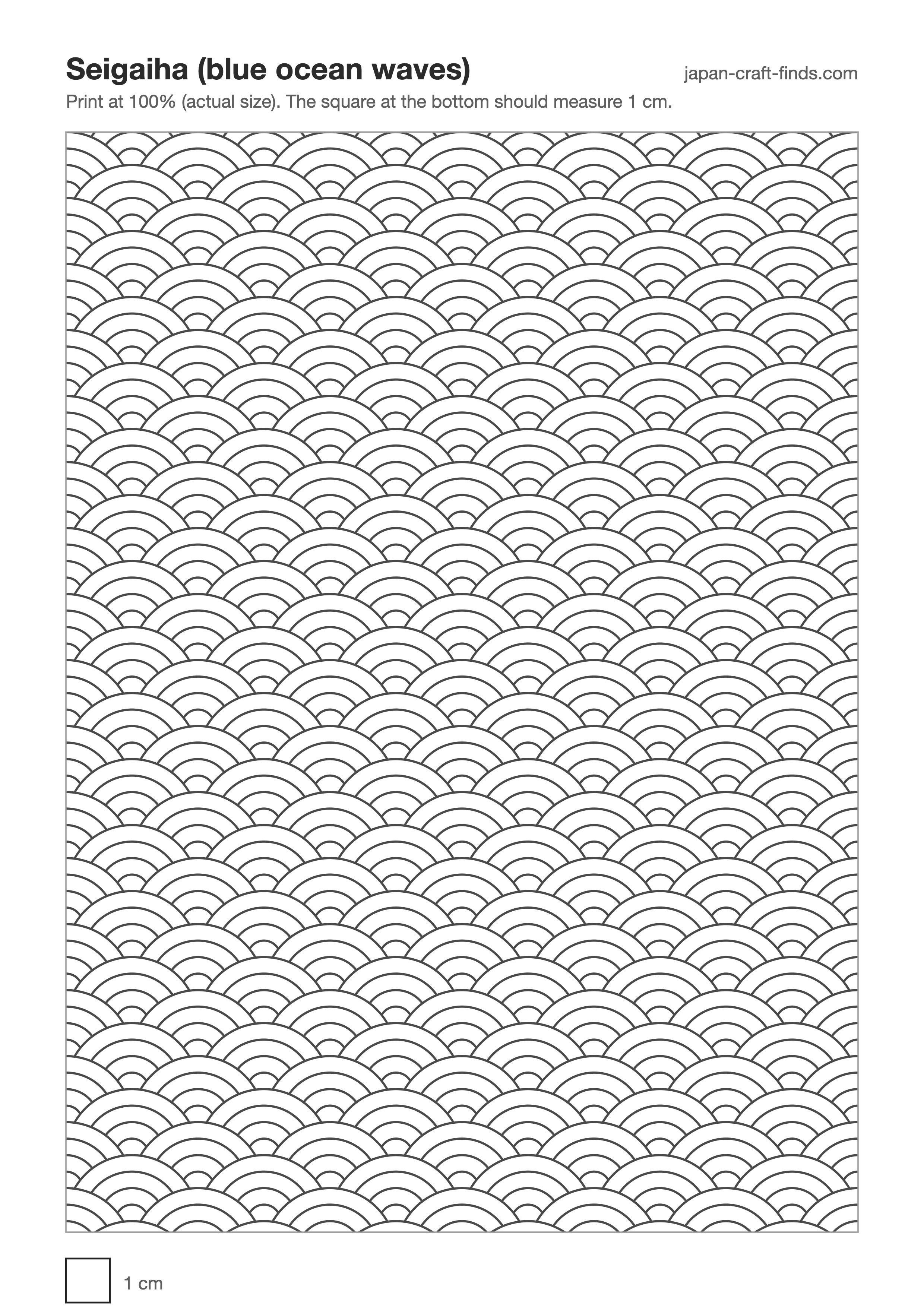
| Seigaiha (blue ocean waves) | Moyozashi | Curves | A peaceful life, like gentle waves (Agency for Cultural Affairs) |
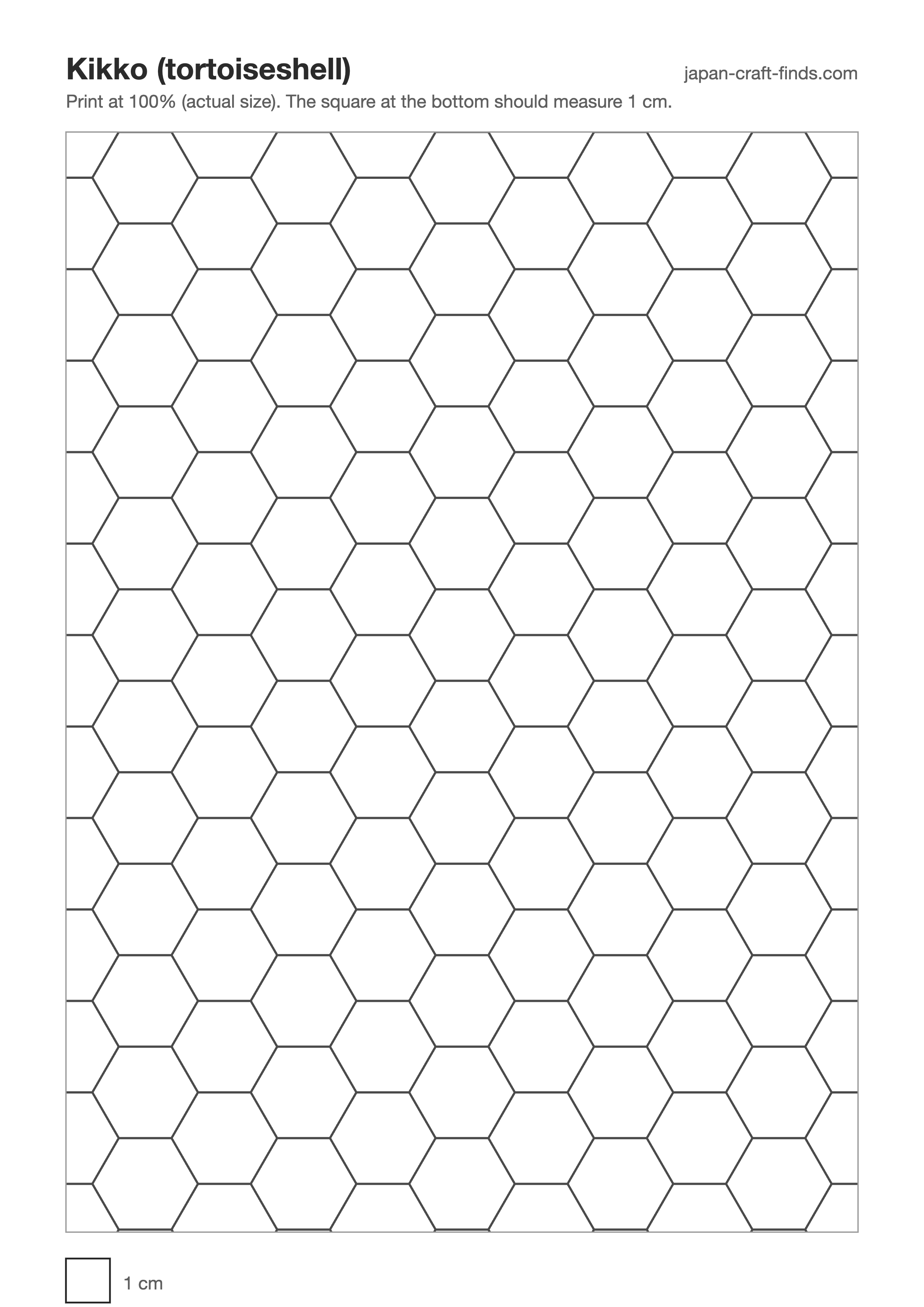
| Kikko (tortoiseshell) | Moyozashi | Straight, in three directions | Not stated by a maker or museum |
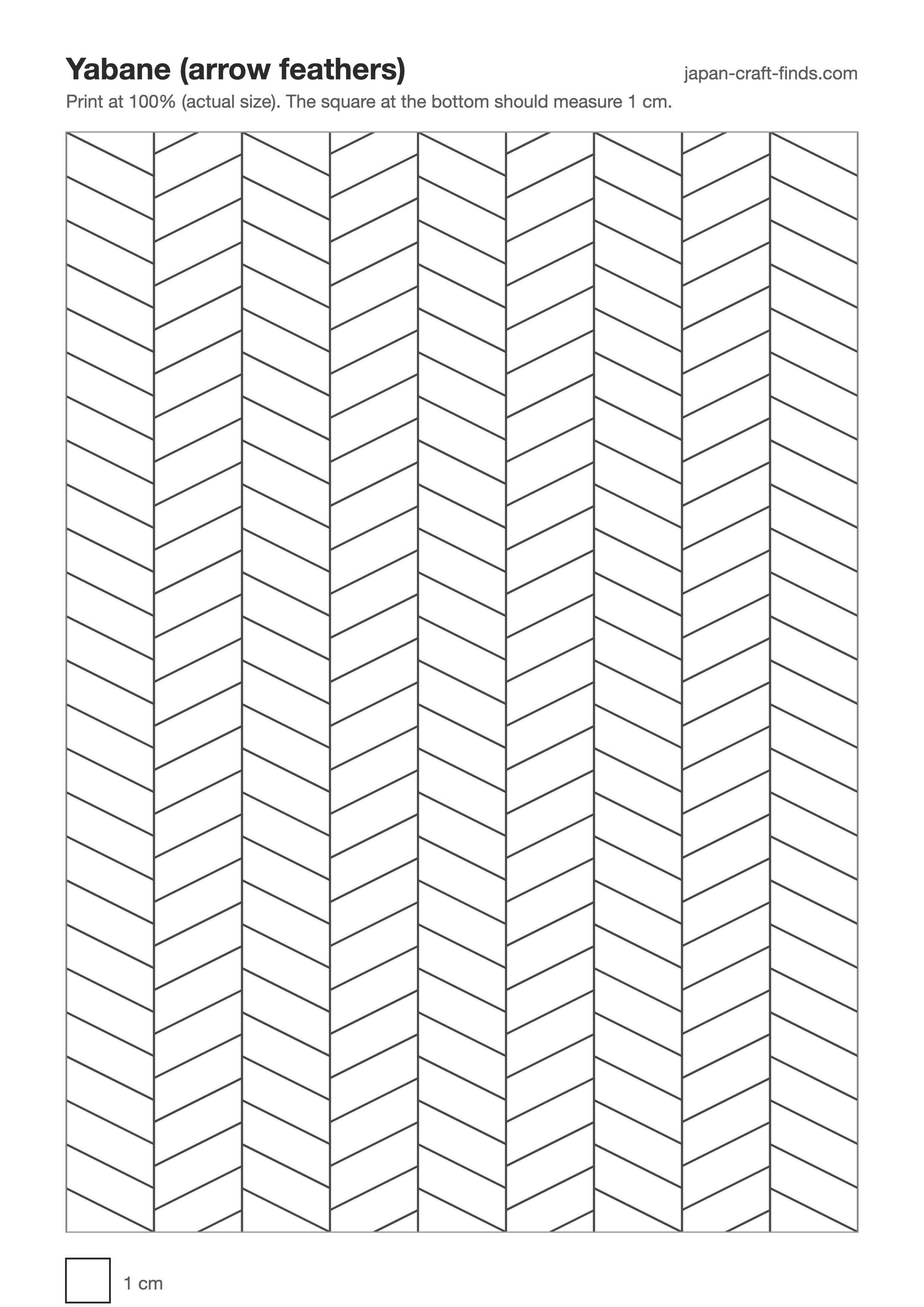
| Yabane (arrow feathers) | Moyozashi | Straight, vertical and slanted | Warding off evil (Olympus) |
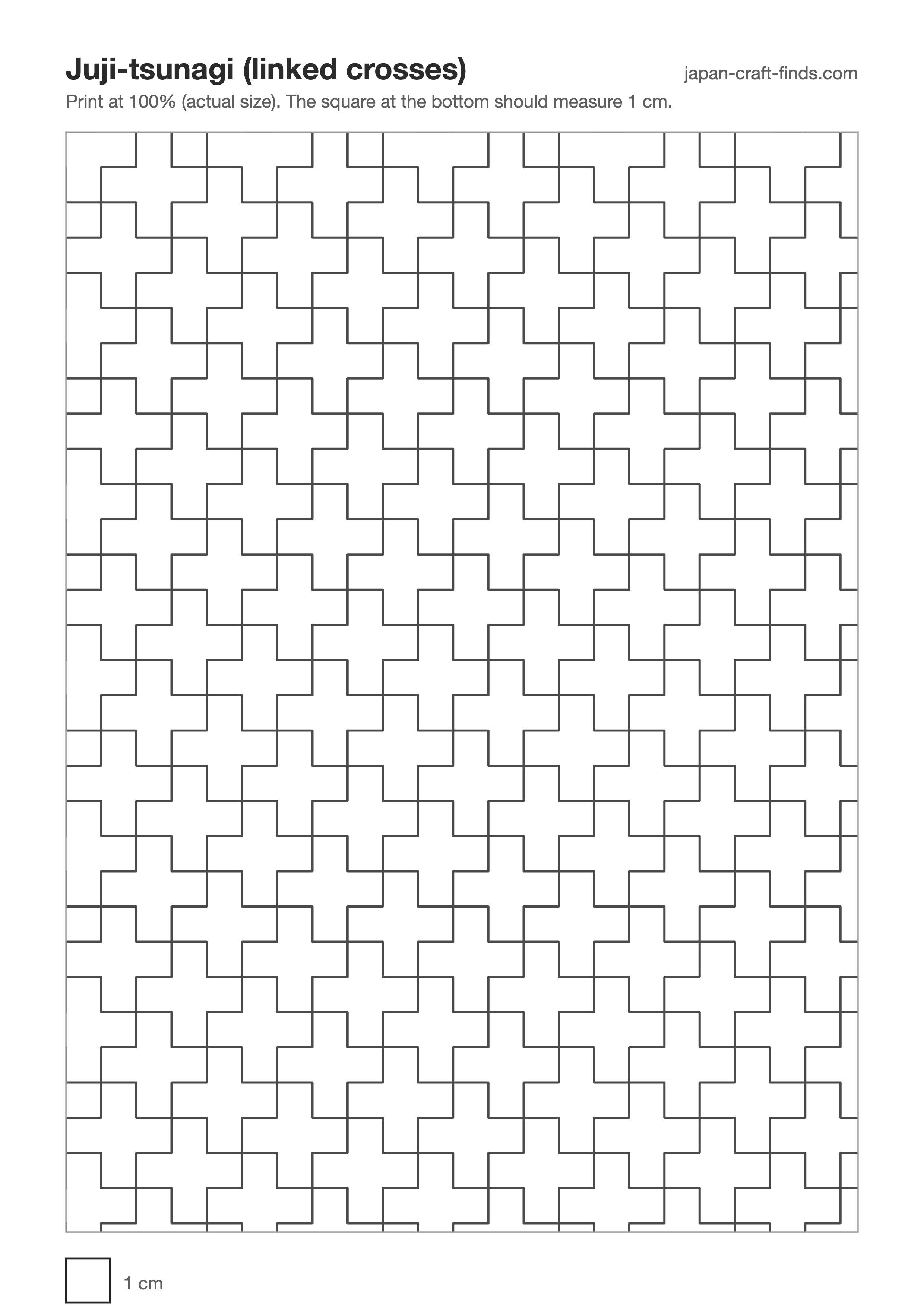
| Juji-tsunagi (linked crosses) | Moyozashi | Straight, stepped | Not stated by a maker or museum |
| Hitomezashi grid | Hitomezashi | Single stitches on a grid | Not stated by a maker or museum |
Each pattern below has a free printable sheet (PNG) sized to fit A4 or US Letter paper.
Two Kinds of Sashiko Pattern
Sashiko patterns fall into two groups: moyozashi, made of continuous lines, and hitomezashi, made of single stitches on a grid. What Is Sashiko? explains both, along with where sashiko comes from.
- Moyozashi traces a larger motif, such as circles or hexagons, with lines of running stitch
- Hitomezashi places one stitch at a time on a grid, and the pattern appears from how the stitches line up in rows and columns
Olympus describes its hitomezashi starter kit as recommended for people who want to try sashiko for the first time, beginning with simple vertical and horizontal patterns before adding diagonals.
Seven Traditional Sashiko Patterns

Asanoha (麻の葉, hemp leaf)
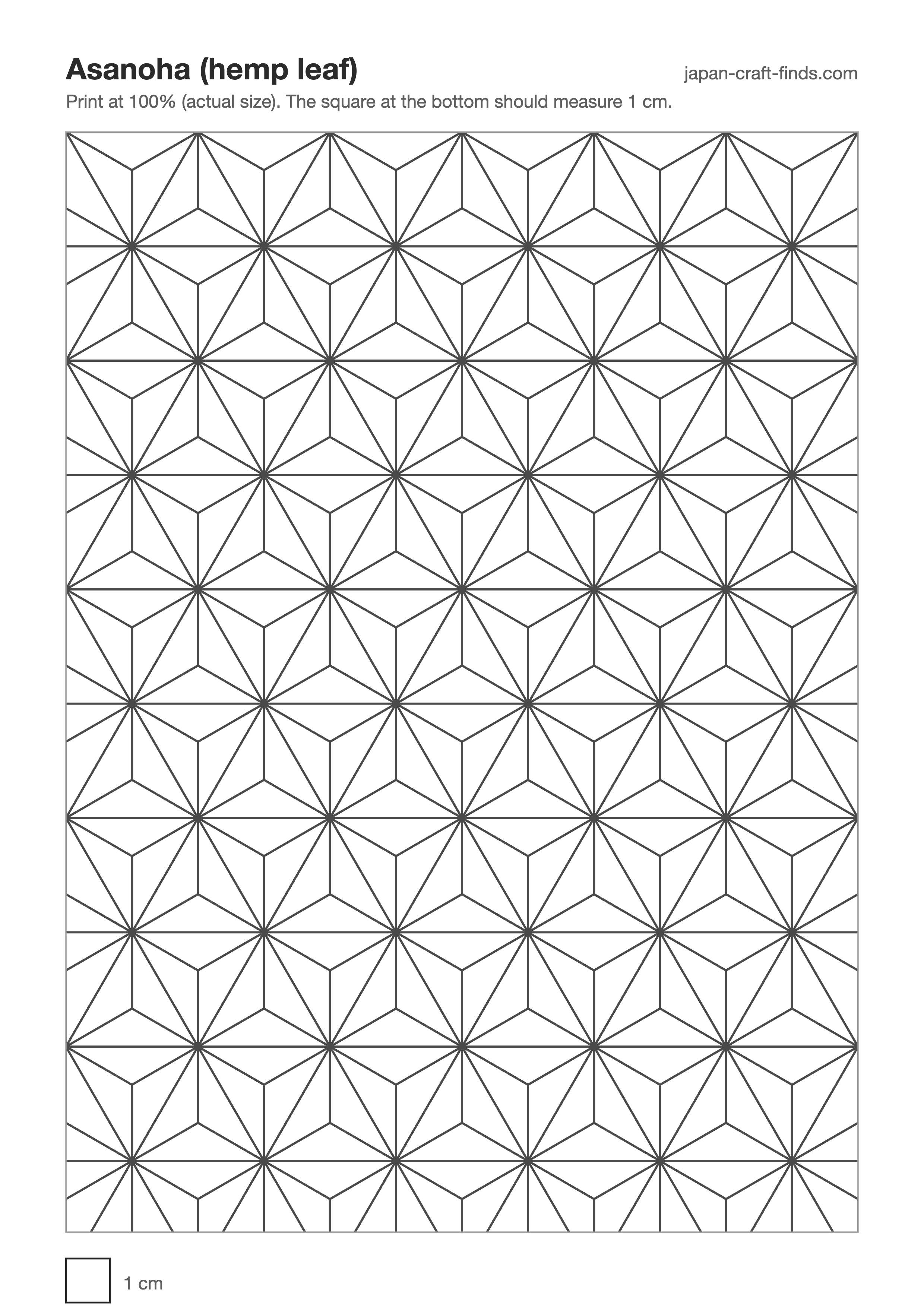
Six-pointed stars made of straight lines, built on a grid of triangles with a line from each corner to the centre. Olympus’s page on traditional patterns says it carries the wish that children grow straight and strong like hemp, and that it was used on clothes for newborn babies. Printable sheet: Asanoha (PNG).
Shippo-tsunagi (七宝つなぎ, linked circles)
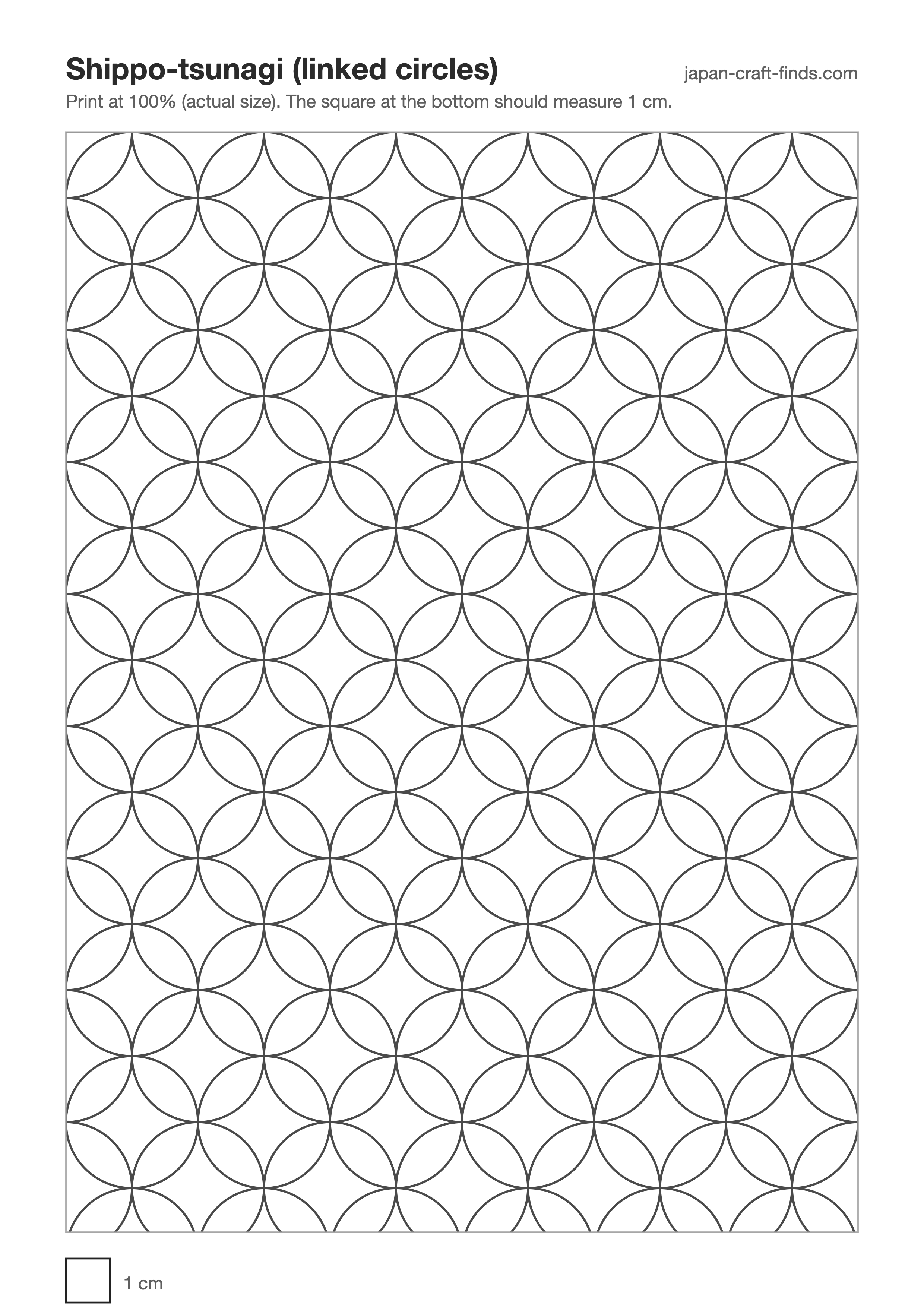
Overlapping circles of the same size, each crossing its four neighbours. Olympus says the endlessly linked circles mean peace and harmony without end, and also endless prosperity for one’s descendants. Printable sheet: Shippo-tsunagi (PNG).
Seigaiha (青海波, blue ocean waves)
Rows of overlapping fans made of concentric arcs. Olympus explains that the pattern is modelled on rolling sea waves and was worn by dancers of the gagaku piece of the same name. The Agency for Cultural Affairs, in its Bunka Isan Online entry for a robe in the Tokyo National Museum, says the pattern expresses a peaceful life that continues like gentle waves. Printable sheet: Seigaiha (PNG).
Kikko (亀甲, tortoiseshell)
A honeycomb of hexagons, named after the plates of a tortoise’s shell. No maker or museum source for its meaning was found, so none is given here; the Akita Sakigake Shimpo, a newspaper in Akita, describes kikko as one of the traditional celebratory patterns stitched in red on bridal cloths. Printable sheet: Kikko (PNG).
Yabane (矢羽根, arrow feathers)
Columns of slanted lines, the slant changing direction from one column to the next, like the feathers of an arrow. Olympus says the pattern comes from the hamaya, a sacred arrow, and carries the meaning of warding off evil. Printable sheet: Yabane (PNG).
Juji-tsunagi (十字つなぎ, linked crosses)
Interlocking plus-shaped crosses made of short horizontal and vertical lines. Olympus describes it as a pattern of continuous crosses and explains that stitching it diagonally, like a staircase, lets the thread run without breaks. No sourced meaning was found. Printable sheet: Juji-tsunagi (PNG).
Hitomezashi grid (一目刺し)
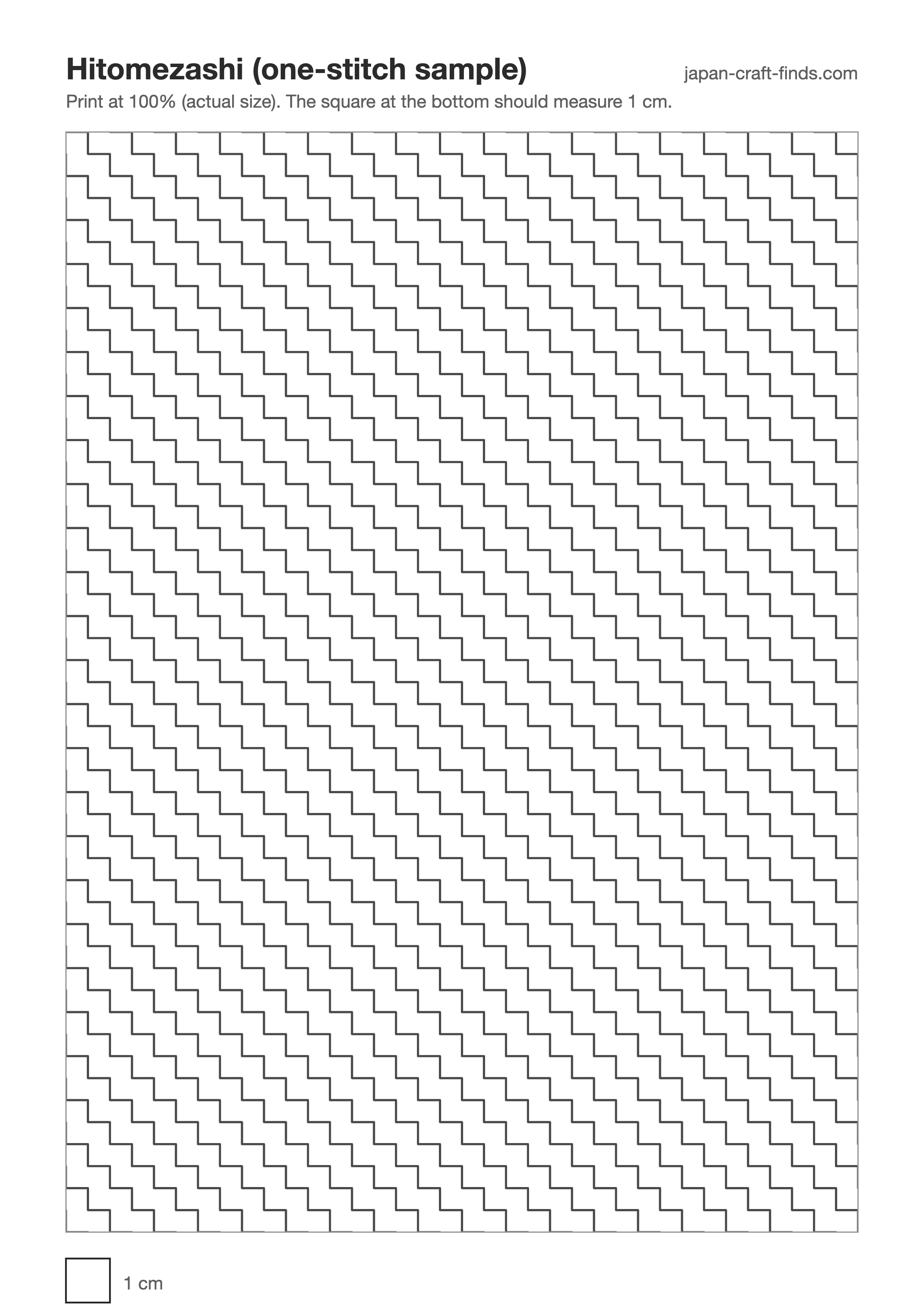
Single stitches placed on a square grid, alternating between horizontal and vertical. The sample here is one simple arrangement; named hitomezashi patterns such as kaki-no-hana follow the same principle. Olympus labels its hitomezashi kits for beginners. Printable sheet: Hitomezashi grid (PNG).
How to Use the Printable Sheets
Print each sheet at 100% (actual size), then check that the square at the bottom measures 1 cm. Each sheet covers 180 × 250 mm, which fits on A4 or US Letter paper.
- Fabric: pre-printed sashiko cloth saves the transfer step. Best Sashiko Fabric compares plain and printed cloths
- Stitching: Olympus’s how-to page says to make the stitch on the front slightly longer than the gap on the back, in a ratio of about 3 to 2, and that a thread length of about 50 cm is easy to work with. How to Sashiko Stitch goes through the steps
- Thread and kits: Best Sashiko Thread for Beginners and Best Sashiko Starter Kit 2026 cover what to buy
- More patterns: Best Sashiko Pattern Books lists books with full-size patterns
Frequently Asked Questions
What are the traditional sashiko patterns?
Well-known traditional patterns include asanoha (hemp leaf), shippo-tsunagi (linked circles), seigaiha (blue ocean waves), kikko (tortoiseshell), yabane (arrow feathers) and juji-tsunagi (linked crosses), along with hitomezashi patterns made of single stitches on a grid.
What does the asanoha pattern mean?
Olympus, a Japanese sashiko thread maker, says asanoha carries the wish that children grow straight and strong like hemp, and that it was used on clothes for newborn babies.
Which sashiko pattern is easiest for beginners?
Olympus labels its hitomezashi kits and the white version of its asanoha cloth for beginners. This guide suggests starting with a pattern made only of straight lines, such as juji-tsunagi or yabane, because straight lines can follow a printed grid.
Can I print these sashiko patterns?
Yes. Each pattern in this guide has a free PNG sheet sized to fit A4 or US Letter paper. Print it at 100% and check that the square at the bottom measures 1 cm.
What is the difference between hitomezashi and moyozashi?
Moyozashi traces a larger motif with continuous lines of running stitch; hitomezashi places single stitches on a grid, and the pattern appears from how the stitches line up.
New to sashiko? What Is Sashiko? covers its history and the regional traditions.
The photo at the top is an illustrative rendering. The pattern diagrams and printable sheets are drawn in code.
Comments