How this article was made: Field reported. It is based on my own visit and photos; visiting details were checked against the official website.
HIBANA, the Symbol of Sakai Knife Museum CUT
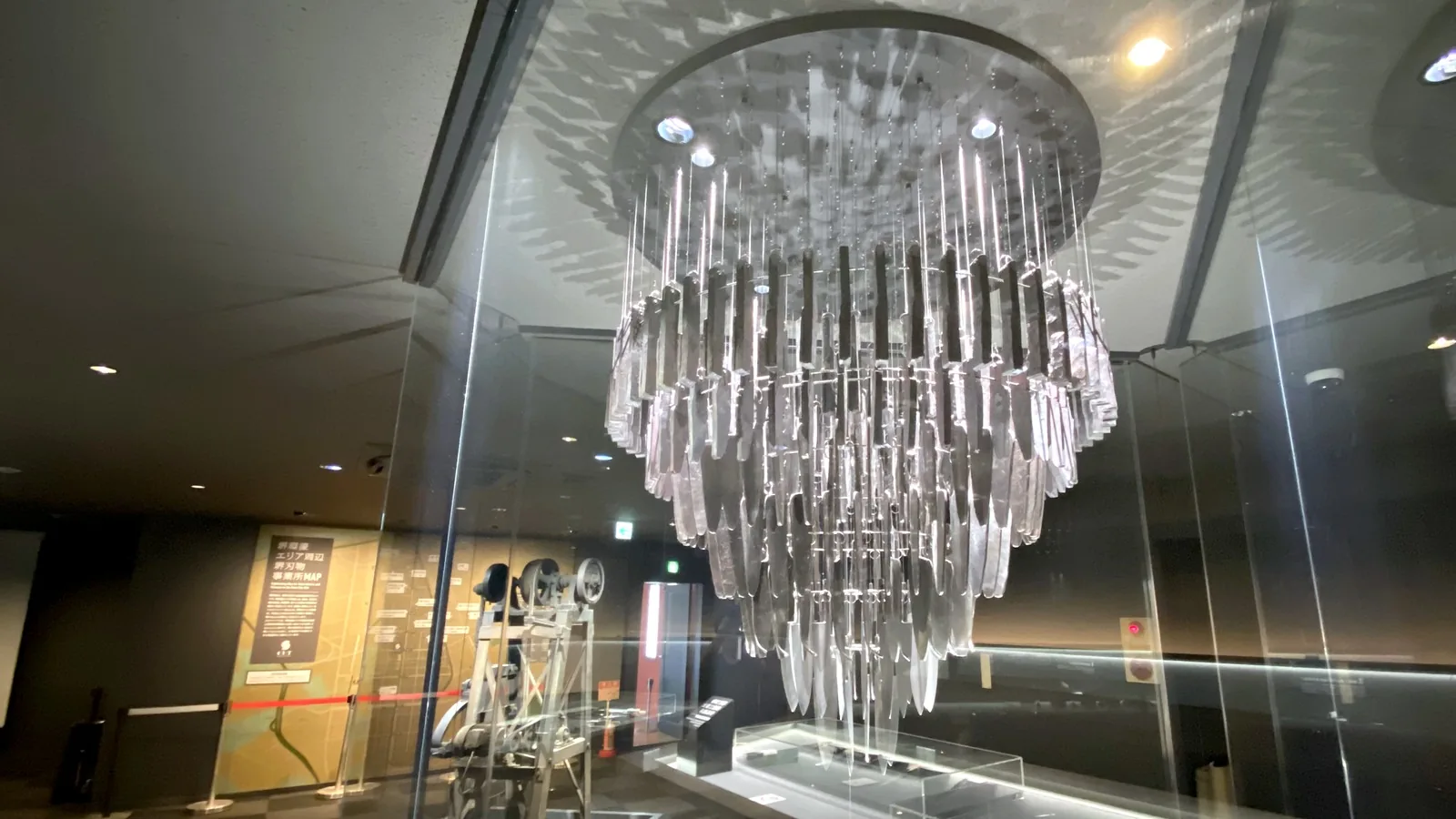
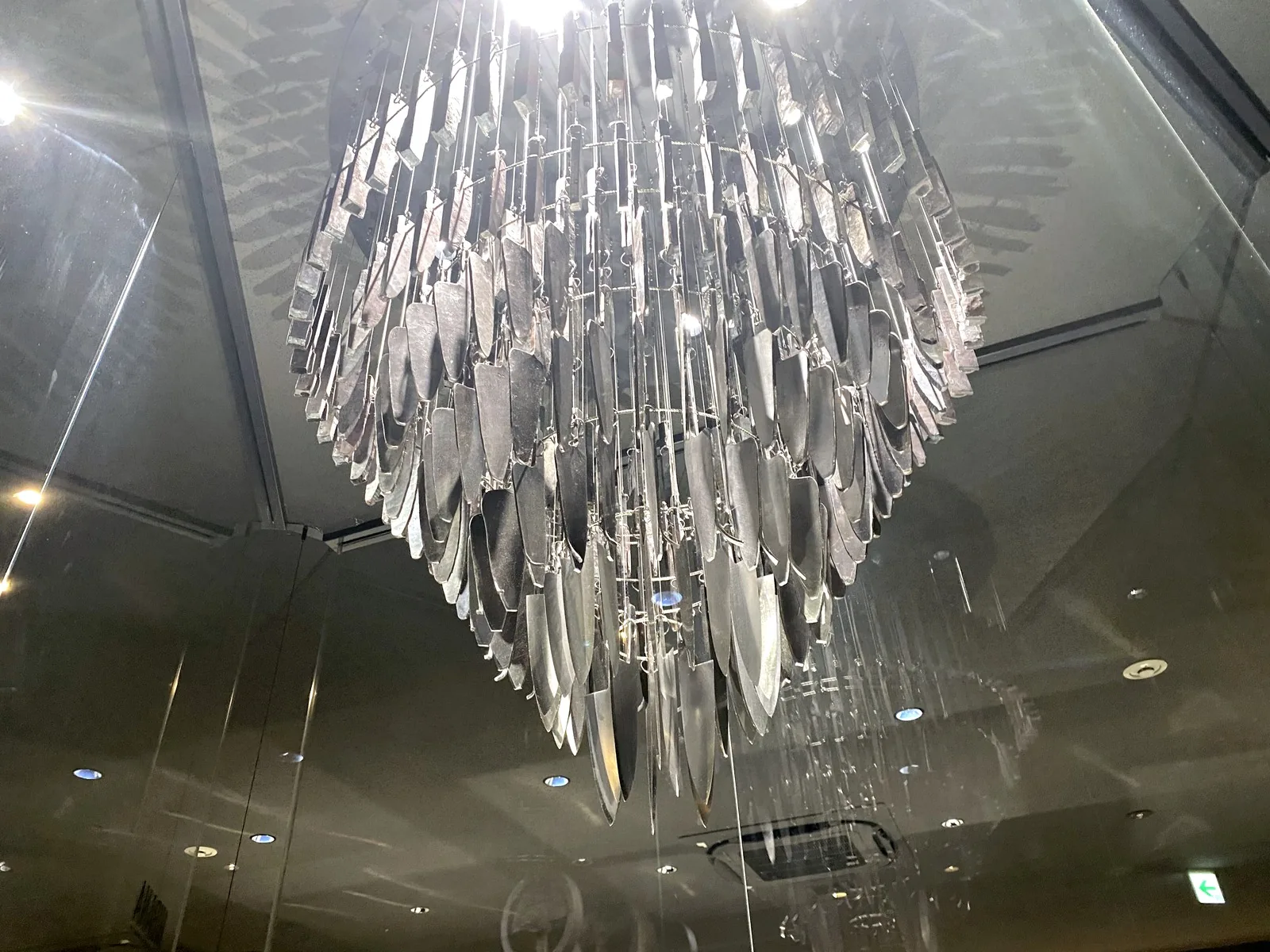
HIBANA is a seven-tier chandelier that, according to the museum, knife craftsmen built from about 300 pieces of knife material, arranged so that a lump of iron turns into a finished knife as you read it from the ceiling down. The official website calls it the symbol of Sakai Knife Museum CUT, the free knife museum on the second floor of the Sakai Traditional Crafts Museum in Sakai, Osaka.
I visited on September 24, 2026, and my full report on Sakai Knife Museum CUT covers the whole museum, from the forging exhibits to the knife types corner. HIBANA only got a short section there, so this article takes a closer look at the one exhibit most visitors stop in front of first: what its name means, what each tier shows, and how it is presented in the room.
All photos here were taken on that visit and are different shots from the ones in the main report.
What the Name 火刃七 Means
The name is written 火刃七, three characters that mean fire, blade, and seven, and it is read hibana, the Japanese word for sparks. The museum’s own explanation ties each character to the exhibit:
- 火 (fire): making bladed tools begins with fire
- 刃 (blade): from 刃物 (hamono), the Japanese word for bladed tools such as knives
- 七 (seven): seven stages were chosen from the many steps of making them
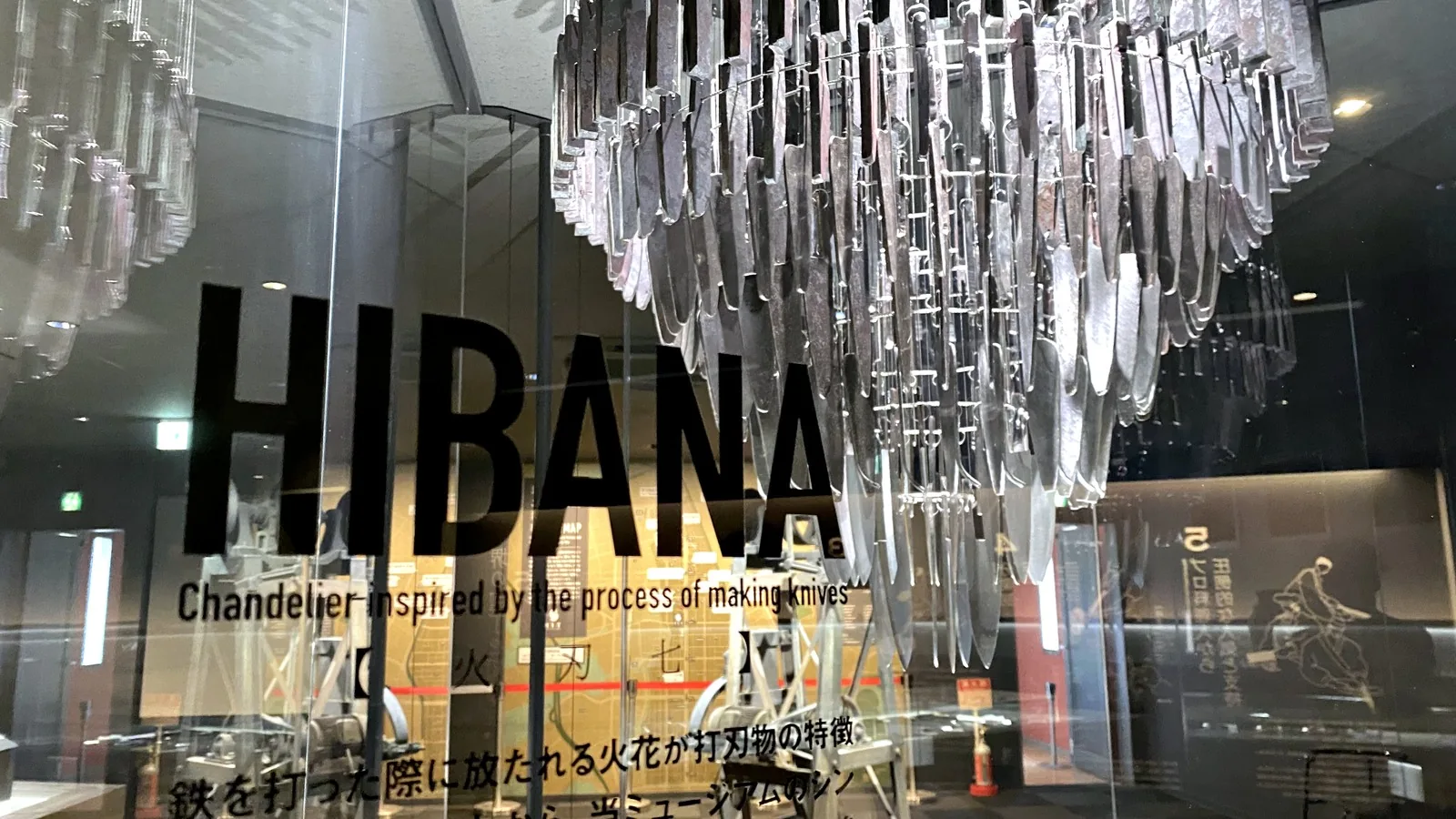
The museum adds a second meaning. Hibana also refers to the sparks that fly when heated iron is struck, which it presents as a signature of uchi-hamono, or hand-forged blades. The sign printed on the glass enclosure carries the same idea: under the English subtitle “Chandelier inspired by the process of making knives” and the characters 火刃七, a Japanese line begins by describing the sparks given off when iron is struck as a feature of forged blades.
It is a neat piece of wordplay. Read aloud, the name is simply “sparks”; written down, it summarizes the exhibit in three characters.
Seven Tiers, From a Lump of Iron to a Finished Knife
Officially, HIBANA uses material from seven stages of knife making, starting with forging (tanzo) and ending with hon-togi, the final sharpening that puts the edge on the blade. The museum says the pieces are arranged so that, from the ceiling downward, you watch a lump of iron become a single knife. It does not publish the name of the stage shown on each individual tier, so I will not assign stage names to them here.
What I can do is describe what my photo from directly below shows. Reading it from the top down, the pieces change roughly like this:
- At the top: short rectangular bars of steel, dark and rough, with no knife shape yet
- Upper middle: longer pieces with a rough blade outline and a tang, still dark on the surface
- Lower middle: flatter blanks with cleaner outlines that are clearly recognizable as knife blades
- At the bottom: bright blades with ground surfaces and edges that catch the light
From photos alone, I could not reliably tell where one of the seven tiers ends and the next begins, so treat the list above as an observation of the overall progression, not a tier-by-tier guide. If you want named steps, the museum has a separate display of 17 numbered stages of a knife, which I cover in the main CUT report. The museum does not say how HIBANA’s seven tiers line up with those 17 stages, so it is best to read the two exhibits side by side rather than as the same list.
Forging, the stage that starts HIBANA, is where the museum says hard steel (hagane) is joined to a heated bar of soft iron (jigane) and hammered out, using tools like the belt hammer behind the chandelier. For the rarer single-steel approach, What Is Honyaki? explains how it differs.
How the Exhibit Is Set Up
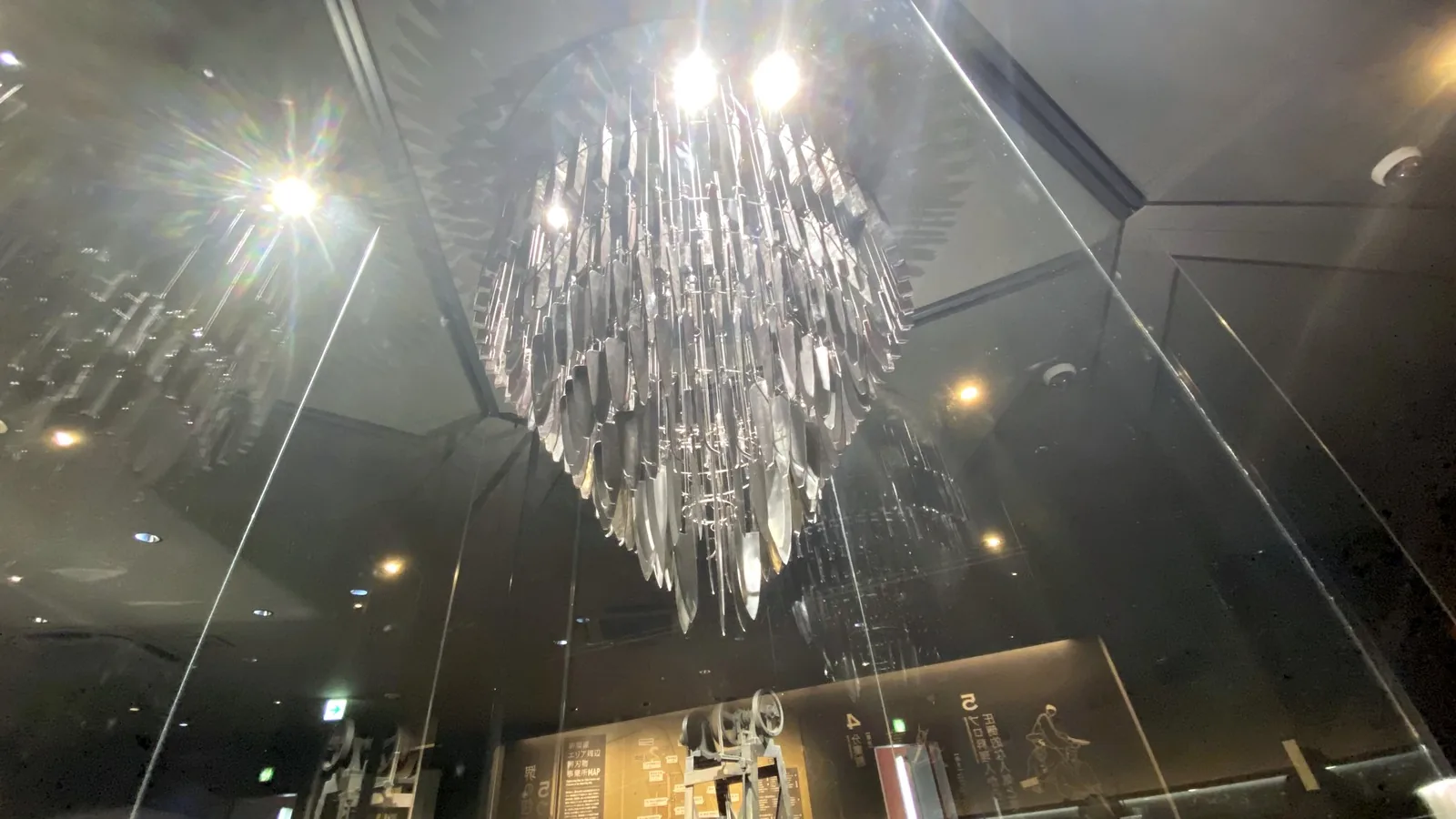
HIBANA hangs inside a glass enclosure near the entrance of CUT, and the museum’s other main exhibits are arranged around it. According to the museum’s announcement, it was installed as a new exhibit when the knife museum reopened under the nickname CUT on April 1, 2021. The museum’s blog describes it as the first thing you see after walking in, which matched my visit.
A few things are worth noticing about the layout:
- The belt hammer behind it. The museum describes this as a real blacksmith’s power hammer used from around 1950, and seeing it through the glass behind HIBANA connects the chandelier’s top tiers to the forging they represent.
- The sign on the glass. The HIBANA name and explanation are printed directly on the enclosure, so you read the sign and see the chandelier through it at the same time.
- The L-shaped display cases. According to the museum, the long cases around the room cover the history of Sakai knives, how they are made, and the different types and their uses.
Because the enclosure is glass, you can see HIBANA from more than one side, and from almost directly underneath.
Photographing HIBANA: What Worked for Me
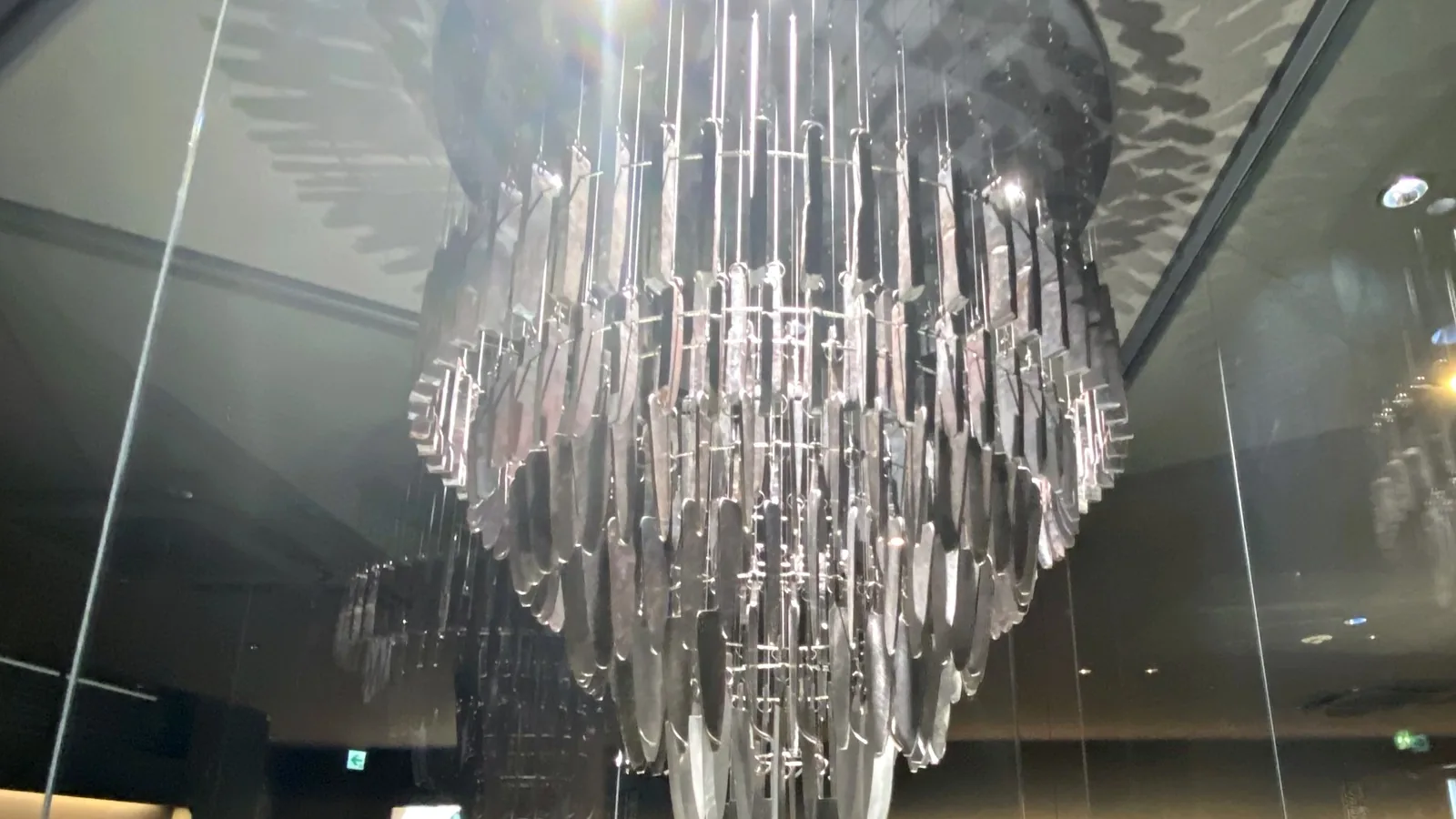
The glass enclosure and the ceiling spotlights make HIBANA easy to see but tricky to photograph, because both create reflections and flare. These notes come from my own phone photos on this visit, not from any museum guidance.
- Stand close to the glass. Shooting from a step or two back picks up reflections of the room and a faint second image of the chandelier in the glass panels.
- Change your angle to avoid the spotlights. Pointing straight at a ceiling light produces strong flare; moving slightly sideways usually removes it.
- Look straight up for the tiers. The top-to-bottom progression is clearest from almost directly below, where all the tiers stack up in one frame.
- Mind the reflections of people. Other visitors, and you, can appear as faint reflections in the glass, so check your shots before sharing them.
Follow any photography signs or staff instructions on the day, since rules for exhibits can change.
Visiting Information
HIBANA is in Sakai Knife Museum CUT, which is free to enter and open from 10:00 to 17:00, except on the third Tuesday of each month. The details below come from the official Sakai Traditional Crafts Museum website, checked on September 28, 2026.
- Location: Sakai Knife Museum CUT, 2nd floor of the Sakai Traditional Crafts Museum (Sakai Denshokan), 1-1-30 Zaimokucho-nishi, Sakai-ku, Sakai, Osaka 590-0941
- Hours: 10:00 to 17:00
- Closed: The third Tuesday of each month (the following day if it is a public holiday), and December 28 to January 3, plus occasional temporary closures
- Admission: Free
Access by tram, train and bus is covered in the main CUT report. Hours and closing days can change, so check the official CUT page before you travel.
Final Thoughts
HIBANA works as both a striking centerpiece and a quick lesson: in one glance, it shows that a Sakai knife starts as a rough bar of steel and passes through many steps before it becomes a sharp blade. Knowing what 火刃七 means, and reading the tiers from top to bottom, makes the rest of CUT easier to follow. For how Sakai became a knife town in the first place, see The History of Sakai Knives.
If you only have a few minutes, spend them looking up at HIBANA from below, then walk over to the 17-stage display. Together, they explain what “forged in Sakai” actually involves better than any product listing.
Frequently Asked Questions
What does HIBANA mean?
HIBANA is written 火刃七 (fire, blade, seven) and read hibana, the Japanese word for sparks. According to the museum, the characters stand for fire, where making bladed tools begins, the blades themselves, and the seven stages chosen for the chandelier, while the reading also refers to the sparks that fly when iron is struck.
How many knives are in HIBANA?
The museum says HIBANA uses about 300 pieces of knife material, arranged in seven tiers. Not all of them are finished blades: the upper tiers hold rough steel pieces from the early stages.
Which seven stages does HIBANA show?
The museum says the seven stages run from forging to hon-togi, the final sharpening, but it does not publish the name of the stage on each tier. From below, you can see the pieces change from rough bars at the top to finished blades at the bottom.
Is there an admission fee to see HIBANA?
No. HIBANA is in Sakai Knife Museum CUT, which the official website lists as free to enter.
Where is HIBANA?
It is on the second floor of the Sakai Traditional Crafts Museum in Sakai, Osaka, inside Sakai Knife Museum CUT, near the entrance.
If you are visiting Sakai for its knives, give HIBANA a few minutes before the rest of CUT: it is the quickest way to see the whole journey from steel to blade.