This article contains affiliate links. If you buy through them, we may earn a commission at no extra cost to you.
How this article was made: Research-based comparison. It draws on published information from makers, retailers, and reference sources, not on hands-on testing.
- They’re All ‘Japanese Knives’ — But They’re Not the Same
- Santoku: The Everyday Home Cook’s Best Friend
- Gyuto: The Workhorse for Serious Cooks
- Nakiri: The Knife That Makes Vegetables Worth Cooking
- Side-by-Side: Santoku vs Gyuto vs Nakiri at a Glance
- Frequently Asked Questions
- So Which One Should You Actually Buy?
They’re All ‘Japanese Knives’ — But They’re Not the Same
Walk into any kitchen store or browse an online knife shop, and you’ll likely see Santoku, Gyuto, and Nakiri knives grouped under the same ‘Japanese knives’ banner. It’s a convenient label, but it quietly glosses over the fact that these three blades were designed for genuinely different purposes — and buying the wrong one is one of the most common mistakes first-time buyers make.
A Gyuto is built around the kind of multi-task, high-speed prep work you’d find in a professional kitchen. A Santoku is optimized for the shorter, push-and-rock motion common in Japanese home cooking. A Nakiri’s flat, rectangular blade exists for one reason: clean, efficient vegetable cutting. Using a Gyuto to do a Nakiri’s job isn’t impossible, but it’s a bit like using a chef’s 10-inch knife to peel garlic — technically fine, practically awkward.
For anyone just getting started, sorting out which blade actually fits your cooking habits will save you real money and frustration. If you’re still weighing whether a Japanese knife makes sense over a Western one at all, this comparison of Japanese vs Western knives is a good place to start. The rest of this guide breaks each knife down by design, use case, and price so you can make a confident choice.
Santoku: The Everyday Home Cook’s Best Friend
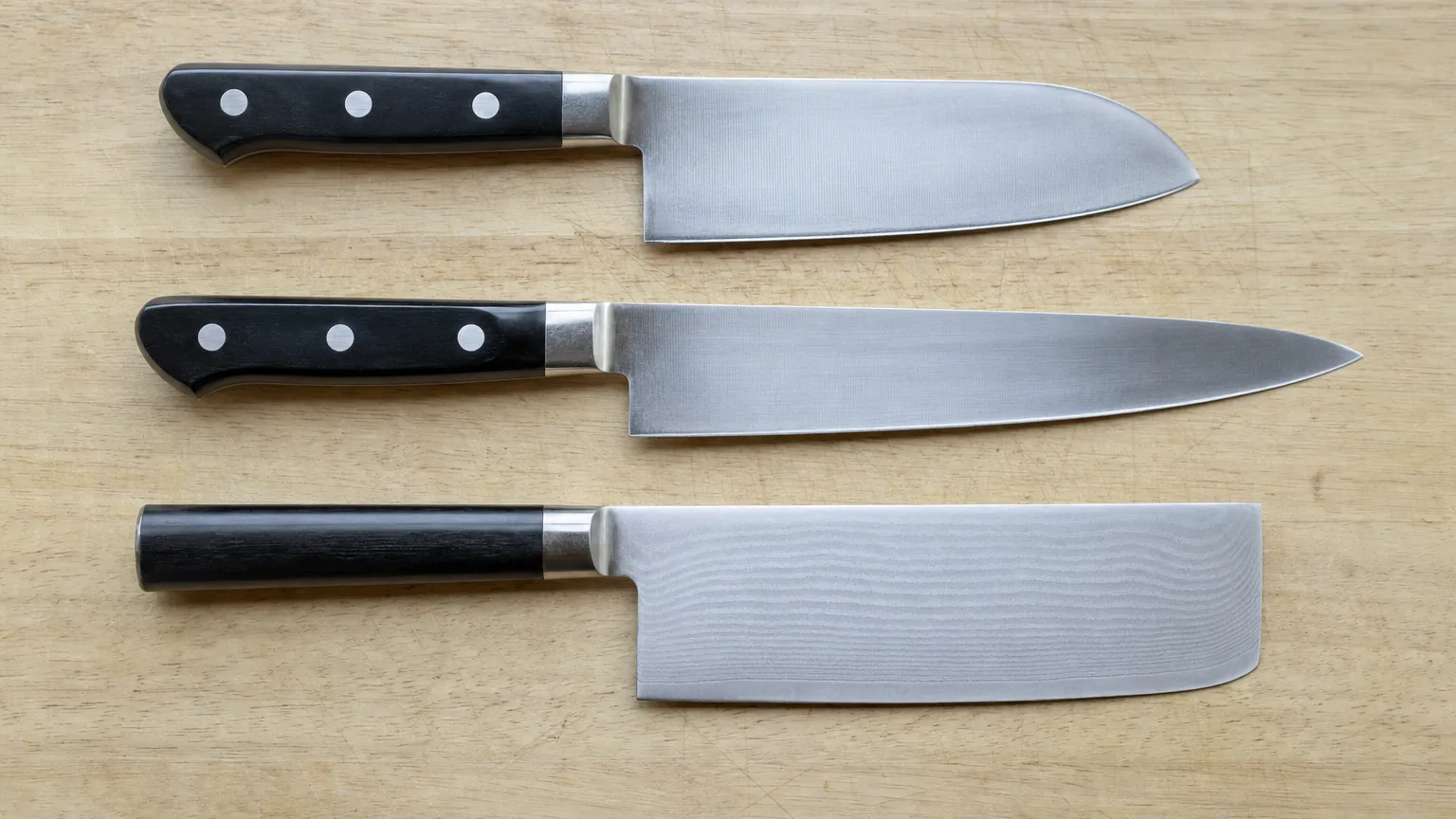
The name Santoku roughly translates to ‘three virtues’ — a nod to its ability to handle meat, fish, and vegetables without specializing in any one of them. That versatility, combined with a blade that is usually 165mm to 180mm long (MAC lists its santoku at 6.5 inches, Tojiro at 170mm and Shun at 7 inches), is exactly why it became the default choice in Japanese households and has since found a massive following in Western home kitchens. A closely related shape, the Bunka, shares that same everyday versatility but trades the Santoku’s rounded tip for a sharper, angular point — see our Bunka vs Santoku comparison for how the two actually differ in use.
The blade profile is shorter and less pointed than a Gyuto, which gives it a more approachable feel, especially if you’re used to smaller Western knives. The slight downward curve at the spine means the tip stays relatively neutral, making up-and-down chopping motions natural rather than forced. Many Santoku models also feature a Granton edge (the small hollow ovals along the blade) to reduce food sticking — a small detail that makes a real difference when slicing thin cuts of boneless chicken or cucumber.
In terms of steel, most mid-range Santoku knives use VG-10 steel, which offers a good balance of edge retention and ease of sharpening — a practical choice for home cooks who sharpen maybe once or twice a year. You’ll also find options in AUS-10 and even Damascus-clad versions at the higher end of the home-kitchen price range.
Price-wise, two options are the Tojiro DP Santoku 170mm ($122.00 on October 5, 2026) and the MAC Superior Santoku 165mm ($59.72). The Shun Classic Santoku 7-inch is a step up at $124.99 (checked on October 10, 2026), for those wanting a Damascus-clad finish. (Other Amazon.com prices checked on October 4, 2026.) US readers can also buy this knife from Chubo Knives, listed as the Tojiro Fujitora DP Santoku 170mm, at $109.00 (checked October 7, 2026). Chubo ships from Japan and says US orders go out duties-paid (DDP); shipping is $15 on orders under $200 and free above that. The Tojiro DP santoku listing on Amazon is sold by Angel Seller, a third-party seller, and shipped by Amazon; the listing does not show a model number, but its specifications (170mm blade, 295mm overall length, a three-layer blade with a cobalt-alloy core and 13-chrome stainless sides, laminated handle) match Tojiro’s official F-503. For a broader look at entry-level options, this guide to the best Japanese knives for beginners covers several Santoku picks in context. If you have already settled on a santoku, Best Japanese Santoku Knife 2026 compares five picks by budget, steel and handle.
Gyuto: The Workhorse for Serious Cooks
If the Santoku is the dependable daily driver, the Gyuto is the performance car you learn to drive properly before you appreciate it. Essentially Japan’s answer to the Western chef’s knife, the Gyuto is sold in many lengths (Tojiro’s Classic series alone runs from 180mm to 330mm, and MAC calls 8 inches, about 200mm, the most commonly used size in home and professional kitchens) — usually longer than a Santoku — and comes with a pronounced pointed tip that makes it far more capable at tasks like breaking down a whole chicken, slicing through larger cuts of beef, or executing the long, sweeping cuts used in professional butchery.
The blade’s curved profile supports a classic rock-chop motion, which is why chefs transitioning from Western knives often find the Gyuto the most intuitive Japanese knife to pick up. That said, the longer blade and thinner grind do demand more careful handling. Gyuto knives are typically ground to a thinner edge angle (MAC describes about 15° per side and Shun 16°, against the 20–25° Shun cites for Western knives) than Western knives, which means they cut with noticeably less resistance but are also more prone to chipping on bones or frozen food.
Most quality Gyuto knives are built from harder steels — VG-10, SG2 (also called R2), or high-carbon options like White Steel No. 2. MAC, for example, gives the hardness of its own steel as 57 to 61 on the Rockwell C scale (HRC). Higher HRC generally means better edge retention but also slightly more brittleness, which is worth knowing before you hand one to someone who’s used to banging a German knife through a butternut squash.
Pricing reflects the professional positioning. A reliable entry point is the Tojiro DP Gyuto 210mm at $95.55. The Sakai Takayuki Grand Chef SP Gyuto 240mm (the linked listing is the SP version, with dimples along the blade) sits at $189.60 as a solid mid-tier step up, while the Misono UX10 Gyuto 240mm runs noticeably higher at $314.00. High-end hand-forged options from makers like Yoshihiro or Takamura can push well past $300. Handle style matters here too — Wa handle (octagonal Japanese handle) versus Western handle changes the balance and grip feel significantly, so it’s worth trying if possible before committing.
If the gyuto sounds like your knife, Best Japanese Gyuto Knife 2026 compares picks by skill level and budget. For how the kiritsuke compares, see Kiritsuke vs Gyuto.
Amazon.com prices checked on October 4, 2026. The Tojiro gyuto linked here is sold under the Fujitora (藤寅作) name. Tojiro’s FAQ says Fujitora knives use the same materials as Tojiro knives with a different mark, and are sold through wholesalers and retailers rather than by Tojiro directly.
Nakiri: The Knife That Makes Vegetables Worth Cooking
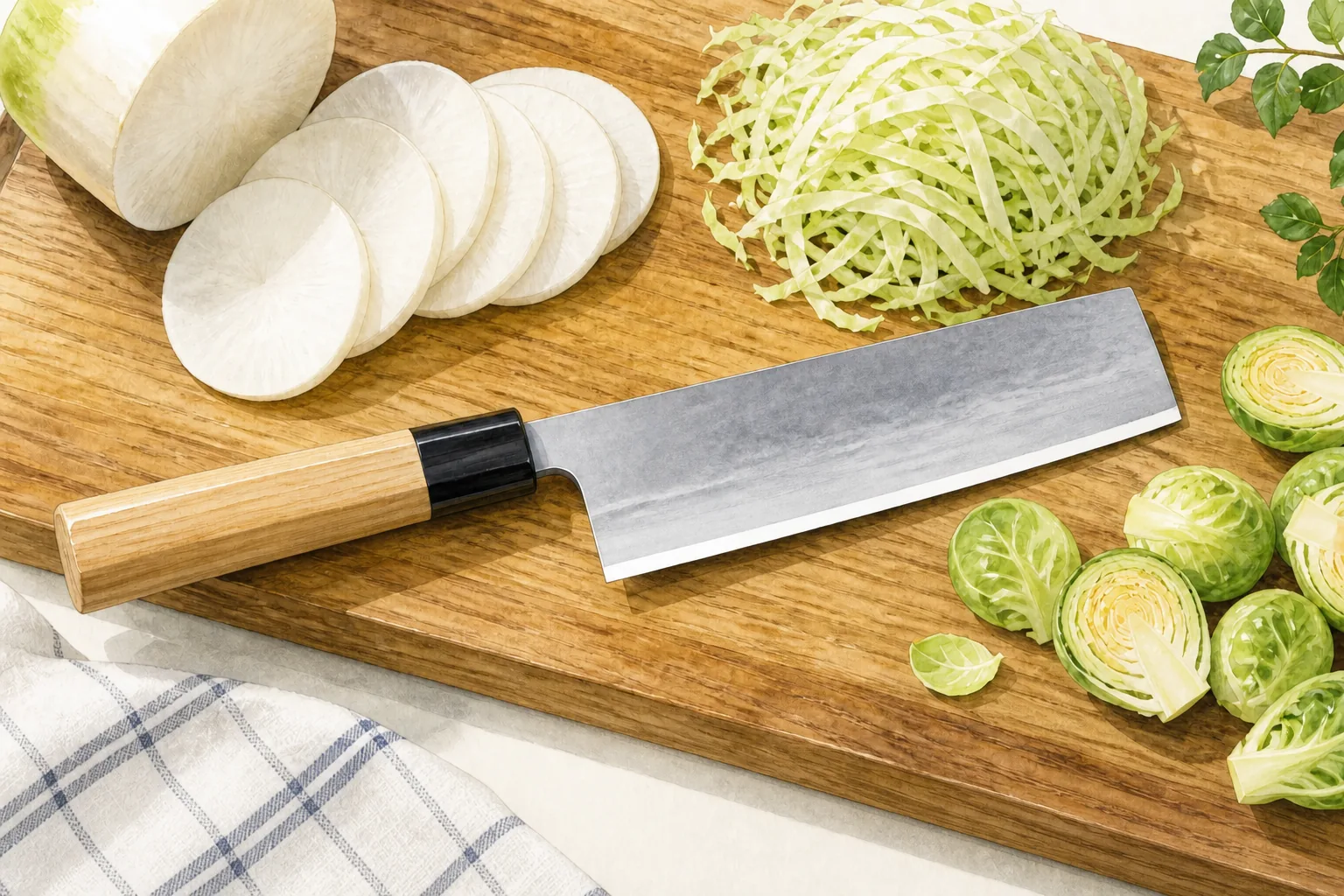
The Nakiri is a specialist, and it makes no apologies for it. The blade is rectangular, flat, and double-beveled (unlike its single-bevel cousin, the Usuba, which is reserved for professional Japanese cuisine), typically around 160mm–170mm long. That flat edge profile is the whole point: it lets the entire length of the blade contact the cutting board in a single downward push, delivering clean, even cuts through vegetables without the forward-rocking motion that a Santoku or Gyuto requires.
For anyone cooking a plant-forward diet — whether that means mostly vegetarian meals, meal-prepping large quantities of produce, or just spending a lot of time breaking down root vegetables — the Nakiri makes a genuinely compelling case for itself. Thin, consistent slices of daikon, fennel, or cabbage that would take real effort with a general-purpose knife come almost effortlessly once you learn the blade’s rhythm.
The Nakiri pairs naturally with a Japanese-style cutting technique that emphasizes straight downward cuts over the rocking strokes taught in most Western culinary schools.
Notable options include the Shun Classic Nakiri 6.5-inch at $182.54 and the Yoshihiro VG-10 Hammered Damascus Nakiri 165mm at $189.99, shown as currently unavailable on Amazon.com (prices and stock checked on October 10, 2026). For a lower price, the Tojiro Basic Nakiri VG-10 165mm from SharpEdge is €60.00 (about $67); US buyers: about $98 in total with shipping and the 25% tariff. It was in stock on October 16, 2026, and Tojiro describes its knives as made in Tsubame-Sanjo, Japan. Keep in mind that because the edge is so flat, proper sharpening technique matters — this guide on Japanese knife sharpening stones for beginners is useful reading before your first maintenance session.
For specific knives, see Best Japanese Nakiri Knife 2026, or Best Japanese Nakiri Under $150 if you have a firm budget.
Side-by-Side: Santoku vs Gyuto vs Nakiri at a Glance
Choosing between these three knives ultimately comes down to two questions: what do you cook most often, and what’s your budget? The table below organizes the key decision factors so you can compare them without having to scroll back through everything.
| Feature | Santoku | Gyuto | Nakiri |
|---|---|---|---|
| Blade Shape | Rounded tip, slight curve | Pointed tip, pronounced curve | Flat, rectangular |
| Best For | Home cooking: meat, fish, veg | Meat-heavy cooking, professional prep | Vegetables only |
| Lengths sold (3 makers) | 165–178mm (also 140, 216) | 152–330mm | 165mm |
| Price (linked knives) | $59.72 to $124.99 | $95.55 to $314.00 | $182.54 to $189.99 |
| Skill Level | Beginner to intermediate | Intermediate to advanced | Beginner to intermediate |
| Verdict | First knife for most home cooks | For serious cooks or an upgrade | Best if you cook mostly vegetables |
Prices are the Amazon.com prices of the knives linked in this article, checked on October 4, 2026; the Shun Classic Santoku and the two nakiri were checked again on October 10, 2026.
A few things worth noting that don’t fit neatly into a table:
- All three knife types are available in both Wa handle (Japanese octagonal) and Western handle styles. Wa handles are lighter and shift balance toward the blade; Western handles feel more familiar if you’re coming from European knives. Wa-Handle vs Western Handle: Which Japanese Knife Grip Is Right for You? compares the two grips in more detail.
- Steel hardness (HRC) varies even within each knife type. A higher HRC means a sharper, longer-lasting edge but also a more brittle blade — relevant if you’re rough on knives.
- Double bevel construction (standard on all three knives listed here) makes sharpening accessible for beginners compared to single-bevel professional knives like the Yanagiba or Usuba.
Still undecided after the table? One all-purpose knife is enough to start with, and Best Japanese Knife for Beginners walks through that choice by price.

Blade lengths are from each maker’s own product pages: Tojiro Classic, Shun Classic and MAC Professional (read on October 5, 2026).
Frequently Asked Questions
How long is a santoku compared with a gyuto?
A santoku is usually 165mm to 180mm long: MAC lists its santoku at 6.5 inches, Tojiro at 170mm and Shun at 7 inches. A gyuto is sold in many lengths: Tojiro’s Classic series runs from 180mm to 330mm, and MAC calls 8 inches, about 200mm, the most commonly used size in home and professional kitchens.
Are Japanese knives sharpened at a different angle from Western knives?
The makers’ own figures say so. MAC describes about 15° per side and Shun 16°, against the 20–25° on each side that Shun’s FAQ gives for German-steel knives.
Is a Fujitora knife the same as a Tojiro knife?
Tojiro’s FAQ says Fujitora knives use the same materials as Tojiro knives with a different mark, and are sold through wholesalers and retailers rather than by Tojiro directly.
So Which One Should You Actually Buy?
The honest answer depends less on which knife is ‘best’ in the abstract and more on what you’ll actually be doing with it three months from now.
If you cook a wide variety of meals at home — some chicken, some fish, plenty of vegetables — and you want a single knife that handles all of it without demanding much technique, start with a Santoku. This guide suggests starting with the Tojiro DP Santoku or the MAC Superior Santoku, because they are the two lower-priced santoku linked above.
If you cook seriously — you break down whole proteins regularly, you spend real time in the kitchen, or you’re coming from a professional background — the Gyuto is the better long-term investment. The three gyuto linked above run from $95.55 to $314.00. Pair it with a good Wa handle version if you want the full Japanese balance experience.
If your diet is mostly plant-based, or you find yourself spending most of your prep time on vegetables, the Nakiri will make that time noticeably more efficient and enjoyable. The Yoshihiro VG-10 Damascus Nakiri is the lower-priced of the two linked nakiri.
For a focused look at which of these knives perform best for raw fish preparation specifically, the best Japanese knives for sushi guide goes deeper on that use case. And if you’re considering a knife as a gift, the Japanese knife gift sets for beginners page is worth a look before you check out.
Ready to pick your knife? Use the product links in the sections above to check current prices on Amazon, and match the blade shape to how you actually cook.
Looking specifically for a Nakiri to buy? See our full Nakiri buying guide with picks across every price tier.
Considering a Gyuto instead? See our full Gyuto buying guide with picks across every price tier.