How this article was made: Research-based comparison. It draws on published information from makers, retailers, and reference sources, not on hands-on testing.
- What Is Sashiko?
- Where Sashiko Comes From: Edo-Period Farmhouses to Meiji Workshops
- Japan’s Three Major Sashiko Traditions
- The Stitches and Patterns: From Running Stitch Basics to Named Geometries
- Sashiko vs Embroidery (and Boro)
- Sashiko in the Modern World: Mending, Home Goods, and Community Projects
- Getting Started: What You Need
- Frequently Asked Questions
- Related Sashiko Guides
- Sources
What Is Sashiko?
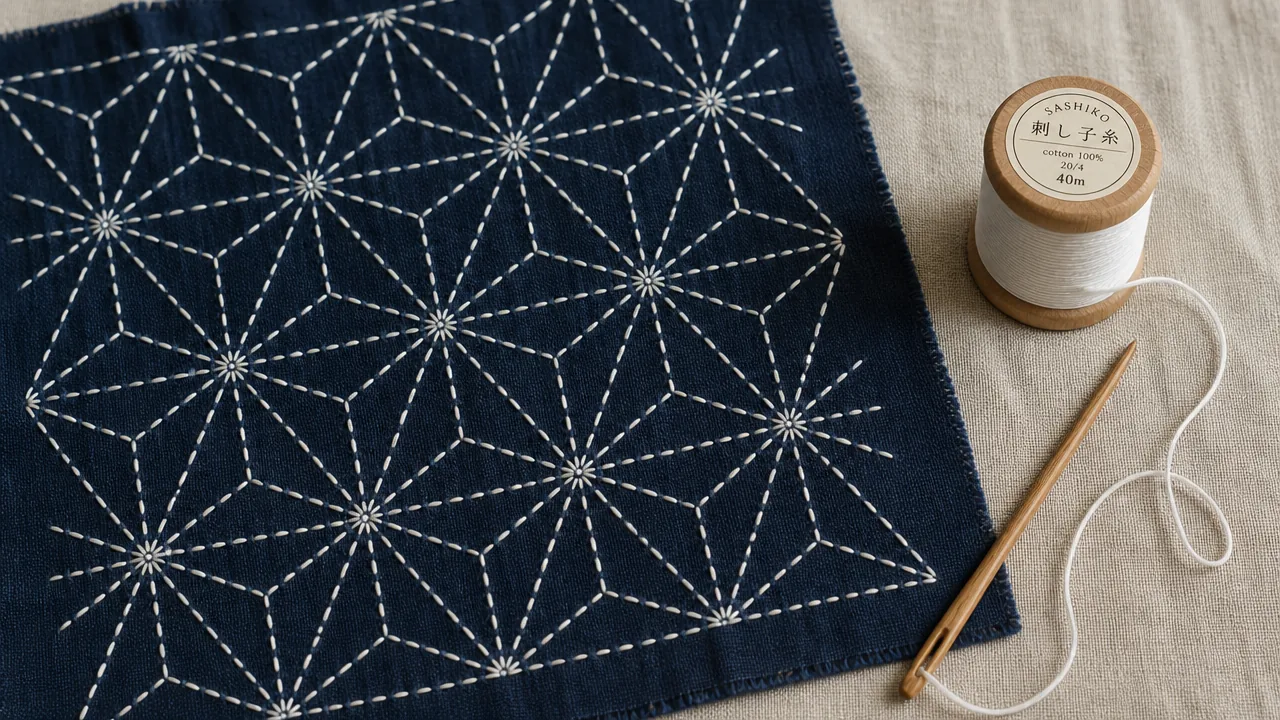
Sashiko (刺し子) is a Japanese hand-stitching technique that uses rows of small running stitches, traditionally white cotton thread on indigo cloth, to reinforce and decorate fabric. The word comes from the verb sasu (刺す), “to pierce” or “to stitch through,” and Japanese dictionaries describe sashiko as cloth layered and stitched closely together, used for items such as firefighters’ coats and judo and kendo uniforms.
It began as a practical answer to cold winters and scarce cloth: stitching layers together made work clothes warmer and harder-wearing. Japan House London describes it as “born out of the spirit of cherishing things,” used both to decorate and to reinforce clothing. Today the same running stitch is used for decorative cloths, home goods and visible mending.
- Technique: rows of small running stitches, traditionally white cotton thread on indigo cloth
- Origin: the cold farming and fishing communities of northern Japan (Tōhoku), where stitching layers together made work clothes warmer and harder-wearing
- Regional styles: Tsugaru kogin-zashi and Nanbu hishizashi from Aomori Prefecture, and Shōnai sashiko from Yamagata Prefecture
- To start: a sashiko needle, cotton sashiko thread and tightly woven cotton cloth. Best Sashiko Starter Kit 2026 compares kits that include them
Where Sashiko Comes From: Edo-Period Farmhouses to Meiji Workshops
The oldest surviving example of sashiko-style stitching in Japan is a Buddhist monk’s robe (shinō kesa) said to have been used by Emperor Shōmu and kept in the Shōsōin treasure house; according to a Sakata City exhibition catalogue, its stitching is still only straight running stitches, which shows that reinforcing cloth with stitching was established by at least the Nara period (8th century).
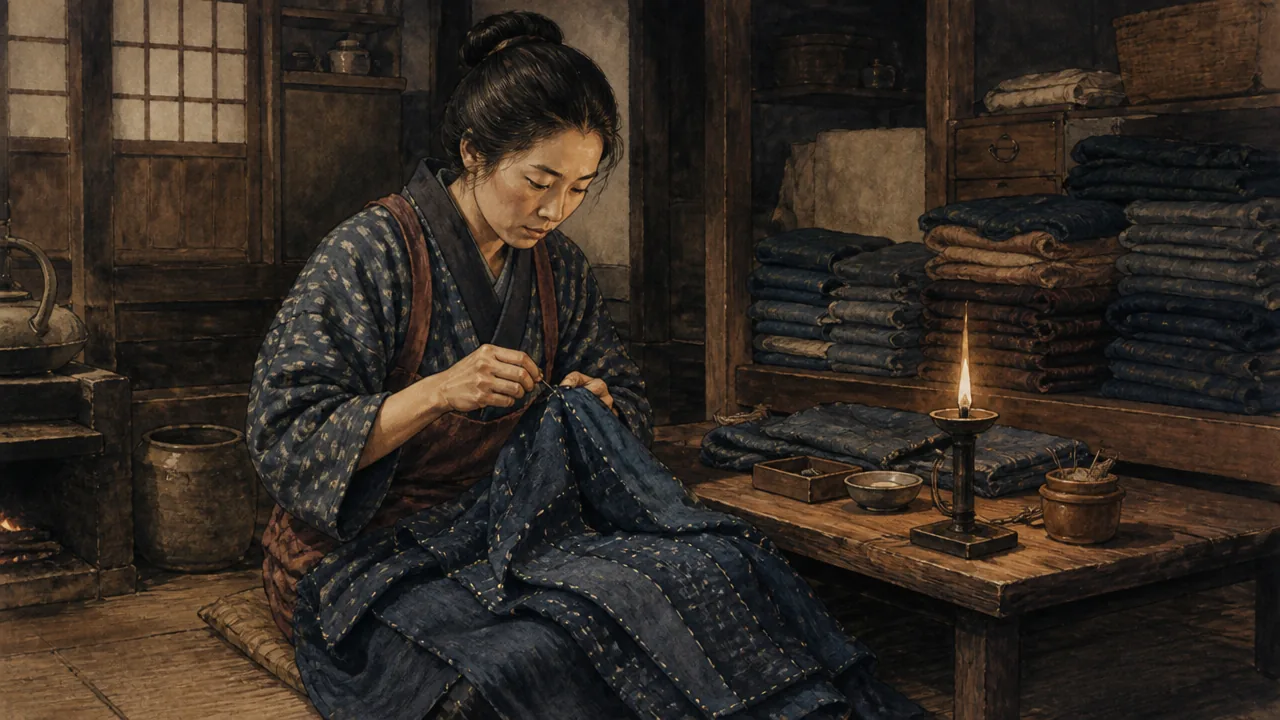
The geometric sashiko known today belongs to the cold farming and fishing communities of northern Japan (Tōhoku), where cotton cloth spread late. Aomori Prefecture explains that in the Edo period farmers in Tsugaru were not permitted to wear cotton clothing; they wore layered hemp, and cotton could be used only as thread. Women stitched cotton thread into the hemp cloth to make it warmer and stronger. Japan House London adds that the running stitches create small pockets of air between two layers of cloth, which work as insulation.
According to the Sakata City catalogue, sashiko reached its peak from the middle of the Edo period to the Meiji era. In the Shōnai area it was used on farm workwear and on fishermen’s work coats, which on Tobishima island and the Shōnai coast were called donza. Stitched cotton was also used for firefighters’ coats; the Metropolitan Museum of Art holds a sashiko jacket of indigo-dyed cotton stitched with white cotton thread, dated to the second half of the 19th century.
From the Meiji era onward, sturdy and brightly colored cotton kimono became available in Tōhoku and less sashiko was made. The Mingei (folk craft) movement of the Shōwa era brought it back to attention, and it became known across Japan. Today, the catalogue notes, sashiko is made mainly as handicraft and art.
Japan’s Three Major Sashiko Traditions
Three regional styles are often called Japan’s three major sashiko: Tsugaru kogin-zashi and Nanbu hishizashi from Aomori Prefecture, and Shōnai sashiko from Yamagata Prefecture. In March 2026, Aomori Prefecture selected the sashiko techniques of Tsugaru and Nanbu as intangible folk cultural properties for which records should be made.
- Tsugaru kogin-zashi (Aomori, west): handed down in the former Tsugaru domain, centered on Hirosaki. White cotton thread is stitched into indigo-dyed hemp cloth by counting an odd number of warp threads, and the basic unit pattern, called modoko, is a vertical diamond.
- Nanbu hishizashi (Aomori, east): handed down in the former Nanbu domain, centered on Hachinohe, and dating back about 200 years. It picks up an even number of warp threads, and its unit patterns, called katako, are horizontal diamonds, with motifs such as ume no hana (plum blossom) and kiji no ashi (pheasant’s foot).
- Shōnai sashiko (Yamagata): about 40 basic stitches, including kome-zashi, uroko-zashi, hishi-zashi and soroban-zashi, stitched in white on indigo with wishes for good harvests, big catches, good business and family health. Kome-zashi takes the shape of the character 米 (rice) and expresses a wish for a good harvest; uroko-zashi, like fish scales, was passed down in fishing villages; soroban-zashi, like an abacus, is described as representative of Shōnai sashiko.
Kogin-zashi and hishizashi are both counted-thread work on hemp, which is why they look different from the line patterns most beginners start with. Both were designated traditional crafts of Aomori Prefecture in March 1996, and today they are also worked on cotton or wool: kogin-zashi for drawstring pouches, obi sashes, bags and ties, and hishizashi for table cloths, aprons, noren curtains and bags, as well as newer products such as ties and tapestries.
In Shōnai, the Hirata Sashiko group was founded in 1983 by seven members of a dyeing circle who were moved by old Shōnai sashiko workwear; according to Yamagata Prefecture’s craft site, its classes have taught more than 400 students. The Sakata catalogue lists further Shōnai stitches, including kaki-no-hana-zashi, which resembles the flower and calyx of the local persimmon, and ya-no-hane-zashi, a stylized arrow feather.

The Stitches and Patterns: From Running Stitch Basics to Named Geometries
At its technical core, sashiko is built entirely on the running stitch — needle in, needle out, consistent spacing, consistent rhythm. What separates sashiko from ordinary hand sewing is not the stitch itself but the discipline applied to it: the stitch length, the thread tension, and the way individual lines of stitching relate to one another to build up a pattern across the fabric surface.
The stitch itself needs only a needle, thread and cloth; Best Sashiko Starter Kit 2026 compares kits by what each one includes.
Practitioners generally distinguish between two broad categories of sashiko design:
- Hitomezashi (one-stitch sashiko): patterns built from individual stitches placed on a grid, where the design emerges from the overall arrangement rather than from continuous lines of stitching.
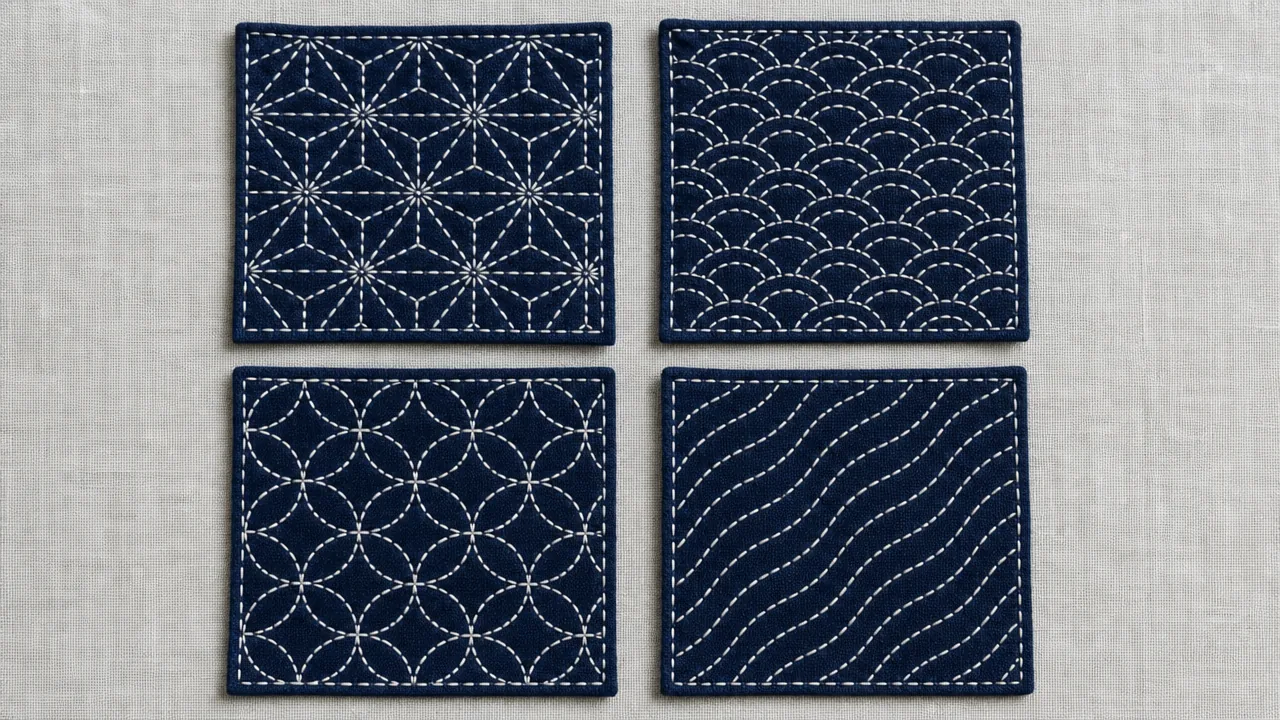
- Moyozashi (pattern sashiko): patterns formed by continuous lines of running stitch that trace out larger geometric motifs. This is what most beginners encounter first. Traditional Sashiko Patterns shows seven of these patterns, with printable sheets.

Many traditional patterns carry a meaning. Olympus, a long-established Japanese sashiko thread maker, explains these:
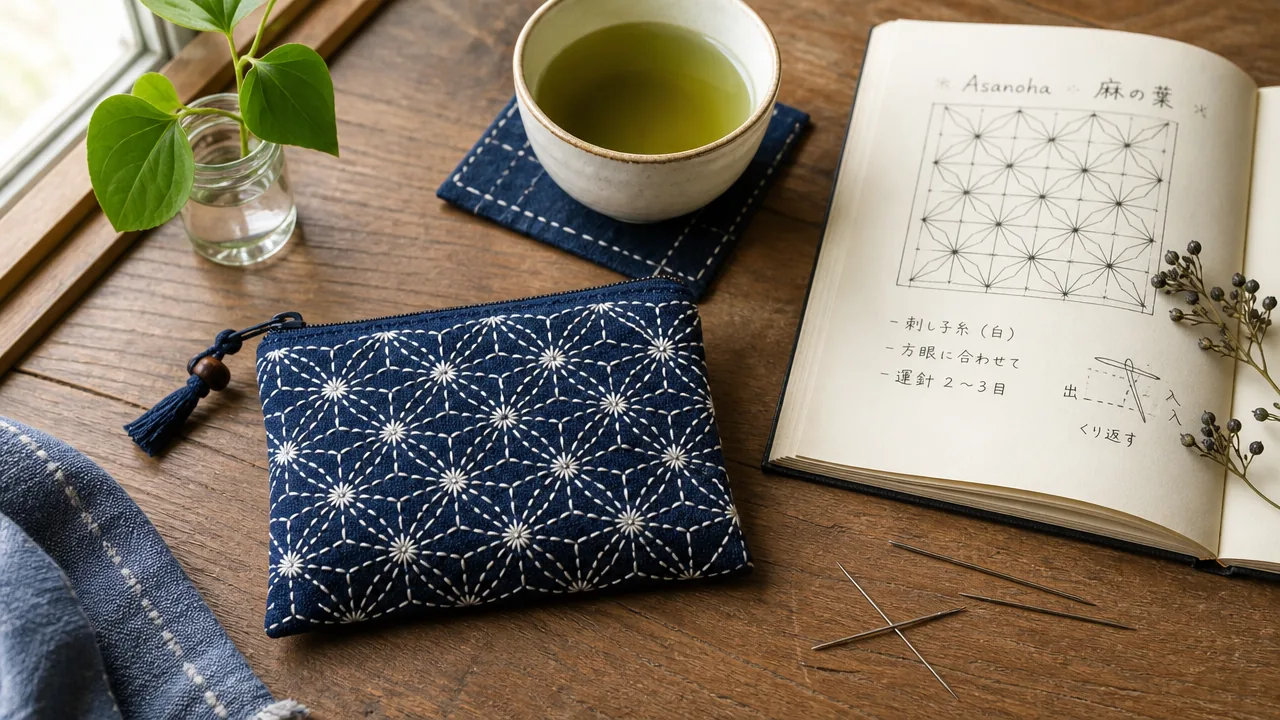
- Asanoha (hemp leaf): a wish that a child grows straight and strong like hemp and lives connected with many people; it was used for babies’ clothing.
- Tobi-asanoha: a variation of asanoha made of straight lines based on regular hexagons.
- Seigaiha (blue-ocean waves): the swell of the sea; the pattern is also used on the costume of the court dance Seigaiha and is counted among auspicious patterns.
- Shippō-tsunagi (linked seven treasures): interlocking circles that stand for endless peace and harmony; as an auspicious motif for “the treasures of the world” and endless prosperity of descendants, it was used on family crests and the backing paper of folding screens.
- Kaku-shippō (square seven treasures): named after the seven treasures listed in a Buddhist sutra: gold, silver, lapis lazuli, crystal, giant clam shell, coral and agate.
- Jūji-tsunagi (linked crosses): literally a chain of crosses; stitching diagonally in steps from the edge lets you keep the thread continuous.
- Sayagata: a lattice of broken interlocking swastikas, named after the saya silk imported in the Edo period, whose woven ground used this pattern.
- Hoshiami (drying nets): crossing curves that resemble fishing nets hung out to dry.
- Fundō-tsunagi: linked shapes of the old balance weight (fundō), made by turning the same curve in different directions.
- Hanazashi (flower stitch): a continuous curved pattern that looks like flowers in full bloom.
- Yabane (arrow feathers): derived from ceremonial arrows that ward off evil.
- Nowaki: named after the wind that parts the grasses of the fields.
Sashiko vs Embroidery (and Boro)
Olympus describes sashiko as a traditional Japanese form of embroidery that draws lines with white thread on indigo cloth, but its roots are different from purely decorative embroidery: it grew out of everyday needs, as a way to add warmth and strength to clothing. It is built on the simple running stitch, and traditionally two layers of cloth were stitched together; today, when sashiko is mostly a handicraft, it is often worked on a single layer.
Cotton thread is standard. Dedicated sashiko thread is the usual choice, although Olympus notes that colorful six-strand (No. 25) embroidery floss can also be used. Boro is a related but different thing: it refers to the patched and layered textiles themselves, which sashiko stitching often held together. Sashiko vs Boro explains the difference in detail.
Sashiko in the Modern World: Mending, Home Goods, and Community Projects
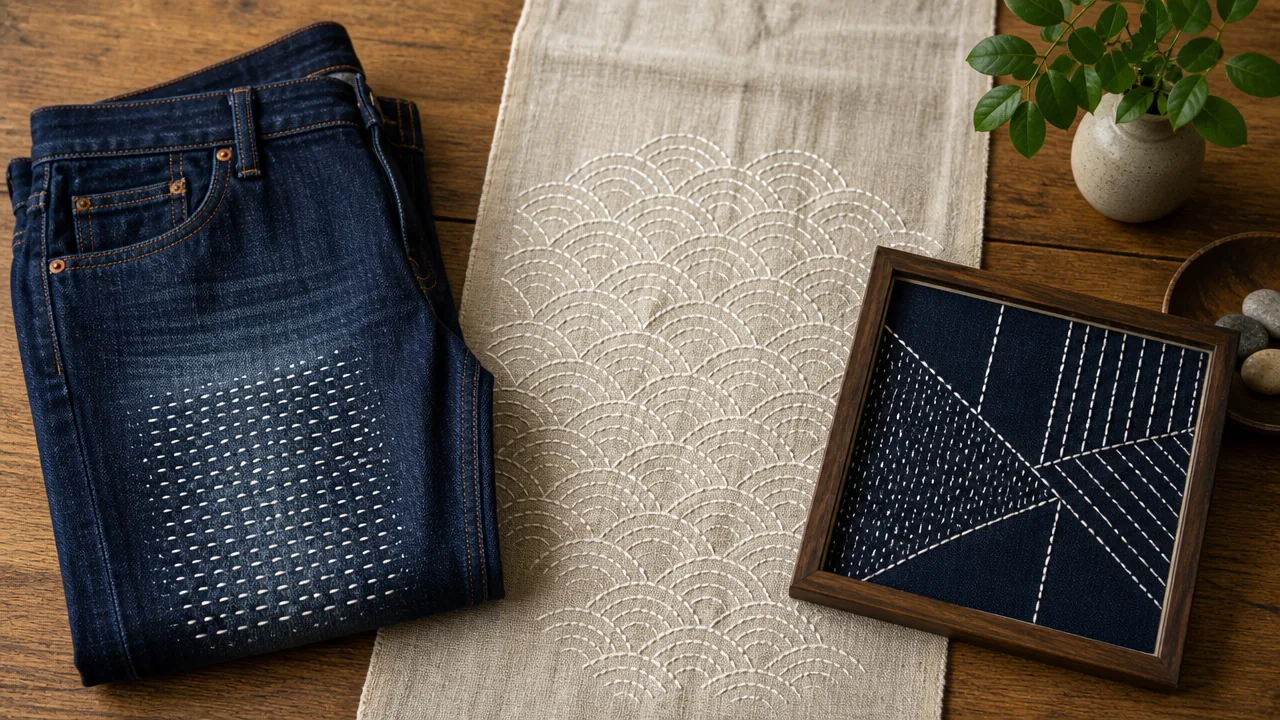
Traditional sashiko patterns now appear on hana-fukin (decorative dishcloths), cushions and bags, and Olympus notes that quilt patterns and original designs are worked in sashiko too. Because the technique is a simple running stitch, Olympus adds, it is also enjoyed by older people as a form of rehabilitation. Olympus itself began selling sashiko thread and sashiko kits in 1979. The same running stitch is used for visible mending, where a worn area is backed with cloth and stitched over so that the repair becomes part of the design; our guide to sashiko for clothing repair shows how, and Best Sashiko Thread for Beginners covers the thread.
Sashiko has also become part of community recovery. After the 2011 earthquake and tsunami in northeastern Japan, older women in Ōtsuchi, Iwate Prefecture, who could not do heavy physical work started the Ōtsuchi Reconstruction Sashiko project, needing only needles, thread and cloth; the Otsuchi Sashiko brand grew out of it, according to Japan House London.
Getting Started: What You Need
The material list is short, and the right basics make the first piece easier:
- Needle: Olympus recommends a dedicated sashiko needle with a large eye; blunt cross-stitch needles are not suited to sashiko. Our guide to sashiko needles compares four packs from Japanese makers by length and eye.
- Thread: cotton is standard. Olympus suggests thin thread for thin fabric and thicker thread for heavier fabric. Our guide to sashiko thread for beginners compares the main options.
- Fabric: tightly woven cotton with some body suits sashiko; indigo cotton was traditional. See the best fabric for sashiko for choices by price.
- Thimble: useful for thick cloth or long needles, according to Olympus.
- Marking tools and patterns: a water-soluble chalk pencil or chalk paper for transferring designs, and a pattern source; sashiko pattern books collect traditional designs with templates.
If you would rather start with everything in one box, a sashiko starter kit bundles needles, thread and pre-printed cloth.
For the stitch itself, Olympus advises keeping the stitches even, stitching straight lines as long as you can before pulling the needle through, and on curves pulling through every two or three stitches and smoothing the thread along the line. How to Sashiko Stitch walks through it step by step. A few more points from Olympus’s guide:
- Stitch proportions: make the stitches on the front slightly longer than those on the back, about 3:2, and a little smaller when the pattern is small.
- Thread length: about 50 cm is easy to work with; much longer thread tends to fuzz.
- Preparing the skein: sashiko thread comes in a skein. Tie it in two places, cut through the loop at one tie, and pull out one strand at a time.
- Threading: fold the thread end over the needle, pinch it flat, slide the needle out and push the fold through the eye.
- Starting and finishing: start a few stitches ahead on the back with small stitches and stitch back over them; finish on the back by catching only the fabric with three small stitches.
- Thimble: wear a plate thimble on the inside of the middle finger, rest the end of the needle in its hollow, and move the needle with the thumb and middle finger.
- Carrying thread: when the piece will be lined, the thread can be carried across the back for up to about 3 cm without cutting it.
Frequently Asked Questions
What does the word sashiko mean?
It comes from the verb sasu (刺す), “to pierce” or “to stitch through”. Japanese dictionaries describe sashiko as cloth layered and stitched closely together, used for items such as firefighters’ coats and judo and kendo uniforms.
Why did sashiko develop in northern Japan?
Aomori Prefecture explains that in the Edo period farmers in Tsugaru were not permitted to wear cotton clothing; they wore layered hemp, and women stitched cotton thread into the hemp cloth to make it warmer and stronger. Japan House London adds that the running stitches create small pockets of air between two layers of cloth, which work as insulation.
What are Japan’s three major sashiko traditions?
Tsugaru kogin-zashi and Nanbu hishizashi, both from Aomori Prefecture, and Shōnai sashiko from Yamagata Prefecture. Kogin-zashi and hishizashi are counted-thread work on hemp, which is why they look different from the line patterns most beginners start with.
What does the asanoha pattern mean?
Olympus, a Japanese sashiko thread maker, explains asanoha (hemp leaf) as a wish that a child grows straight and strong like hemp and lives connected with many people; it was used for babies’ clothing.
Is sashiko the same as embroidery?
Not quite. Olympus describes sashiko as a traditional Japanese form of embroidery, but its roots are practical: it grew out of the need to add warmth and strength to clothing. It is built on the simple running stitch, and traditionally two layers of cloth were stitched together.
What do you need to start sashiko?
A dedicated sashiko needle with a large eye, cotton sashiko thread, tightly woven cotton fabric, and a water-soluble chalk pencil or chalk paper for marking the pattern. A thimble helps with thick cloth or long needles, according to Olympus.
Related Sashiko Guides
- How to Sashiko Stitch: A Beginner’s Step-by-Step Guide
- Best Sashiko Starter Kit 2026: Top Picks by Skill Level
- Best Sashiko Thread for Beginners: Top Picks and Buying Guide
- Best Sashiko Fabric: What to Look For and Top Picks by Price
- Best Sashiko Pattern Books
- Boro vs Sashiko: What’s the Difference?
- Sashiko for Clothing Repair: A Practical Guide
- Sashiko Thread Colors: What They Traditionally Mean
Sources
- Kotobank: 刺子 (sashiko) and 刺す (sasu) (Japanese dictionaries)
- Sakata City Museum, exhibition catalogue 184: Shōnai dyeing and weaving (PDF, Japanese)
- Aomori Prefecture: Sashiko techniques of Tsugaru and Nanbu (Japanese)
- Aomori Prefecture: Kogin-zashi and Nanbu Hishizashi
- Yamagata Furusato Crafts: Shōnai sashiko (Japanese)
- Olympus Thread: Sashiko basics (introduction, thread, fabric and needles, how to stitch, traditional patterns; Japanese)
- Olympus Thread: Company profile
- Japan House London: Sashiko – reviving communities through Japanese embroidery
- The Metropolitan Museum of Art: Sashiko Jacket