How this article was made: Research-based comparison. It draws on published information from makers, retailers, and reference sources, not on hands-on testing.
- The Short Answer: Which Japanese Knife Roll or Case to Buy
- Why Japanese Knives Need Proper Storage and Carrying Cases
- Types of Japanese Knife Rolls and Storage Cases
- Price Comparison: Top 3 Japanese Knife Rolls and Cases in 2026
- Each Product in Detail
- How to Choose the Right Knife Roll or Case
- Frequently Asked Questions
- Can I use a regular knife roll for Japanese knives, or do I need a special one?
- How do I keep my knives from sliding out of the pockets during transport?
- Are these cases suitable as gifts for Japanese knife enthusiasts?
- How do I clean and care for a canvas knife roll?
- What is the best Japanese knife roll?
- What size knife roll do I need?
- Final Verdict: Which One Should You Buy?
The Short Answer: Which Japanese Knife Roll or Case to Buy
For a small kit of up to about four knives with blades no longer than 240 mm, this guide suggests the Tojiro Canvas Knife Pocket F-359 ($25.40), because it is the lowest-priced of the three, weighs about 235 g according to its listing, and is Tojiro’s own roll, made in Japan according to the retailer. If you carry up to six knives, the Yoshihiro Cotton Knife Pouch, 6 Slots ($59.99) has six slots. If your knives stay at home, a wooden saya such as the Yoshihiro Magnetic Oak Wood Saya Cover for Gyuto 210mm ($31.99) covers one 210 mm gyuto with a blade up to 52 mm tall and 4 mm thick.
Before you order, check the blade length of your longest knife: the Tojiro listing gives a 240 mm limit, while the Yoshihiro pouch listing gives only its overall size (28 x 22 inches), not a maximum blade length. Prices on Amazon.com, checked October 27, 2026; all three were in stock (the Yoshihiro pouch showed only 13 left).
Why Japanese Knives Need Proper Storage and Carrying Cases
Japanese knives are precision tools with thin, hard blades that chip and corrode far more easily than their Western counterparts — storing them loose in a drawer or wrapping them in a dish towel simply is not good enough. A dedicated knife roll or hard case keeps each blade isolated, cushioned, and moisture-free, which directly extends the edge life and prevents costly accidents. If you want to go deeper on rust prevention and daily care routines, the guide on How to Store and Maintain a Japanese Knife: Preventing Rust and Chips covers everything you need to know alongside a proper storage setup.
This buying guide focuses on the carrying and storage side of the equation. Whether you are a home cook who wants a tidy solution on the countertop, a culinary student commuting to class, or a professional chef who travels with a full kit, there is a purpose-built option for you — and the three products below cover all three scenarios without breaking the bank.
Types of Japanese Knife Rolls and Storage Cases
Not all knife storage is created equal, and choosing the wrong format can be just as damaging as no storage at all. There are three well-established formats worth knowing before you buy.
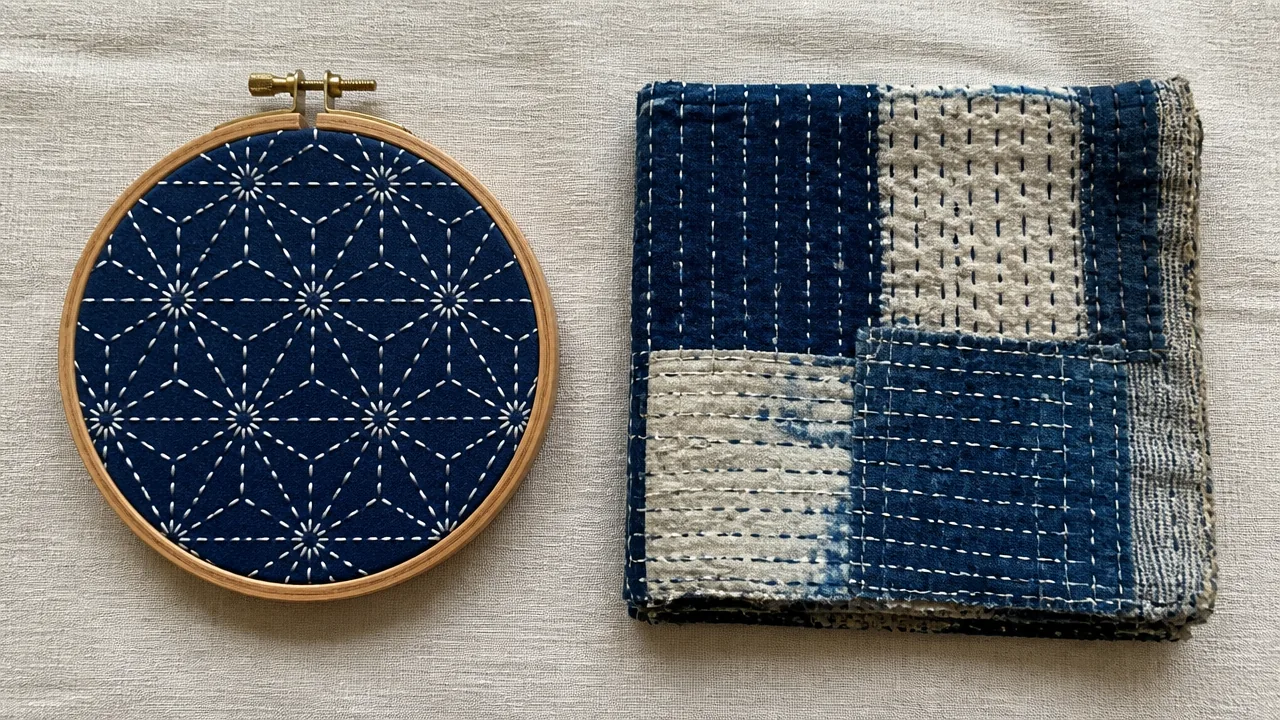
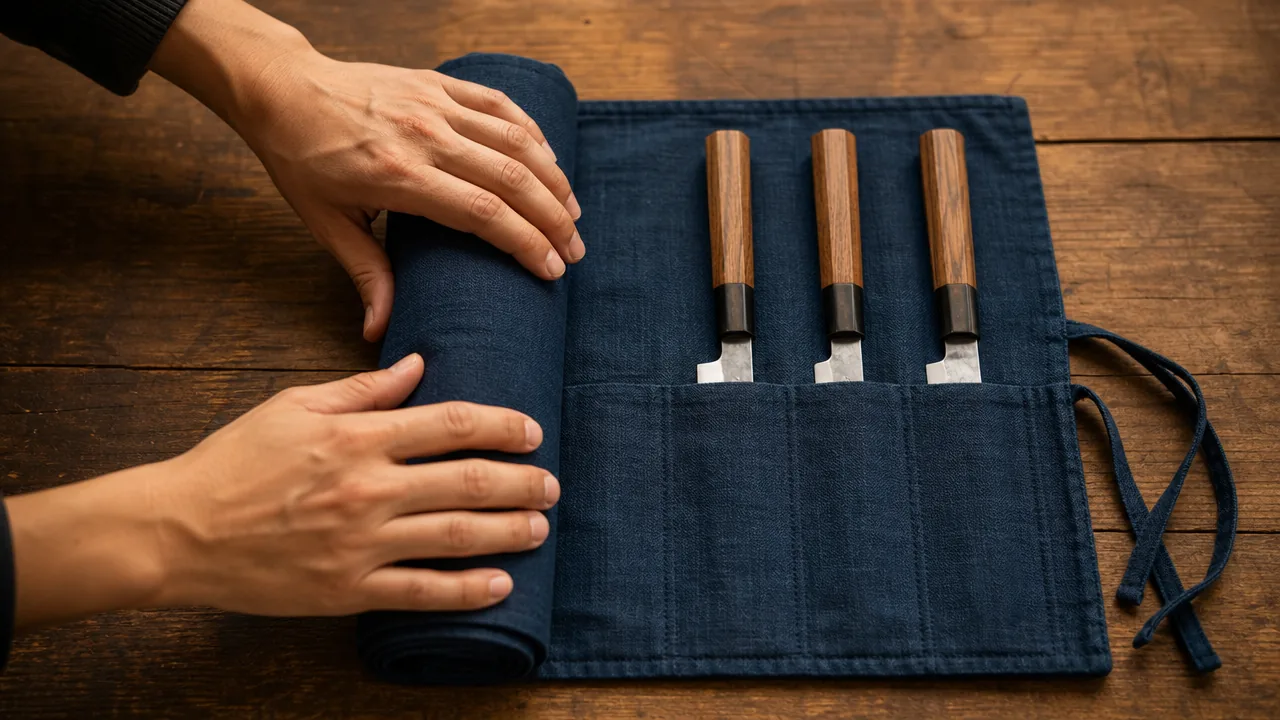
The first is the traditional Japanese-style indigo-dyed cotton and canvas knife roll. These are constructed from thick, tightly woven fabric — often dyed with traditional Japanese dyeing techniques — and feature multiple blade pockets sewn in a row. You lay the knives into the pockets, then roll the whole piece up and secure it with a long fabric cord or lace tied around the outside. The aesthetic is unmistakably Japanese. This format works well for cooks who want something lightweight.
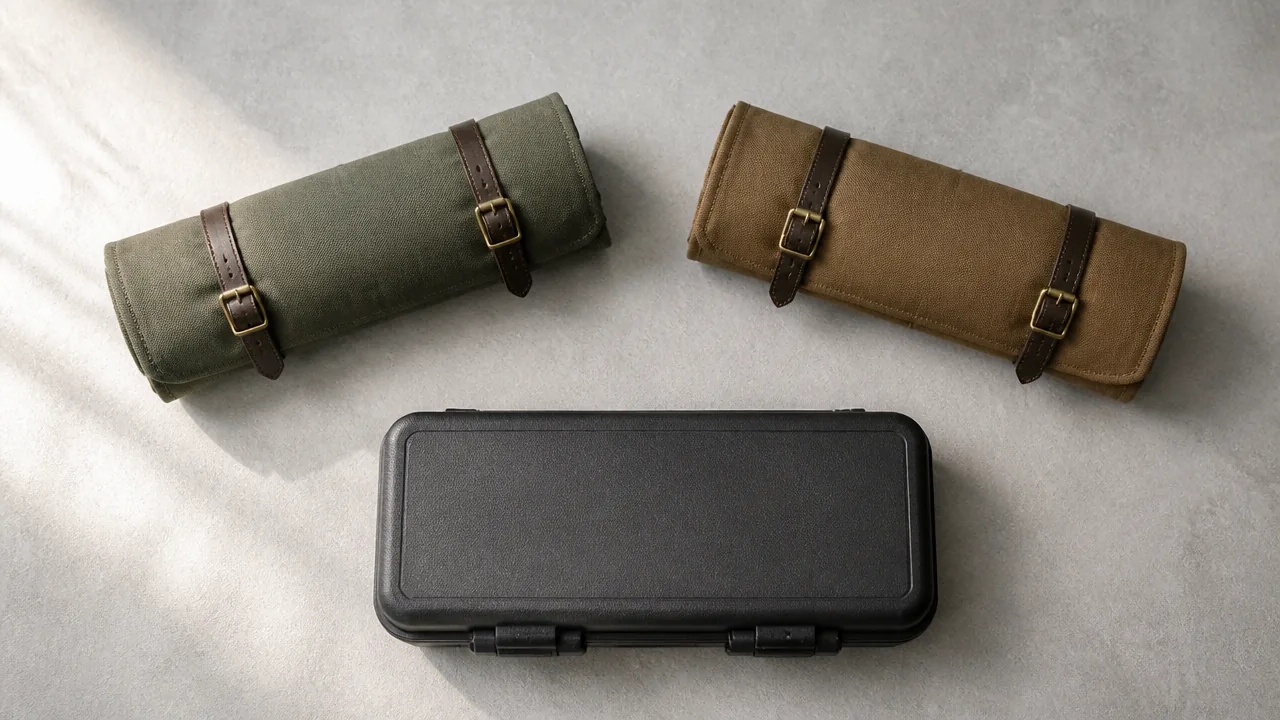
The second format is the canvas roll bag. Functionally similar to the traditional roll, but constructed in a more modern, Western-influenced style with heavier canvas and often a zippered compartment or reinforced binding. These tend to be more structured and handle repeated use on the road well.
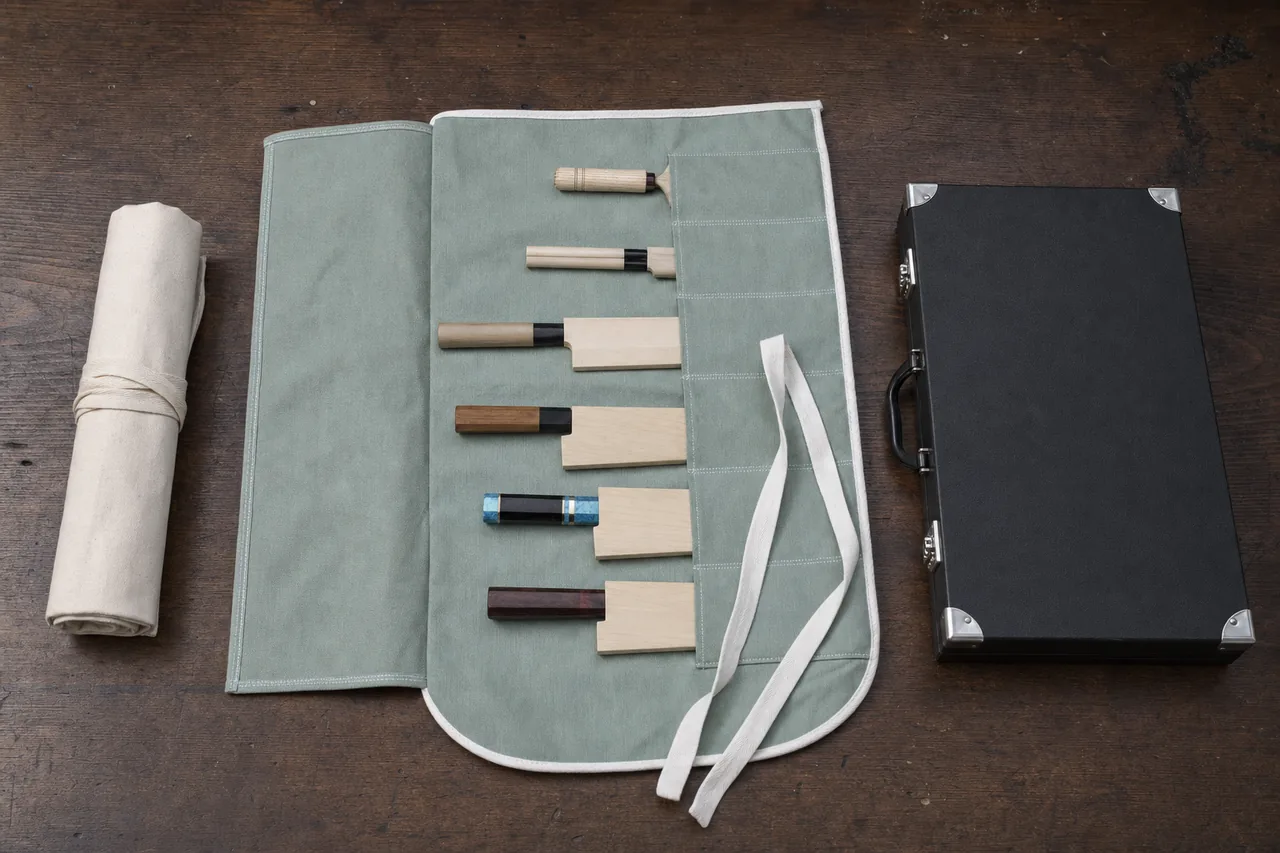
The third format is the PVC and polywood hard attache case. Unlike rolls, these open like a briefcase and hold knives in fixed, padded slots inside a rigid shell. The hard exterior offers impact protection that no fabric roll can match, and the presentation is clean enough that these cases are frequently used as gift boxes for premium knives. The trade-off is bulk and weight. This guide’s third pick is not a carrying case at all but a wooden saya (blade cover) for storing a knife at home, covered below.
Price Comparison: Top 3 Japanese Knife Rolls and Cases in 2026
The table below summarizes the three recommended products. Prices and stock were checked on October 27, 2026.
| Product | Price | # | Type | Capacity | Max Blade Length | Weight |
|---|---|---|---|---|---|---|
| Tojiro Canvas Knife Pocket F-359 | $25.40 | 1 | Cotton-blend canvas roll | About 4 knives | 240 mm | About 235 g |
| Yoshihiro Cotton Knife Pouch, 6 Slots, Olive-Green | $59.99 | 2 | Cotton roll | 6 slots | Not listed | Not listed |
| Yoshihiro Oak Saya for 210mm Gyuto | $31.99 | 3 | Wooden saya (blade cover), magnetic | 1 knife | 210 mm gyuto (blade up to 52 mm tall, 4 mm thick) | Not listed |
All three products are listed on Amazon.com; when checked on October 27, 2026, the Tojiro pocket was sold by a third-party seller and the two Yoshihiro products by Yoshihiro Cutlery. Each product link above includes an affiliate parameter — purchasing through these links supports this site at no extra cost to you.
Product images are illustrative renderings based on retailer product photos.
Each Product in Detail
Entry Pick — $25.40: Tojiro Canvas Knife Pocket F-359
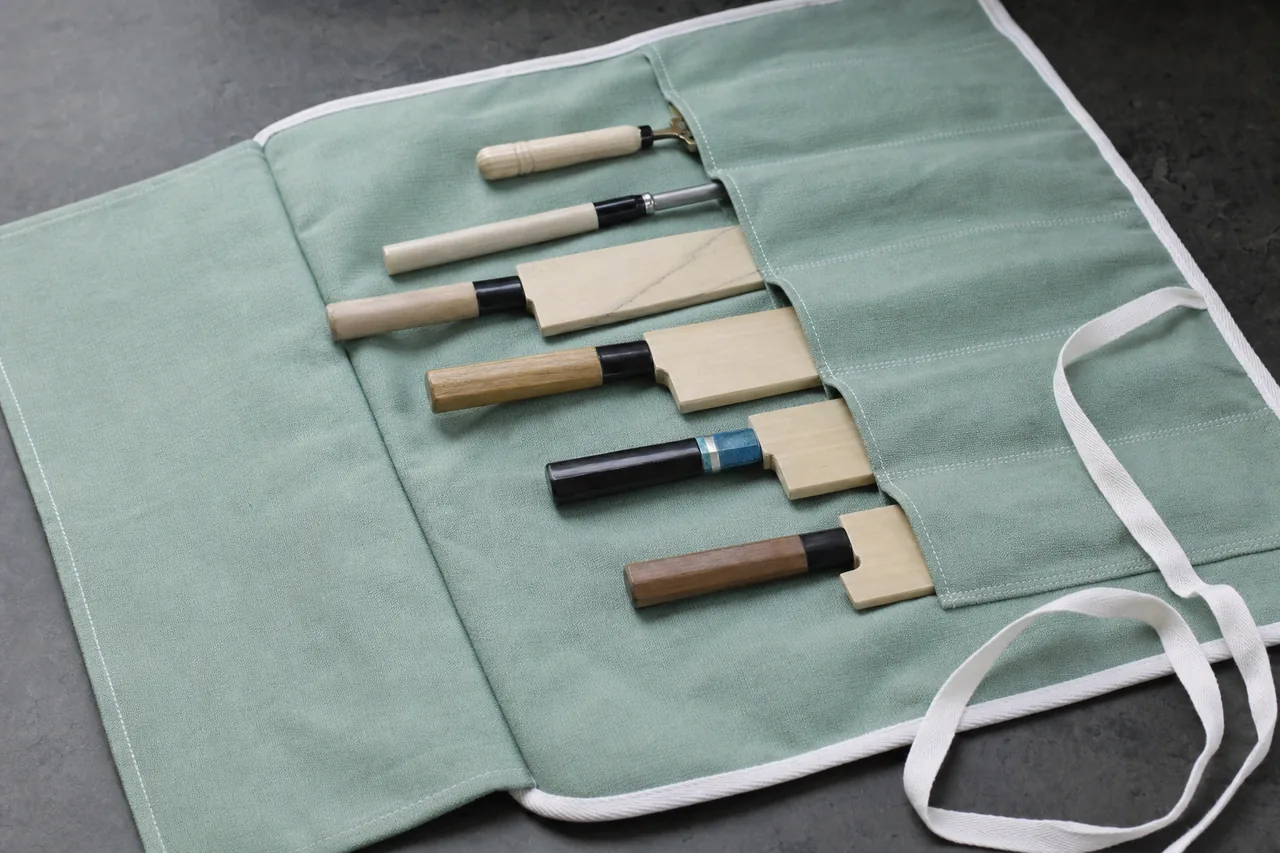
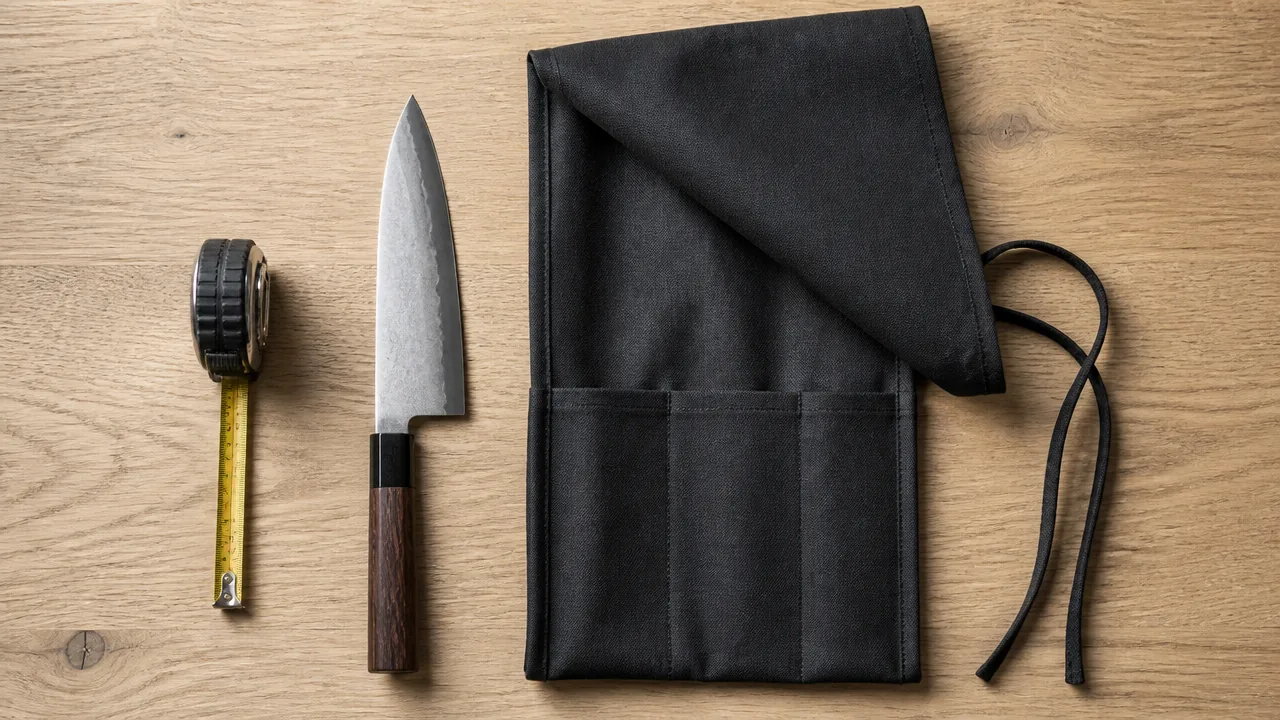
The Tojiro Canvas Knife Pocket F-359 is the simplest and lightest option of the three. Tojiro is one of Japan’s largest kitchen knife makers, and this is its own carrying roll: a cotton-polyester canvas pocket that the listing gives as about 21.5 x 17.3 inches (roughly 545 x 440 mm) and about 235 g, with the country of manufacture given as Japan (per retailer). According to the listing it takes knives up to 240 mm, including a gyuto, a slicer, a yanagiba, and a shorter 165 mm blade, which covers a typical home or student kit. It will not take 270 mm or longer slicers. For home cooks or culinary students who want an inexpensive roll from a Japanese knife maker, this is the natural starting point.
Mid-Range Pick — $59.99: Yoshihiro Cotton Knife Pouch, 6 Slots
The Yoshihiro Cotton Knife Pouch, 6 Slots, Olive-Green is the pick for a larger kit. It is a cotton roll with six slots, listed at 28 x 22 inches (roughly 710 x 560 mm) and with Japan as the country of origin, and it is sold on Amazon by Yoshihiro Cutlery itself. The larger size gives more room than the Tojiro for longer knives, though the listing does not state a maximum blade length or a weight, so measure your longest knife against the 28-inch dimension before ordering. Knives are not included.
Home-Storage Pick — $31.99: Yoshihiro Magnetic Oak Saya for a 210mm Gyuto
The Yoshihiro Magnetic Oak Wood Saya Cover for Gyuto 210mm ($31.99 on Amazon.com, October 27, 2026; sold and shipped by Yoshihiro Cutlery) is a different kind of product from the two rolls: it is not a carrying case but a wooden blade cover (saya) for storing one knife at home, for example in a drawer. Yoshihiro’s own store describes it as oak with a magnetic closure instead of a pin, sized for a 210 mm (8.25 in) gyuto with a blade up to 52 mm tall and 4 mm thick, and states that it is made in Japan. Yoshihiro says it fits most of its own 210 mm gyuto; for other brands, check your blade’s height and thickness first. You need one saya per knife, in the matching shape and length: a gyuto saya will not fit a santoku or a petty. Note that the Amazon listing’s bullet points still describe an older magnolia version with a pin, while the title and Yoshihiro’s store describe the magnetic oak version.
How to Choose the Right Knife Roll or Case
Picking the right format comes down to five practical factors, and being honest with yourself about each one will save you from buying twice.
- Knife count and types you carry: The Tojiro pocket suits about four knives up to 240 mm. The Yoshihiro pouch has six slots and a larger footprint. The saya protects a single 210 mm gyuto, so you need one per knife.
- Portability and weight: The Tojiro pocket at about 235 g is the easiest to carry for long distances. The saya is made for storage at home rather than for carrying a kit.
- Intended use — home storage vs. travel: If your knives stay at home, a saya on each blade protects the edges in a drawer without a bulky case. If you commute with your knives, a roll format that compresses into a bag is more practical.
- Durability and cleaning: Fabric rolls are easy to spot-clean and air-dry, while a wooden saya only needs a wipe and should be fully dry before the knife goes back in.
- Budget: The gap between $25.40 and about $60 is real, but it mostly reflects capacity and format rather than one product being objectively better than another. The entry roll is not a compromise — it is just sized for a smaller kit.
If you have not yet settled on which knives to carry, the roundup of Best Japanese Gyuto Knife 2026: Top Picks by Skill Level and Budget is worth reading first, as the blade length of your chosen knives will directly determine which roll fits. For those just starting out, Best Japanese Knife for Beginners is a gentler place to start before committing to a full storage setup.
Related: Japanese Knife Blade Length Guide: Which Size Do You Need? explains the common blade lengths for each knife type, which helps when you check a roll’s maximum blade length.
Frequently Asked Questions
Can I use a regular knife roll for Japanese knives, or do I need a special one?
You can use any roll that keeps each blade fully isolated and does not allow knives to knock against one another — that is the core requirement. That said, Japanese knives tend to have longer, thinner blades than Western knives, so checking the maximum blade length and pocket depth before buying is important. The products covered here all come from Japanese knife brands, so they are sized with Japanese blades in mind.
How do I keep my knives from sliding out of the pockets during transport?
For roll-style cases, rolling or folding tightly and securing the ties snugly is usually sufficient — the friction of the fabric and the compression of the roll hold the blades in place. The Yoshihiro saya holds its knife with a magnet rather than a pin, but it is meant for storage at home rather than as a travel case. If you are carrying exceptionally heavy knives or expect rough handling, adding a thin blade guard over each edge before rolling provides an extra layer of security.
Are these cases suitable as gifts for Japanese knife enthusiasts?
Yes. The Yoshihiro cotton pouch is a good gift for someone who already owns several knives and needs a way to carry them, and a saya is a useful add-on when you give a single 210 mm gyuto, as long as the blade is within the saya’s size limits.
How do I clean and care for a canvas knife roll?
Spot-clean with a damp cloth and mild soap, then air-dry fully before putting knives back inside — residual moisture is the main enemy of both the fabric and the knife steel. Avoid machine washing unless the maker says otherwise, as it can distort the pocket shapes and weaken the stitching over time. For a wooden saya, wipe it with a dry cloth and let it dry fully before sheathing a knife. Full maintenance guidance for the knives themselves is covered in detail in How to Store and Maintain a Japanese Knife: Preventing Rust and Chips.
What is the best Japanese knife roll?
It depends on how many knives you carry. For up to about four knives with blades no longer than 240 mm, this guide suggests the Tojiro Canvas Knife Pocket F-359 ($25.40 on Amazon.com on October 27, 2026), because it is the lowest-priced roll here and is Tojiro’s own roll, made in Japan according to the retailer. If you carry up to six knives, the Yoshihiro Cotton Knife Pouch, 6 Slots ($59.99) has six slots, though its listing does not give a maximum blade length.
What size knife roll do I need?
Count your knives and check the blade length of the longest one. The Tojiro pocket takes about four knives with blades up to 240 mm, according to its listing, so a 270 mm or longer slicer will not fit. The Yoshihiro pouch has six slots and measures 28 x 22 inches, but its listing does not give a maximum blade length, so check that your longest knife will fit before ordering, or ask the seller.
Final Verdict: Which One Should You Buy?
All three products covered here solve the same core problem — protecting Japanese knife edges during storage and transport — but they do so in ways that suit quite different users.
The Tojiro Canvas Knife Pocket F-359 at $25.40 is the pick in this guide for a small kit, because it is the lowest-priced of the three, light, made in Japan (per retailer), and sized for knives up to 240 mm.
The Yoshihiro Cotton Knife Pouch at $59.99 is the one to choose when you carry more knives and want a roomier roll with six slots.
The Yoshihiro Magnetic Oak Wood Saya Cover for Gyuto 210mm at $31.99 is the right call when your knives stay at home and you want each edge protected in a drawer; it covers one 210 mm gyuto, so buy one per knife.
Whichever you choose, pairing a quality storage case with the right knife care habits makes a meaningful difference to how long your edges stay sharp and chip-free.
Which format suits your setup best — the light canvas pocket, the six-slot cotton roll, or a wooden saya for home storage? Our other guides can help you find the right knives to fill whichever case you choose.