This article contains affiliate links. If you buy through them, we may earn a commission at no extra cost to you.
How this article was made: Research-based comparison. It draws on published information from makers, retailers, and reference sources, not on hands-on testing.
In brief: for a bowl or cup you will eat or drink from, use urushi lacquer with genuine gold powder. For a piece that will only be displayed, a two-part epoxy with brass powder costs far less and is finished sooner. New to the craft? Start with What Is Kintsugi?
Quick picks
- Black urushi for Kintsugi (Chimahaga) — $17.50 / 5g: urushi for the undercoat layers of a traditional repair
- PC Products PC-Clear Epoxy — $7.06: for decorative pieces only; do not use it on tableware
- Chimahaga Genuine Gold Powder 0.1g — $49.80 / 0.1g: genuine gold powder; the smaller pack
Prices on Amazon.com, checked October 4, 2026.
- The Short Answer: What Is Kintsugi Glue?
- Why Buy Kintsugi Adhesive and Gold Powder Separately?
- Which Glue for Which Piece?
- Urushi Lacquer vs. Epoxy: How to Choose Your Adhesive
- Gold Powder Grades: Brass, Alloy Gold, and Why It Matters
- Recommended Products at a Glance
- Product Details: What Each Item Actually Offers
- Using a Repaired Piece
- Frequently Asked Questions
- Closing Thoughts
- Sources
The Short Answer: What Is Kintsugi Glue?
Kintsugi glue is urushi lacquer, not a gold-coloured adhesive. In a traditional repair the pieces are joined with mugi-urushi, a thick urushi mixture that Chimahaga says takes about a week to harden. The gold is a separate material: a powder applied to the lacquered seam at the finishing stage. How to Do Kintsugi at Home: Step-by-Step sets out each stage as two Japanese kit makers describe it.
- For tableware: urushi, finished with genuine gold powder. Chimahaga says natural urushi can be used for repairing tableware. The whole repair takes about a month (Chimahaga), and two to three months is very common (Tsugu Tsugu)
- For display pieces: a two-part epoxy sets in hours and can be finished with brass powder. Chimahaga states that most commercially available adhesives are not suitable for use on tableware, so keep an epoxy to pieces that will not hold food or drink unless its product page names the food-contact standard it meets
Why Buy Kintsugi Adhesive and Gold Powder Separately?
If you already own a starter kit and know which step you want to improve, buying the adhesive and the powder on their own lets you choose each material for the piece in front of you, and you pay only for what you need. If you are still deciding between kit styles, read Kintsugi Kit for Beginners: Authentic Urushi vs Synthetic Resin first.
Which Glue for Which Piece?
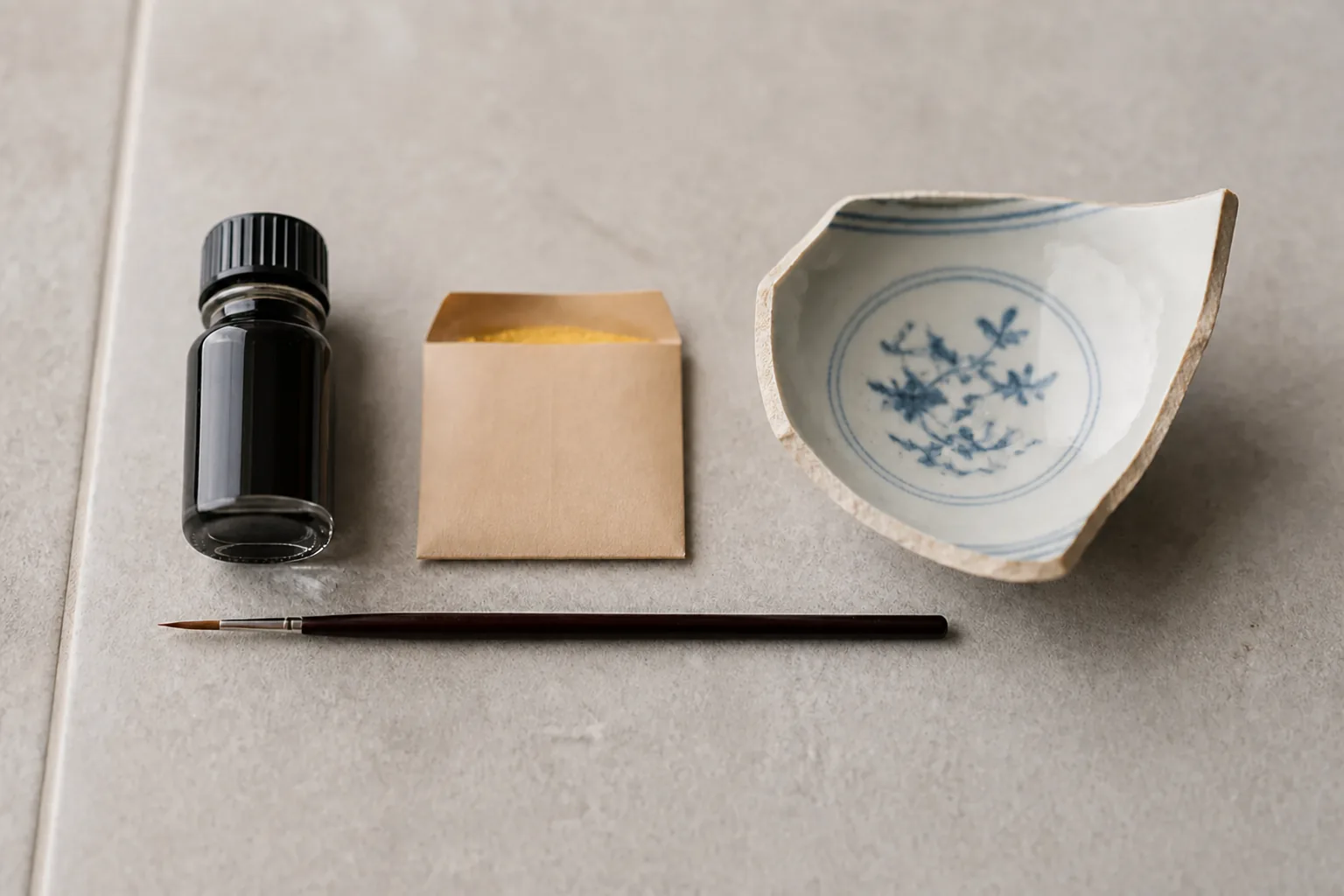
| The piece | Adhesive | Powder | Time | Keep in mind |
|---|---|---|---|---|
| Tableware you will eat or drink from | Urushi lacquer | Genuine gold powder | About a month (Chimahaga); two to three months is very common (Tsugu Tsugu) | Wait about a month after finishing before use; no dishwasher or microwave |
| A piece for display only | Two-part epoxy, or urushi | Brass powder, or genuine gold | Epoxy: hours to a day, depending on the product | Not for food or drink |
| Glass | Urushi | Genuine gold powder | As for tableware | Tsugu Tsugu says kintsugi on glass requires advanced skills; see Can You Use Kintsugi on Glass? |
Timings are from Chimahaga and Tsugu Tsugu, two Japanese makers of urushi kintsugi kits. The details are in the next section.
Urushi Lacquer vs. Epoxy: How to Choose Your Adhesive
The adhesive you choose shapes the entire repair—its working time, its durability, and how it behaves under heat or humidity.
Urushi lacquer is the traditional material for kintsugi. Chimahaga notes that natural urushi was originally used to join bowls and can be used for repairing tableware. The tradeoff is time, because urushi does not dry without humidity:
- Temperature and humidity: Chimahaga says curing proceeds best at 25°C and around 75% humidity; Tsugu Tsugu gives 20 to 25°C (68–77°F) and around 70 to 80% humidity.
- Each layer: Chimahaga says black urushi used for a first coat takes 8 hours at the earliest, and the thicker mugi-urushi glue about a week. Tsugu Tsugu says one layer usually takes a few days to a week to dry completely.
- The whole repair: about a month (Chimahaga); two to three months is very common (Tsugu Tsugu).
- Before you use the piece: Chimahaga says not to use it for a month after the repair is complete, and Tsugu Tsugu recommends waiting at least one month.
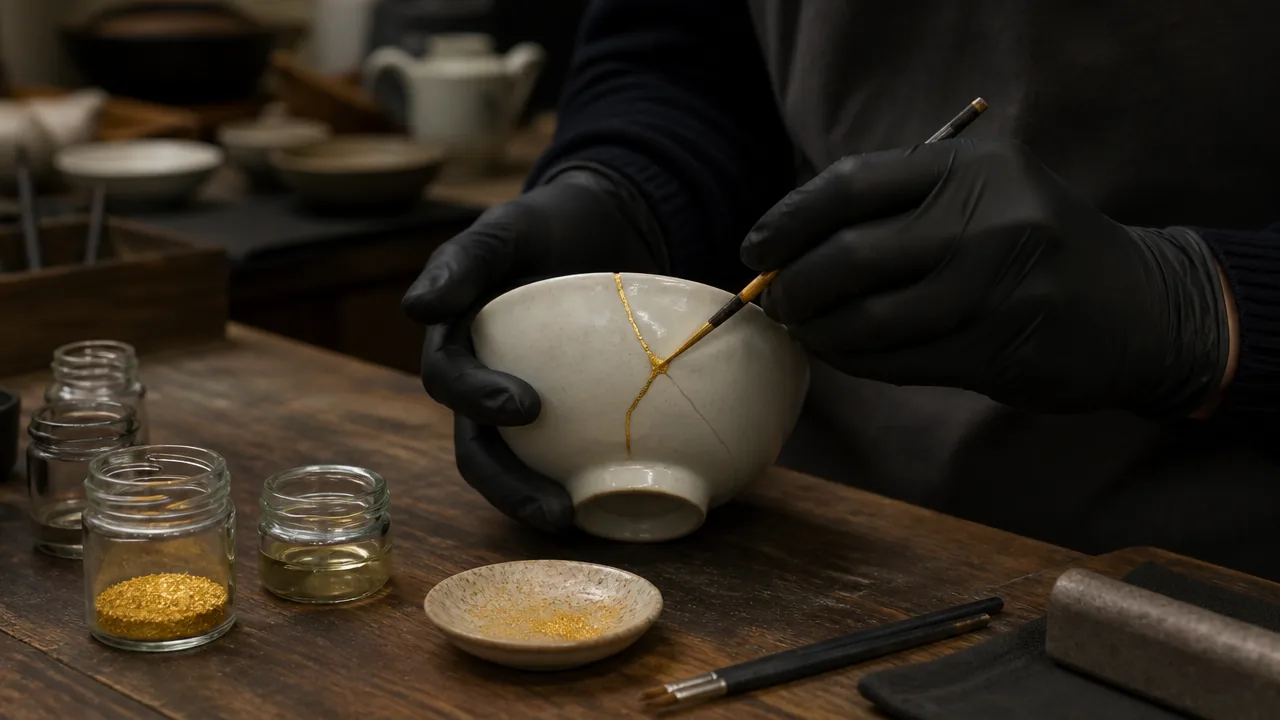
Raw urushi also contains urushiol, which can cause a skin reaction similar to poison ivy in people who are sensitive. First-time urushi users should wear nitrile gloves and work in a ventilated space.
Epoxy adhesives set in hours rather than weeks and are far more forgiving for beginners who are working on decorative pieces. Food use is a different matter. Chimahaga states that most commercially available adhesives are not suitable for use on tableware, and adds that even adhesives that conform to Japan’s Food Sanitation Law often lack strength and heat resistance. Tsugu Tsugu describes kits based on synthetic glues as not food safe. So read what the product page actually says. A seller calling a product “food-safe” is not the same as naming the food-contact standard it meets, and if the page names no standard, do not use the adhesive on bowls or cups that will hold food or drink. For a thorough breakdown of how these two adhesive philosophies differ in practice, see Authentic Kintsugi Kit vs Synthetic Resin Kit: What Really Differs?
In short:
- Choose urushi if the piece will hold food or drink, or if you want the traditional method and can wait a month or more
- Choose epoxy if you are working on a decorative object and want it finished sooner
- Do not use an epoxy on tableware unless its product page names the food-contact standard it meets
Gold Powder Grades: Brass, Alloy Gold, and Why It Matters
Gold powder in kintsugi is not simply decorative—it is the material that defines the finished seam. Understanding what you are buying before you spend money is essential.
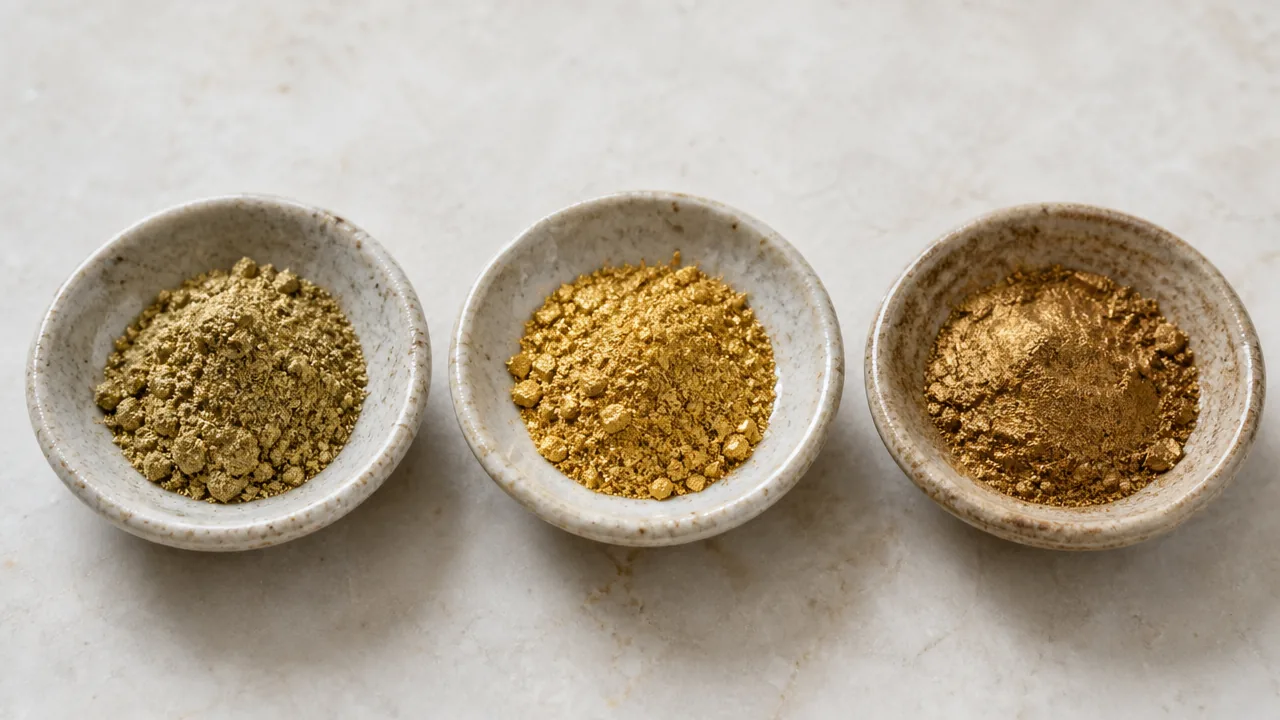
The traditional powder used in kintsugi is called keshifun (消粉), a fine matte powder made from gold alloy. It is worth knowing that authentic keshifun is not pure 24-karat gold. Historical and contemporary Japanese suppliers typically use a gold-silver-copper alloy, which gives the powder its characteristic warm tone and workability. This is not a compromise—it is how the craft has always been practiced.
Brass powder is the most affordable option and visually mimics gold when freshly applied. The significant downside is oxidation: brass is a copper-zinc alloy, and over time it will tarnish and shift color. For pieces you intend to display long-term or give as gifts, this is an important limitation to factor in. Tsugu Tsugu also describes brass as not certified as food safe, so keep brass powder to pieces that will not hold food or drink.
Genuine gold powder eliminates the oxidation problem entirely. The cost is substantially higher, but the seam will look the same in ten years as it does the day you finish the repair. If you are working on a single cherished piece, the per-repair cost of a small quantity of genuine gold powder is often more reasonable than it first appears.
Recommended Products at a Glance
The six products below were checked for availability and pricing on Amazon.com on October 4, 2026. If you are looking for complete kits rather than individual components, Best Japanese Kintsugi Repair Kits 2026: Top Picks by Skill Level and Budget covers that category in full.
| Product | Price | Tier | Best For |
|---|---|---|---|
| Black urushi for Kintsugi (Chimahaga) | $17.50 / 5g | Mid (Urushi) | Traditional undercoat layers; improving seam visibility during finishing |
| Mejiro Low-Allergenic Ki Urushi, 50g | $50.00 (out of stock, October 4, 2026) | Premium (Urushi) | Practitioners sensitive to standard urushi; larger-scale or repeated repairs |
| PC Products PC-Clear Epoxy | $7.06 | Entry (Epoxy) | Decorative pieces only; not for tableware |
| Brass Powder for Kintsugi 1g (Chimahaga) | $12.80 / 1g | Entry (Powder) | Practice repairs; temporary or low-priority decorative pieces |
| Chimahaga Genuine Gold Powder 0.1g | $49.80 / 0.1g | Mid (Powder) | Tableware and pieces you want to keep; the smaller pack |
| Chimahaga Genuine Gold Powder 1.0g | $269.00 / 1.0g | Premium (Powder) | Ongoing practice or multiple pieces; lower price per gram than the 0.1g pack |
Product Details: What Each Item Actually Offers
Adhesives
Black urushi for Kintsugi (Chimahaga) — This 5g jar of black urushi is designed specifically for the first and second undercoat layers of a traditional repair. The product description explains a practical technique: using black lacquer for the base coats makes it visibly easier to spot missed spots when you apply bengara (red iron oxide) lacquer in the finishing stage. For anyone working with the traditional multi-layer approach, this is the mid-priced adhesive on this list at $17.50.
Mejiro Low-Allergenic Ki Urushi for Kintsugi & Maki-e, 50g — Mejiro’s ki urushi uses a protein-coating process that reduces the urushiol exposure associated with standard raw lacquer, making it a meaningful option for practitioners who have experienced mild reactions in the past. It was listed at $50.00 but is currently out of stock on Amazon.com (checked on October 4, 2026); when available, the 50g jar is well suited for ongoing work. If you need urushi now, the traditional kits in Best Japanese Kintsugi Repair Kits 2026 include it. The manufacturer recommends using it within one year of purchase. Painters, ceramicists, and sword artisans are among the noted users. Low-allergenic urushi like this is a niche product that tends to sell out, so confirm current availability before planning a purchase around it.
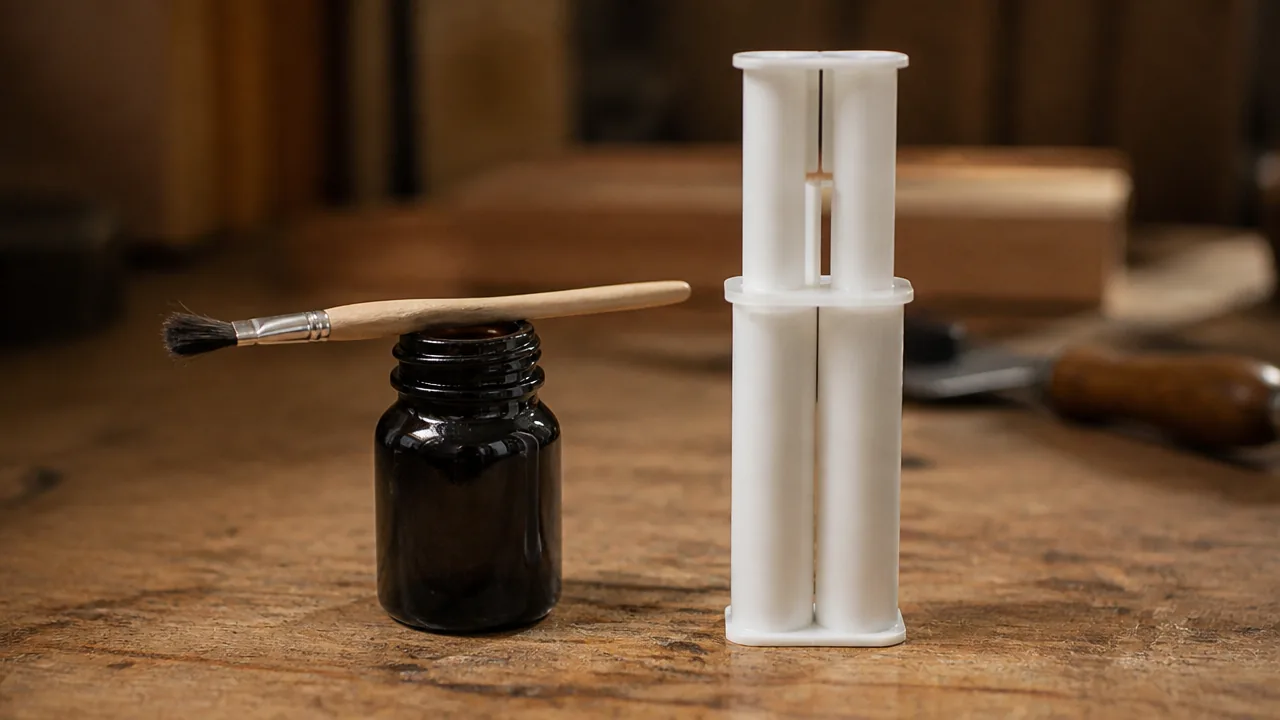
PC Products PC-Clear Epoxy Adhesive Liquid, 1oz Double Syringe — At $7.06, this is the lowest-cost entry point if you want to try kintsugi on non-food ceramics without committing to urushi. It bonds glass, ceramic, and metal with about 4 minutes of open working time and reaches handling strength in an hour. The product page does not carry any food-safe designation, so treat it as a decorative-use adhesive only. Suitable for vases, figurines, or practice pieces.
Gold Powders
Brass Powder for Kintsugi 1g (Chimahaga) — At $12.80 for 1g, brass powder is accessible for practice and experimentation. It is composed of 75% copper and 25% zinc, and Chimahaga’s own listing states clearly that it will oxidize and change color over time. This is not a hidden limitation—it is the defining tradeoff of any non-gold metallic powder. Use it freely for practice repairs or pieces where longevity is not the priority.
Also on Amazon UK.
Genuine Gold Powder 0.1g for Kintsugi (Chimahaga) — This small-quantity option at $49.80 contains 0.1g of keshifun with a declared composition of 95.79% gold, 3.53% silver, and 0.67% copper—which is consistent with how traditional Japanese gold powder has historically been formulated. Chimahaga does not say how many repairs the pack covers. For reference, its Basic kit, which includes the same 0.1g of gold powder, is described by the maker as enough for about three chipped items or one broken item. It is the pack to choose when you want lasting results on one piece that matters to you.
Also on Amazon UK / Amazon.de.
Genuine Gold Powder 1.0g for Kintsugi (Chimahaga) — The same alloy composition as the 0.1g version, scaled up to 1.0g for $269.00. That is about $269 per gram, against about $498 per gram for the 0.1g pack, and having a full gram on hand means you can work on multiple pieces or approach each repair without rationing the powder. For anyone doing kintsugi regularly rather than as a one-off project, this is the more practical option.
US readers: options from Blick Art Materials. If you are taking the epoxy route on a decorative piece, Blick Art Materials, a US art-supply retailer that only ships within the United States, stocks two common two-part epoxies: Gorilla Epoxy ($5.74, 0.85 oz) and Zap Z-Poxy 5 Minute Epoxy Formula ($15.69, 4 oz set). Neither listing describes the product as food-safe, so the rule above still applies: use them only on pieces that will not hold food or drink.
For a gold finish made with leaf instead of powder, Blick carries Mona Lisa Composition Gold Metal Leaf ($11.01, 25 sheets) and Mona Lisa Gold Leaf Adhesive ($5.15). Composition leaf is a gold-colored alloy, not pure gold, and the same food-contact caution applies to anything it is laid over.
Blick also sells mica pigments such as Jacquard Pearl-Ex in Aztec Gold ($5.03). These are craft powders that make resin look gold. They are not a substitute for the brass or genuine gold powder used in kintsugi, and they are not food-safe either. Blick ships free within the 48 contiguous US states on orders of $79 or more; smaller orders cost $9.95 to ship (as of October 3, 2026).
Also Needed: Disposable Nitrile Gloves
Raw urushi lacquer contains urushiol, the same compound behind poison ivy rashes, so it can cause an itchy skin reaction; wear disposable nitrile gloves whenever you handle it (they are a sensible precaution with two-part epoxy too), and wash any skin contact with soap and water straight away. A 100-glove box such as MedPride Powder-Free Nitrile Exam Gloves (about $9.99 on Amazon.com, October 2026; choose your size) lasts for many repairs. Also on Amazon.de. For keeping urushi, adhesives and powders between repairs, see How to Store Kintsugi Repair Supplies.
Using a Repaired Piece
A piece repaired with urushi needs gentler handling than it did before it broke. The two makers agree on the main points:
- Dishwasher and microwave: no. Chimahaga says a dishwasher may cause damage and gold to peel off, and warns of sparks from the seams in a microwave. Tsugu Tsugu rules out the microwave, dishwasher, oven and open fire.
- Washing: by hand, gently, with a soft sponge (Chimahaga).
- First use: about a month after the repair is complete (both makers).
Hot drinks and the epoxy kits are covered in more detail in Best Japanese Kintsugi Repair Kits 2026.
Frequently Asked Questions
What glue is used for kintsugi?
Traditional kintsugi uses urushi lacquer. The glue itself is a thick urushi mixture called mugi-urushi, which Chimahaga says takes about a week to harden. Simplified kits replace it with a synthetic adhesive such as two-part epoxy, which sets in hours and is a practical choice for vases and display pieces. Tableware is different: Chimahaga states that most commercially available adhesives are not suitable for use on tableware, so unless the product page names the food-contact standard the adhesive meets, keep it to decorative pieces. The product page for the PC-Clear epoxy in this guide carries no food-safe statement.
How much gold powder do I need for one repair?
Chimahaga does not state how many repairs its powder packs cover. As a reference point, the maker describes its Basic kit, which includes 0.1g of genuine gold powder, as enough for about three chipped items or one broken item. A large break, or a piece in many fragments, will need more.
What is the difference between brass powder and genuine gold powder in kintsugi?
Visually, they look similar when freshly applied. The difference emerges over time. Brass is a copper-zinc alloy that oxidizes—the seam will eventually shift from gold to a darker, more brownish tone. Genuine gold powder (keshifun) is a stable gold-silver-copper alloy that does not oxidize, so the seam retains its appearance indefinitely. For a piece you want to keep or give as a gift, genuine gold powder is the more honest long-term investment.
Is urushi lacquer safe to use at home?
Urushi can cause a skin reaction (urushiol contact dermatitis) in people who are sensitive to it—the same compound found in poison ivy. This does not mean it is unusable at home, but precautions matter: always wear nitrile gloves, work in a ventilated space, and avoid touching your face. The Mejiro low-allergenic urushi in this guide uses a protein-coating process intended to reduce this risk, which makes it a more approachable option for home practitioners who have had mild reactions before.
Is there a gold glue for kintsugi?
Not in the traditional method. The glue is urushi lacquer, and the gold line comes from gold powder applied to the lacquered seam at the finishing stage. Brass powder gives a similar colour for less, but brass oxidizes over time and Tsugu Tsugu describes it as not certified as food safe.
How long does kintsugi glue take to dry?
Chimahaga says mugi-urushi, the urushi glue, takes about a week to harden, and black urushi used for a first coat 8 hours at the earliest. Tsugu Tsugu says one layer usually takes a few days to a week to dry completely. A two-part epoxy sets in hours.
Closing Thoughts
Buying adhesive and gold powder separately puts the decision-making back where it belongs—with you, based on what your specific repair actually needs. If the piece is precious, use urushi and genuine gold powder. If it is a practice run or a purely decorative object, the epoxy and brass powder options keep the cost reasonable while you develop your technique.
The honest summary is this: no single product works for every situation, and the craft rewards practitioners who understand their materials rather than simply reaching for whatever is in the kit. Start with the tier that matches your current project, and move up when the work calls for it. This attention to material choice reflects something larger about the practice itself — see our guide to the wabi-sabi philosophy behind kintsugi for why the craft treats a visible repair as something worth celebrating rather than hiding.
Sources
- Chimahaga, Choosing the Kintsugi Kit that Suits Your Needs (adhesives and tableware; the whole repair “a month at the earliest”, while Chimahaga’s About Kintsugi page says “up to a month”; mugi-urushi about one week)
- Chimahaga, What is urushi? (25°C and around 75% humidity; first coat 8 hours at the earliest)
- Chimahaga, Is Kintsugi ware dishwasher safe? (dishwasher, microwave, washing, one month before use)
- Chimahaga, Kintsugi Repair Kit -Basic- (contents; how many items the kit repairs)
- Tsugu Tsugu, Kintsugi Beginner’s Guide (20 to 25°C, 70 to 80% humidity; a few days to a week per layer; two to three months)
- Tsugu Tsugu, 5 reasons why you should consider purchasing a kintsugi kit (synthetic-glue kits; brass)
- Tsugu Tsugu, TSUGUKIT (glass)
Maker pages read on October 4, 2026.
Which component are you looking to upgrade first—your adhesive or your gold powder? If you are still weighing full kits against individual materials, our Best Japanese Kintsugi Repair Kits 2026 guide covers the complete-set options side by side.