This article contains affiliate links. If you buy through them, we may earn a commission at no extra cost to you.
How this article was made: Research-based comparison. It draws on published information from makers, retailers, and reference sources, not on hands-on testing.
The Short Answer: Which Santoku to Buy
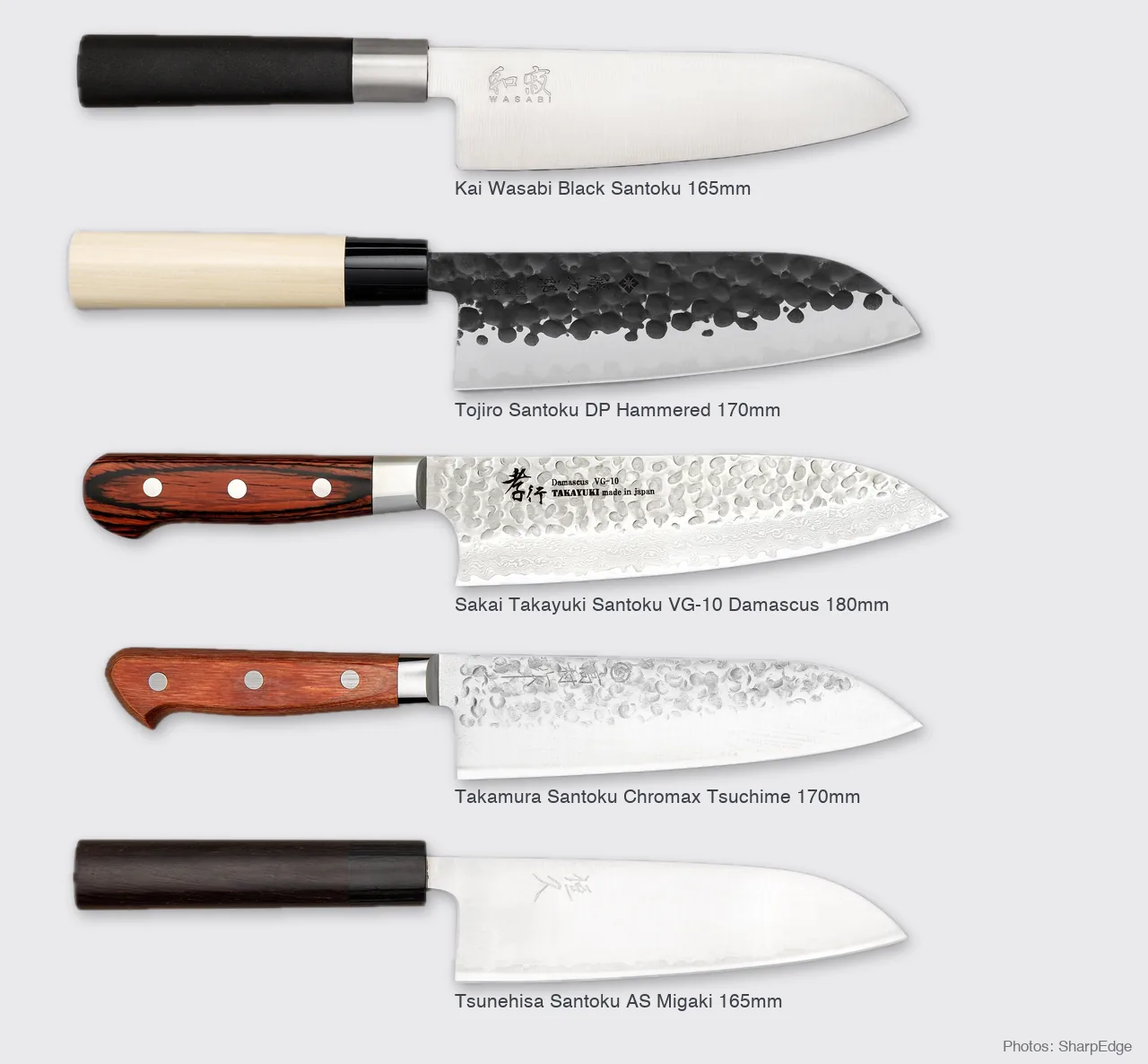
For most home cooks, the Tojiro Santoku DP Hammered is the best balance of steel, weight and price. If your budget is tight, start with the Kai Wasabi Black; if you want the sharpest edge and don’t mind wiping the blade dry, the Tsunehisa Aogami Super is the one to aim for. All five picks are double-bevel santoku knives between 165mm and 180mm, sold by SharpEdge.
This guide assumes you have already decided on a santoku. If you are still choosing between a santoku, a gyuto and a nakiri, start with Santoku vs Gyuto vs Nakiri; for the santoku’s close cousin, see Bunka vs Santoku.
| Knife | Price | US total (est.)* | Best for | Steel (HRC) | Length | Handle |
|---|---|---|---|---|---|---|
| Kai Wasabi Black | ~$57 (€51) | ~$86 | Tight budget, low maintenance | 6A/1K6 stainless (58) | 165mm | Western |
| Tojiro DP Hammered | ~$152 (€135) | ~$203 | Best all-round value | VG-10 (60–61) | 170mm | Japanese |
| Sakai Takayuki VG-10 Damascus | ~$185 (€165) | ~$246 | Western grip, longer blade | VG-10 (61–63) | 180mm | Western |
| Takamura Chromax Tsuchime | ~$185 (€165) | ~$246 | Edge retention | Chromax, semi-stainless (64–65) | 170mm | Western |
| Tsunehisa AS Migaki | ~$292 (€260) | ~$379 | Finest edge, carbon steel | Aogami Super (63) | 165mm | Japanese |
*US total (est.) is an estimate for a US buyer, including shipping and the 25% tariff, as of October 2026, based on SharpEdge’s shipping page: (price + €10 shipping) × 1.25 for orders under €300, or price × 1.25 for orders of €300 or more, which ship free. Example: a €51 knife came to €76.10 at checkout for a New York address on October 3, 2026. Tariff rates can change.
Prices and shipping: prices are SharpEdge’s euro prices on October 3, 2026, with US dollar figures converted at the ECB reference rate of 1 EUR = 1.1225 USD on October 2, 2026; shipping is not included. SharpEdge ships from Europe by DHL Express. Its shipping page lists a €10 flat rate, free shipping on orders over €300, and US delivery in 2–4 business days. US buyers: as of October 2026, per SharpEdge’s shipping page, SharpEdge does not absorb US tariffs; a 25% tariff applies to knives and is calculated and charged at checkout along with any duties and taxes, and orders ship DDP (Delivered Duties Paid), so nothing more is charged on delivery. Tariff rates can change, so check the total at checkout. Other countries: the same page says SharpEdge covers duties and import taxes, including local VAT, for most destinations, with listed exceptions; shipping to the UK costs €15. Check the shipping page for your country before you buy.
How to Choose a Santoku: Length, Steel, Handle and Finish
Choose blade length first, then steel, then handle; the finish matters least.
- Length: 165mm to 180mm covers almost every santoku. 165mm (Kai, Tsunehisa) is nimble on a small board; 180mm (Sakai Takayuki) handles a whole cabbage more easily. Our blade length guide goes into more detail
- Steel: four of the five are stainless or semi-stainless, and one is carbon steel. The stainless knives (Kai’s 6A/1K6, VG-10 in the Tojiro and Sakai Takayuki) forgive a wet cutting board. Takamura’s Chromax is semi-stainless and very hard. Tsunehisa’s Aogami Super takes the keenest edge but must be dried after use. Japanese Knife Steel Types Explained compares these steels
- Hardness: a higher HRC number usually means longer edge retention but a less forgiving edge. The picks run from 58 (Kai) to 64–65 (Takamura)
- Handle: three Western handles and two Japanese handles; the section below explains the difference
- Finish: polished (migaki), hammered (tsuchime), black forge-scale (kuro-uchi) and Damascus are mostly about looks, though a hammered surface can help food release from the blade
Best Santoku Knives by Budget
Entry Pick: Kai Wasabi Black Santoku 165mm
Kai Wasabi Black Santoku 165mm from SharpEdge — €51.00 (about $57). US buyers: about $86 in total with shipping and the 25% tariff. That is a sale price (regular €60.00, about $67).
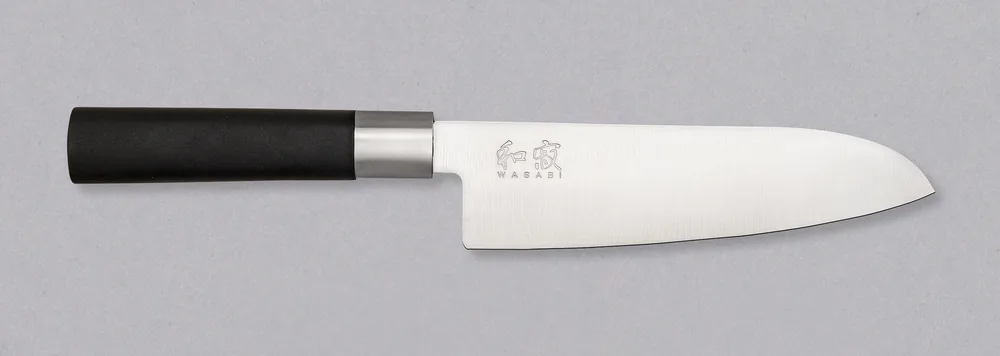
The cheapest knife here is also the easiest to live with. The blade is a single layer of 6A/1K6 stainless steel hardened to 58 HRC, which SharpEdge describes as corrosion-resistant and easy to maintain, and the handle is water-resistant polypropylene with a seamless joint to the blade. It will not hold an edge as long as the VG-10 knives, but it is a sensible first santoku, and it is the same series recommended in Best Japanese Knife for Beginners.
Japan Check
Made in: Japan (Kai, Seki)
Steel: 6A/1K6 stainless (monosteel)
HRC: 58 (±1)
Blade Length: 165mm
Handle: Western, black polypropylene
Weight: 136g
Checked Against: sharpedgeshop.com
Last Checked: 2026-10-03
Best Value: Tojiro Santoku DP Hammered 170mm
Tojiro Santoku DP Hammered 170mm from SharpEdge — €135.00 (about $152). US buyers: about $203 in total with shipping and the 25% tariff.
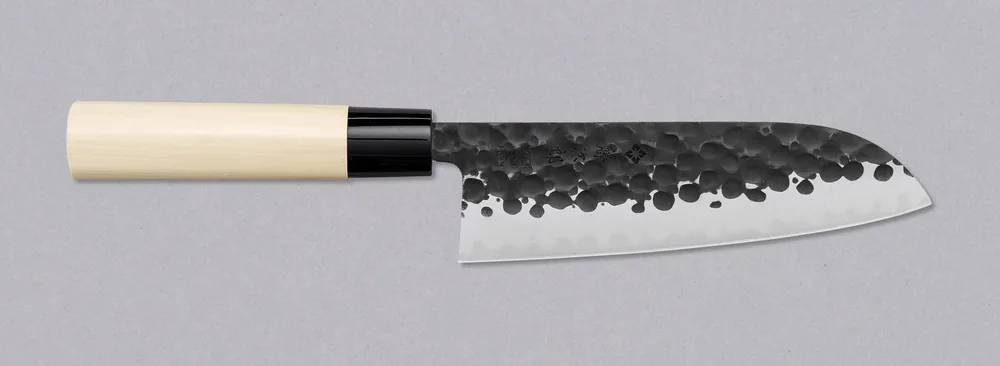
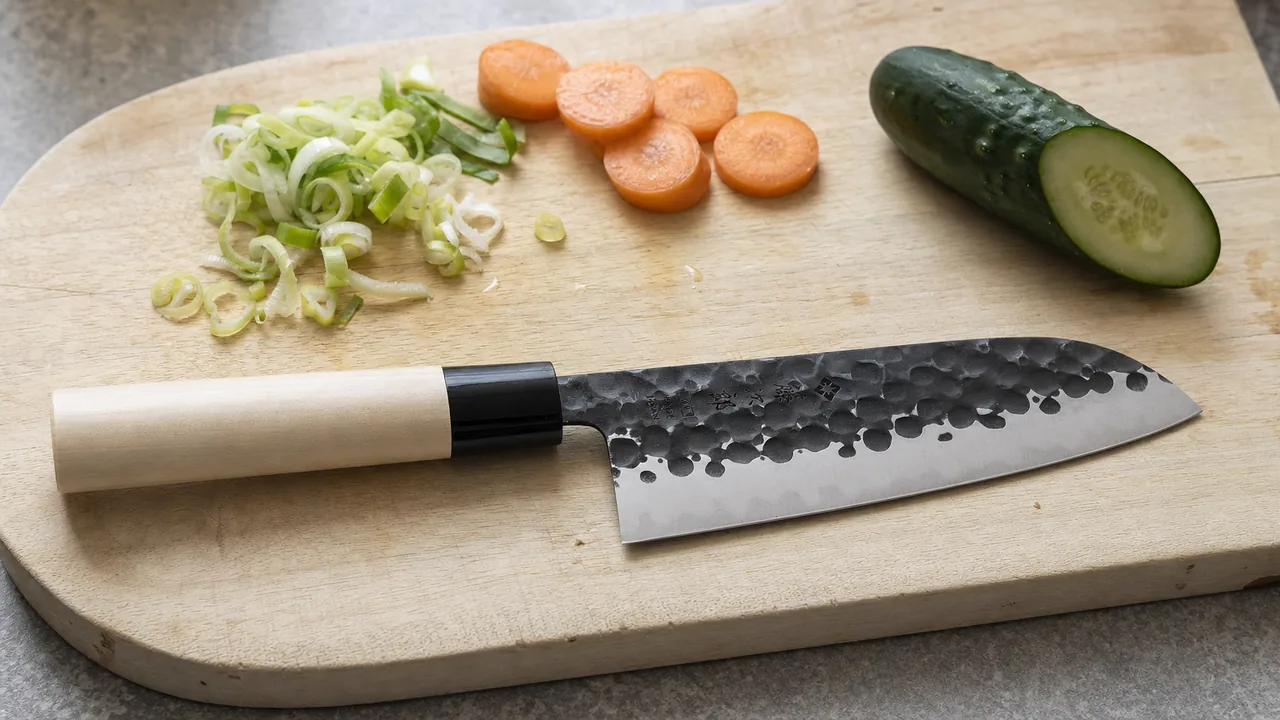
Tojiro puts a VG-10 core hardened to 60–61 HRC between layers of softer stainless steel, then leaves the hammer marks and black forge finish on the upper blade. SharpEdge notes the hammer dents also help food release. At 135g with a light magnolia handle, it is the knife in this list that most cooks will reach for every day.
Japan Check
Made in: Japan (Tojiro, Tsubame-Sanjo, Niigata)
Steel: VG-10 core, stainless cladding (san-mai)
HRC: 60–61
Blade Length: 170mm
Handle: Japanese D-shaped, magnolia
Weight: 135g
Checked Against: sharpedgeshop.com
Last Checked: 2026-10-03
Western Grip, Longer Blade: Sakai Takayuki Santoku VG-10 Damascus 180mm
Sakai Takayuki Santoku VG-10 Damascus 180mm from SharpEdge — €165.00 (about $185). US buyers: about $246 in total with shipping and the 25% tariff.
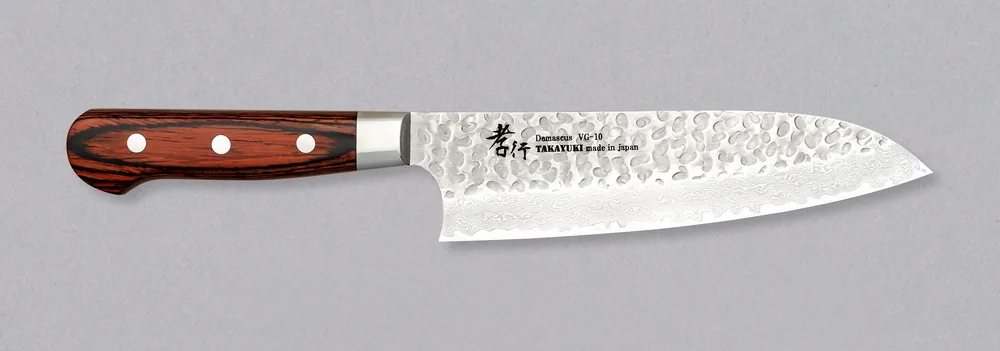
This is the longest and heaviest pick (180mm, 180g), with a VG-10 core rated at 61–63 HRC under stainless Damascus cladding and a riveted Western handle with a bolster. It suits cooks who are used to a Western chef’s knife but want a santoku’s wide, flat blade. Sakai Takayuki is a Sakai maker; Sakai is one of Japan’s oldest knife-making towns. Its background is covered in The History of Sakai Knives.
Japan Check
Made in: Japan (per retailer; Sakai, Osaka)
Steel: VG-10 core, stainless Damascus cladding
HRC: 61–63
Blade Length: 180mm
Handle: Western (yo), riveted pakkawood
Weight: 180g
Checked Against: sharpedgeshop.com
Last Checked: 2026-10-03
Edge Retention: Takamura Santoku Chromax Tsuchime 170mm
Takamura Santoku Chromax Tsuchime 170mm from SharpEdge — €165.00 (about $185). US buyers: about $246 in total with shipping and the 25% tariff.
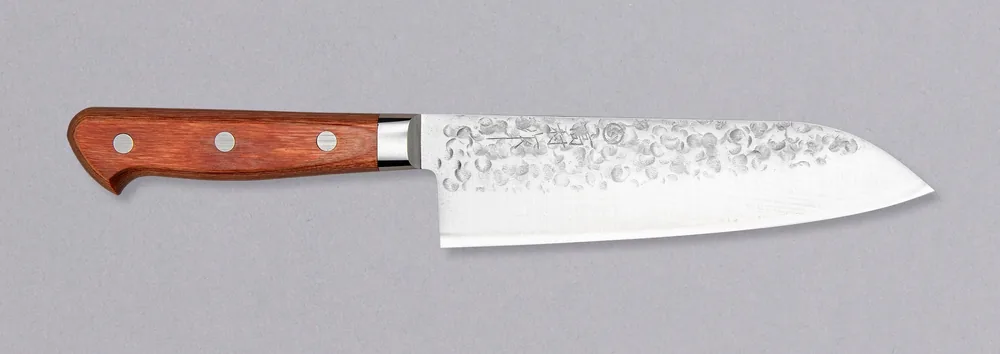
Takamura Hamono, a knife maker in Echizen, uses Chromax, a steel SharpEdge describes as very hard (64–65 HRC) and easy to sharpen. Chromax is semi-stainless: according to SharpEdge it resists corrosion much better than high-carbon steel but can still form a patina and react with acidic vegetables and fruit, so wipe the blade after cutting tomatoes or citrus and dry it before putting it away. The core is clad in softer, more corrosion-resistant steel, and the handle is a riveted Western pakkawood handle.
Japan Check
Made in: Japan (Takamura Hamono, Echizen, Fukui)
Steel: Chromax core (semi-stainless), stainless cladding
HRC: 64–65
Blade Length: 170mm
Handle: Western (yo), riveted pakkawood
Weight: 155g
Checked Against: sharpedgeshop.com
Last Checked: 2026-10-03
Carbon Steel Pick: Tsunehisa Santoku AS Migaki 165mm
Tsunehisa Santoku AS Migaki 165mm from SharpEdge — €260.00 (about $292). US buyers: about $379 in total with shipping and the 25% tariff.
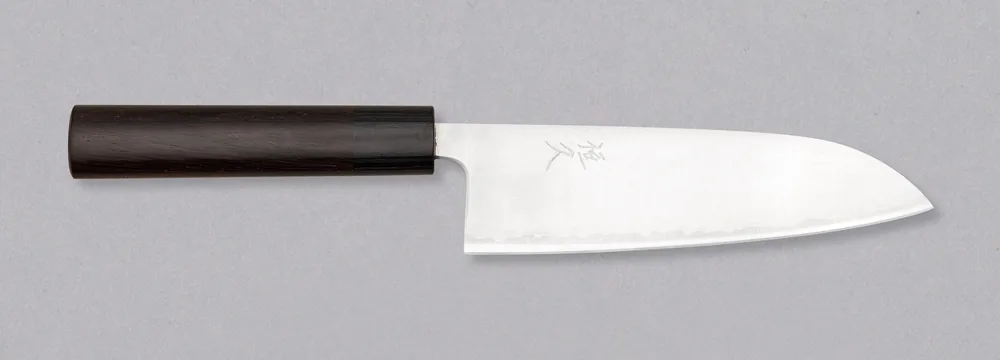
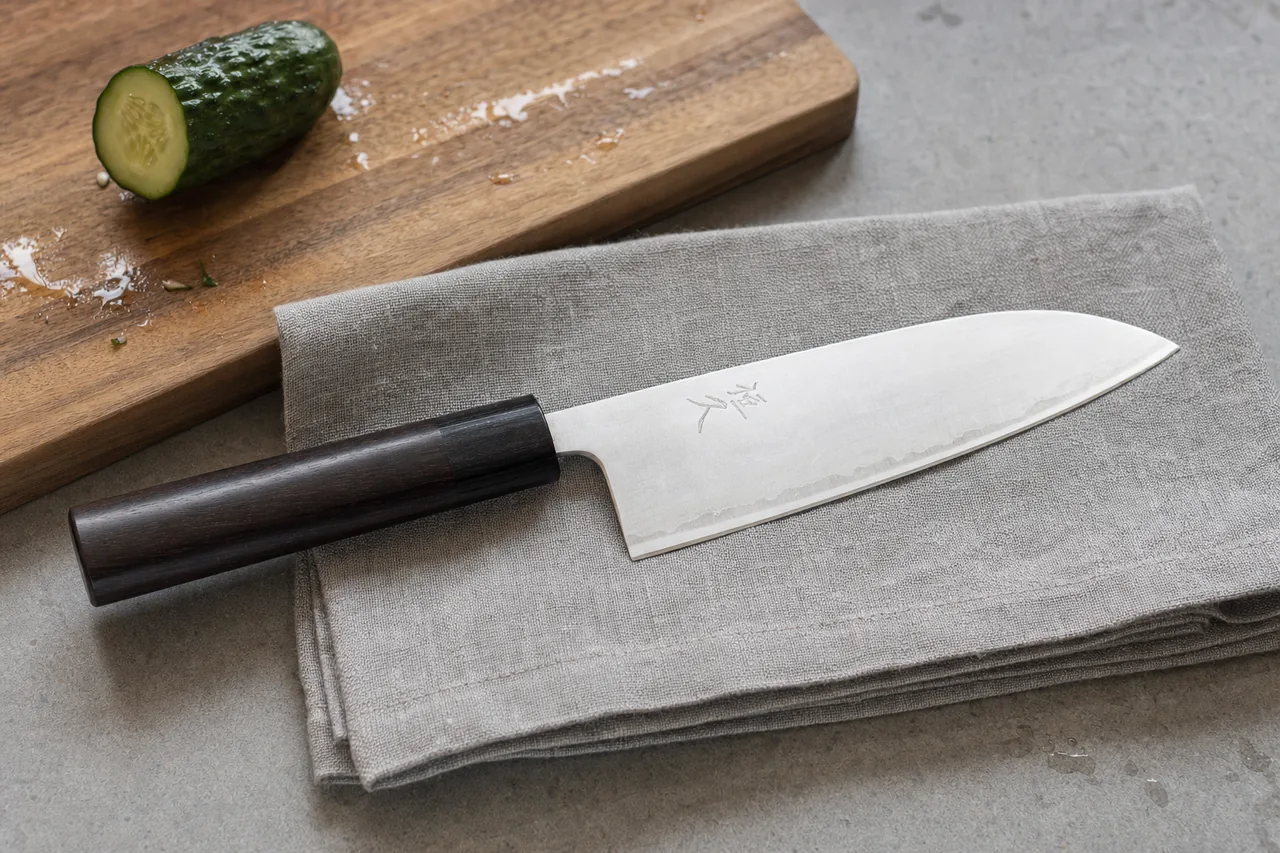
The most expensive pick has an Aogami Super carbon steel core at 63 HRC, a plain polished finish and an octagonal rosewood handle, and at 120g it is also the lightest. SharpEdge is clear about the trade-off: Aogami Super will develop a patina and can rust if left wet or in contact with food acids, so it needs to be wiped dry after use. If you accept that routine, it gives the finest edge of the five.
Japan Check
Made in: Japan (per retailer; Tosa, Kochi)
Steel: Aogami Super carbon steel core (san-mai)
HRC: 63
Blade Length: 165mm
Handle: Japanese (wa), rosewood
Weight: 120g
Checked Against: sharpedgeshop.com
Last Checked: 2026-10-03
Western or Japanese Handle? What Changes in Daily Use
A Western handle puts more weight in your hand and gives a fuller grip; a Japanese handle is lighter and shifts the balance toward the blade. Neither is better; it depends on how you hold a knife.
- Western handles (Kai, Sakai Takayuki, Takamura): the Sakai Takayuki and Takamura use riveted pakkawood with a metal bolster, the familiar shape of a Western chef’s knife. The Kai uses a smooth polypropylene handle with no rivets
- Japanese handles (Tojiro, Tsunehisa): a D-shaped magnolia handle on the Tojiro and an octagonal rosewood handle on the Tsunehisa. Both knives weigh 135g or less, the lightest in this guide
If you pinch the blade near the handle when you cut, both styles work. If you prefer to hold the handle itself, a Western handle often feels more secure at first.
Caring for a Santoku
Hand-wash, dry immediately, and sharpen on a whetstone rather than a pull-through sharpener. That applies to all five knives; it matters most for the carbon steel Tsunehisa and the semi-stainless Takamura.
- After use: wash by hand, wipe the blade dry and store it in a block, on a magnet or in a sheath
- Patina: on carbon and semi-stainless steels a grey or bluish patina is normal; rust is not, so dry the blade promptly
- Sharpening: a 1000-grit whetstone is enough for most home cooks. See how to sharpen a Japanese knife on a whetstone and the best sharpening stones for beginners
For storage and rust prevention in more detail, read How to Store and Maintain a Japanese Knife.
Frequently Asked Questions
What size santoku is best for a home cook?
165mm to 180mm. A 165mm santoku is easier to control on a small cutting board; 180mm is better for large vegetables and bigger boards.
Is a santoku better than a gyuto?
Not better, different. A santoku has a shorter, flatter blade suited to push-cutting and chopping, while a gyuto is longer and better for rocking cuts and large pieces of meat. Our santoku vs gyuto vs nakiri comparison covers the choice.
Which santoku steel is easiest to maintain?
Stainless steel. Of the five picks, the Kai Wasabi Black (6A/1K6) and the VG-10 knives from Tojiro and Sakai Takayuki are the most forgiving. Takamura’s Chromax is semi-stainless and Tsunehisa’s Aogami Super is carbon steel, so both need drying after use.
Are these knives made in Japan?
Yes. Kai, Tojiro and Takamura make their knives in Japan, and SharpEdge lists the Sakai Takayuki and Tsunehisa knives as made in Japan, in Sakai and Tosa respectively.
Do I have to pay import fees in the US?
As of October 2026, SharpEdge says a 25% tariff applies to knives shipped to the US. It is calculated and charged at checkout with any duties and taxes, and the order ships with duties paid, so there is nothing more to pay on delivery.
Still deciding which knife shape you need? Start with Santoku vs Gyuto vs Nakiri. Product images are illustrative renderings based on retailer product photos.