This article contains affiliate links. If you buy through them, we may earn a commission at no extra cost to you.
How this article was made: Research-based comparison. It draws on published information from makers, retailers, and reference sources, not on hands-on testing.
For readers in the US
- Shun Classic 8″ Chef’s Knife — $140.15 at Amazon.com: sold and shipped by Amazon; made in Seki, Japan, per Shun
- Kai Wasabi Black Gyuto 200mm — about $97 in total from SharpEdge: €59.50 (sale price) plus shipping and the 25% tariff
For readers in the UK and Europe
- Kai Wasabi Black Gyuto 200mm — €59.50 at SharpEdge (sale price)
- Tojiro Zen Gyuto 210mm — €150.00 at SharpEdge
The Shun Classic 8″ listed above is also on Amazon.de.
Prices and stock checked October 7, 2026. SharpEdge prices are in euros and exclude shipping; taxes are worked out at checkout.
- The Short Answer: Which Gyuto to Buy
- What Is a Gyuto — and Why Do Home Cooks Love It?
- Gyuto vs Santoku vs Nakiri: How They Differ
- How to Choose the Right Gyuto: Four Things That Actually Matter
- Top Gyuto Picks by Price Tier: Entry, Mid-Range, and Pro
- Single Bevel or Double Bevel? Where the Gyuto Fits
- Common Mistakes When Buying (and Using) a Gyuto
- Care & Maintenance Basics
- Frequently Asked Questions
- Final Thoughts: Which Gyuto Is Right for You?
The Short Answer: Which Gyuto to Buy
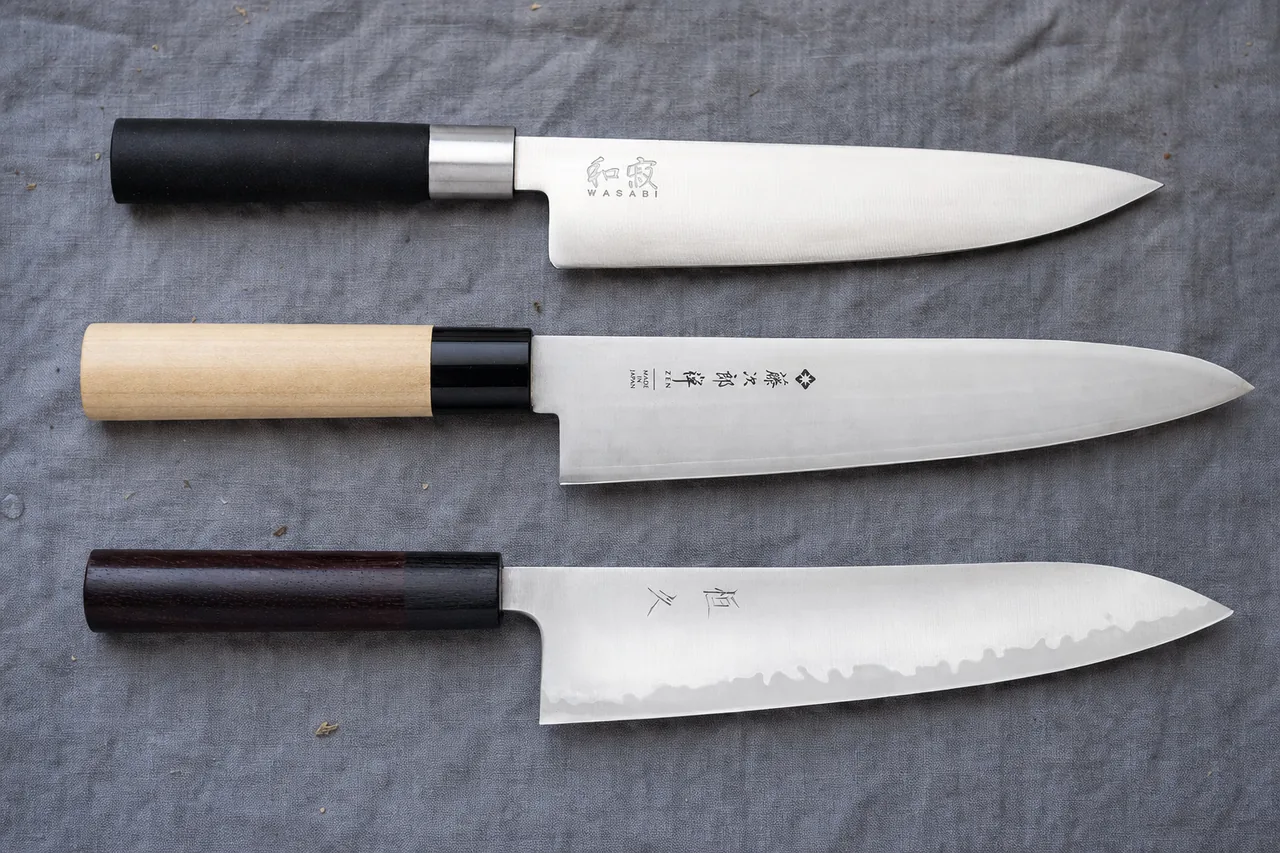
For most home cooks, this guide recommends a 210mm gyuto in VG-10 stainless steel, because that length handles the majority of kitchen tasks and the steel lasts for years with basic care. The three picks below are one knife at each price level, all made in Japan and in stock at SharpEdge when checked.
- A first Japanese knife at the lowest price: Kai Wasabi Black Gyuto 200mm, €59.50 on sale (about $67; US total, est. about $97). 6A/1K6 stainless steel at HRC 58±1, in a 200mm length that is slightly shorter than the standard 210mm
- A daily knife for most home cooks: Tojiro Zen Gyuto 210mm, €150.00 (about $168; US total, est. about $224). A VG-10 core at HRC 60–61, with a round magnolia handle that suits both left- and right-handed cooks
- Carbon steel, for cooks ready for the care: Tsunehisa Gyuto AS Migaki 210mm, €275.00 (about $308; US total, est. about $399). An Aogami Super core, which needs proper drying and occasional oiling to avoid rust
The US totals are estimates that include shipping and the 25% tariff; the table below explains how they are worked out.
What Is a Gyuto — and Why Do Home Cooks Love It?
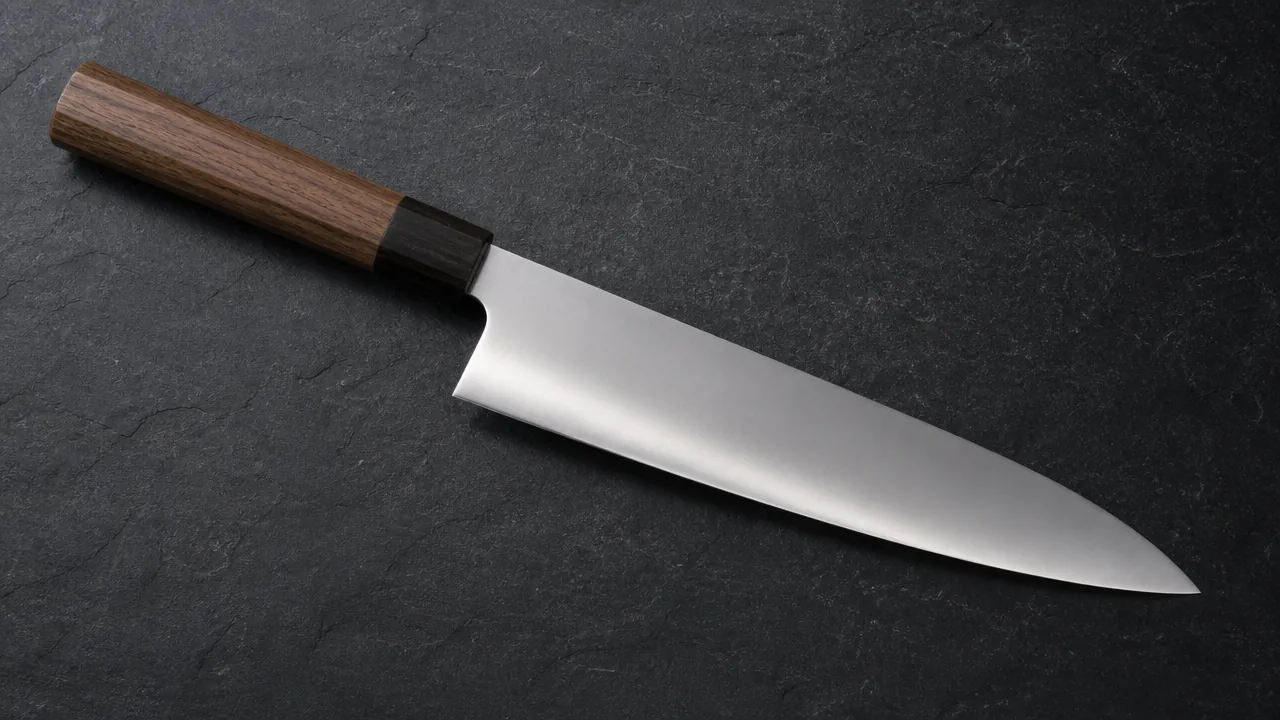
The Gyuto (牛刀) is often described as the Japanese answer to a Western chef’s knife, but that comparison only goes so far. The name literally translates to ‘beef sword,’ though today’s Gyuto handles everything from julienning vegetables to breaking down whole fish. What makes it stand out is a combination of a longer, tapered blade — typically between 210mm and 270mm — with a thinner spine and a more acute edge angle than most European knives. That geometry lets it glide through proteins and produce with noticeably less effort.
If you’ve already been looking at Santoku or Nakiri knives and wondered how a Gyuto fits in, the short answer is versatility. Where a Nakiri excels at flat, push-cut vegetable prep, and a Santoku offers a compact, all-around option, the Gyuto’s longer belly is especially useful for rocking cuts and slicing larger ingredients in a single stroke. A closely related, more advanced shape — the Kiritsuke — borrows the Gyuto’s reach but adds a single-bevel edge and a distinctive angled tip; see our Kiritsuke vs Gyuto comparison if you are curious how the two actually compare in the kitchen.
For those just starting to explore Japanese knives, the sheer variety of options — double bevel vs single bevel, Wa handle vs Western handle, carbon steel vs stainless — can feel overwhelming at first. If you’re completely new to the category, this guide for beginners is a useful starting point before diving into the specifics of Gyuto selection.
Gyuto vs Santoku vs Nakiri: How They Differ
Before committing to a Gyuto, it helps to see it next to the other two all-purpose Japanese knives it’s most often confused with. All three are double bevel, general-purpose blades — the difference comes down to tip shape and blade length, not which one is objectively ‘better.’
A Santoku runs shorter (typically 165mm to 180mm) with a rounded tip and a flatter edge, favoring an up-and-down chopping motion rather than a rocking cut. A Nakiri goes further in the other direction: a rectangular blade with a blunt tip and two flat edges, built specifically for push-cutting through vegetables. The Gyuto sits at the longer, more pointed end of the spectrum — usually 210mm to 270mm, with a pronounced belly curve that suits rocking cuts through meat, fish, and produce alike.
In practice, the choice often comes down to what kind of cutting motion feels natural and how varied your prep work is. For a side-by-side breakdown of all three — including which one to buy first — Santoku vs Gyuto vs Nakiri: Which Japanese Knife Do You Actually Need covers the decision in more depth.
How to Choose the Right Gyuto: Four Things That Actually Matter
Walking into a Gyuto purchase without a framework usually ends in either overspending or buying the wrong tool for how you cook. Four practical criteria cover most of what you need to evaluate:
- Blade length: A 210mm Gyuto suits most home kitchens and handles daily tasks comfortably. Step up to 240mm if you regularly butcher larger cuts or work on a full-size cutting board. The 270mm range is largely territory for professional prep, where speed and reach matter more than maneuverability.
- Steel type: Stainless options like VG-10 steel offer corrosion resistance and easier maintenance — a sensible choice if you won’t be sharpening frequently. High-carbon steels (such as Shirogami or Aogami) hold a finer edge and are preferred by serious cooks, but they require drying immediately after use to prevent oxidation. Damascus knife finishes, while visually striking, are largely aesthetic layering over a core steel and don’t change cutting performance on their own.
- Handle shape: Wa handles (traditional Japanese octagonal or D-shaped handles, usually in magnolia or ebony) keep the weight forward on the blade, which many cooks prefer for pinch grip. Western handles feel more familiar if you’re coming from European knives. Neither is objectively better — it’s a matter of grip preference and hand size.
- Price range and HRC: Hardness rating (HRC) tells you how hard the steel is. Harder steel holds an edge longer, and Shun notes that micro-chipping can be the downside of very hard steel when a knife is used roughly. Makers publish their own figures: Shun hardens its VG10 and VG-MAX steel to 60–61 on the Rockwell scale, and MAC gives 57 to 61 for its knives. If you’re buying your first Gyuto, prioritizing ease of maintenance over maximum sharpness is usually the wiser call. Best Japanese Knife Brands sets out where the main makers are based.
To put those length differences into practical terms: a 180mm Gyuto is the most maneuverable of the three, and it’s a natural fit for smaller hands, tighter kitchen counters, or cooks who mostly prep single portions — think weeknight dinners for one or two people. A 210mm blade is the default recommendation for a reason: it’s long enough to break down a whole chicken or slice a loaf of bread in one pass, yet still short enough to control with a pinch grip during detailed work like mincing garlic or trimming silverskin. Once you move to 240mm, the knife starts behaving less like an all-purpose tool and more like a specialist’s blade — ideal for someone regularly portioning larger cuts of meat, slicing multiple loaves in a single prep session, or working across a commercial-sized cutting board where the extra reach saves real time. Home cooks who batch-cook for a family of five or more, or who host frequently, often find the jump from 210mm to 240mm pays off; those cooking mostly for one or two people rarely notice the difference in daily use.
Thinking through these four points before browsing will narrow your options considerably and reduce the chance of buyer’s remorse.
Top Gyuto Picks by Price Tier: Entry, Mid-Range, and Pro
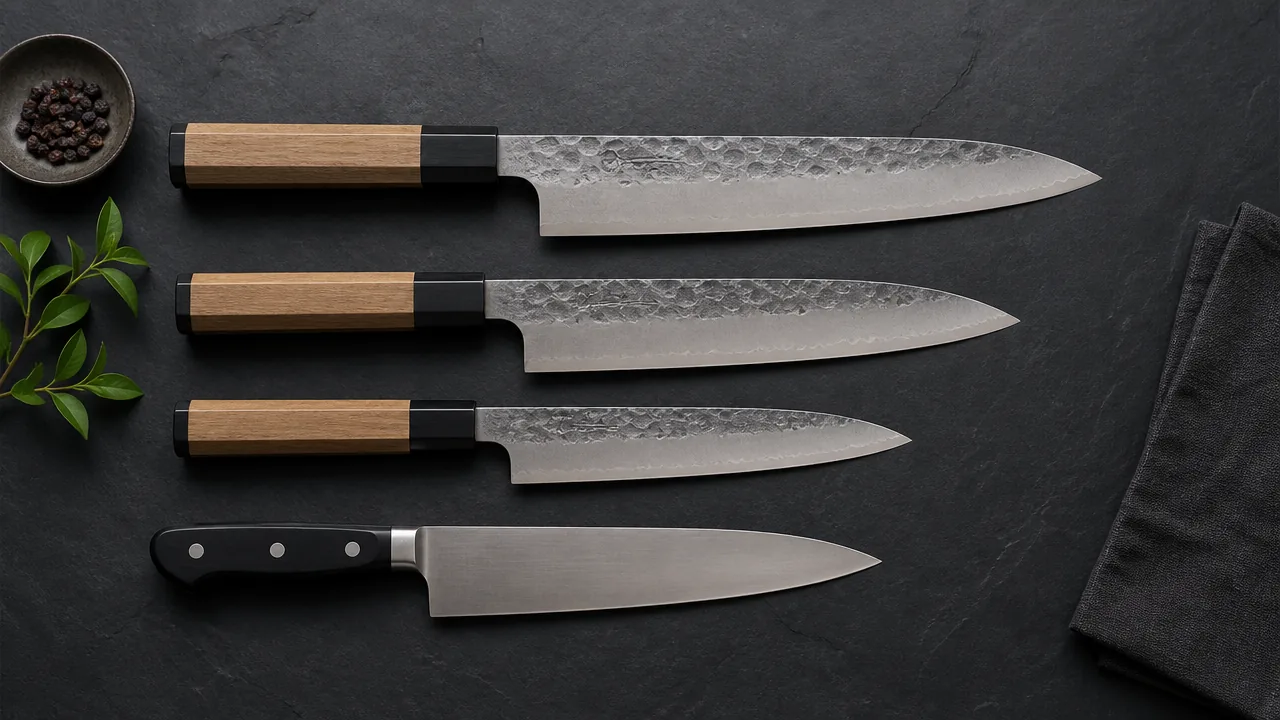
Rather than a single ‘best’ pick, the more useful framing is which knife is best for where you are right now. Here’s how the market breaks down across three tiers, verified directly against current listings. All three picks are in stock at SharpEdge, which prices in euros; the US dollar figures are approximate, converted at the ECB reference rate of 1 EUR = 1.1206 USD on October 9, 2026, and do not include shipping:
| Tier | Price | US total (est.)* | Steel | HRC | Blade Length | Handle | Best For | Made in |
|---|---|---|---|---|---|---|---|---|
| Entry — Kai Wasabi Black Gyuto 200mm |
~$67 (€59.50, sale price) | ~$97 | 6A/1K6 stainless | 58 (±1) | 200mm | Polypropylene with bamboo powder, oval | First-time Japanese knife buyers | Japan |
| Mid-Range — Tojiro Zen Gyuto 210mm |
~$168 (€150.00) | ~$224 | VG-10 core, three-layer stainless construction | 60–61 | 210mm | Magnolia Wa handle, round | Cooks who want a durable daily driver | Japan (Tsubame-Sanjo) |
| Pro — Tsunehisa Gyuto AS Migaki 210mm |
~$308 (€275.00) | ~$399 | Aogami Super (Blue Paper Super) core, clad | Not listed | 210mm | Rosewood Wa handle, oval | Experienced cooks ready for carbon steel care | Japan (per retailer) |
*US total (est.) is an estimate for a US buyer, including shipping and the 25% tariff, as of October 2026, based on SharpEdge’s shipping page: (price + €10 shipping) × 1.25 for orders under €300, or price × 1.25 for orders of €300 or more, which ship free. Example: a €51 knife came to €76.10 at checkout for a New York address on October 3, 2026. Tariff rates can change.
Entry-level (under $80)
Kai Wasabi Black Gyuto 200mm — €59.50 (approximately $67)
US buyers: about $97 in total with shipping and the 25% tariff.
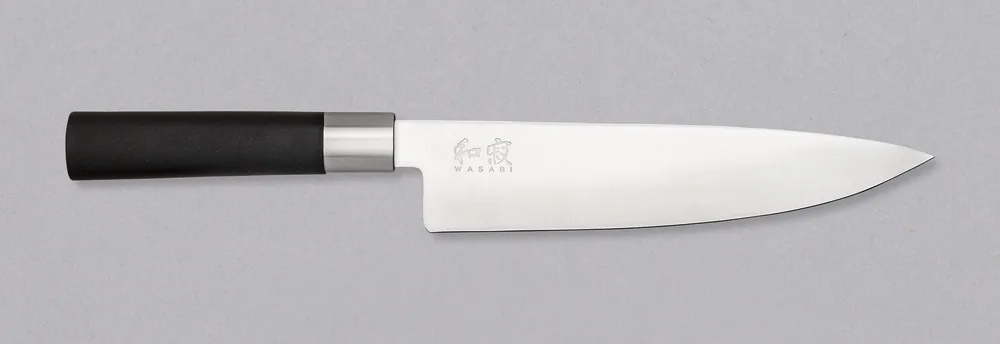
This is the entry point of the lineup, from Kai, and Kai lists the Wasabi Black series as made in Japan. The 6A/1K6 stainless steel is hardened to HRC 58±1, a forgiving hardness that is easy to maintain and holds a solid working edge, and the matte handle is water-resistant polypropylene blended with bamboo powder. At 200mm it is slightly shorter than the standard 210mm, which many first-time buyers find easier to control. The price shown is a sale price (regular €70.00, about $78), so it can change without notice.
Japan Check
Made in: Japan (Kai)
Steel: 6A/1K6 stainless steel
HRC: 58±1
Blade Length: 200mm
Checked Against: sharpedgeshop.com
Last Checked: 2026-10-02
Mid-range ($80–$200)
Tojiro Zen Gyuto 210mm — €150.00 (approximately $168)
US buyers: about $224 in total with shipping and the 25% tariff.
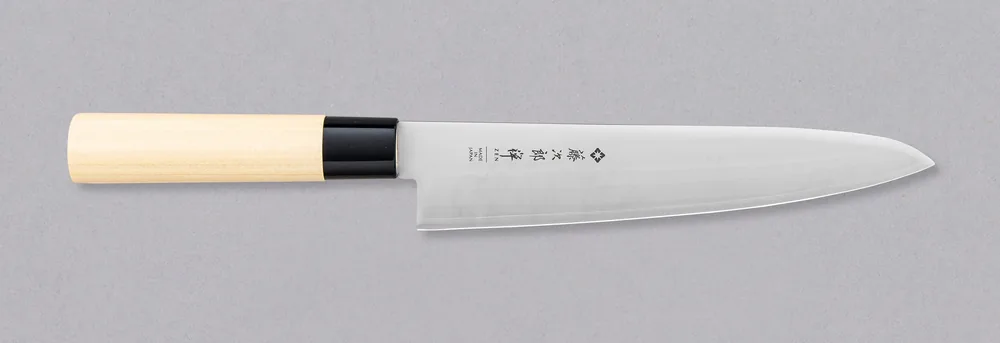
Stepping into the mid-range, this knife pairs a VG-10 core, heat treated to HRC 60–61, with two outer layers of softer stainless steel and a clean polished finish. The round magnolia Wa handle keeps the knife light and suits both left- and right-handed cooks — a practical choice for anyone who wants mid-range performance with a traditional Japanese feel.
Japan Check
Made in: Japan (Tojiro, Tsubame-Sanjo, Niigata)
Steel: VG-10 stainless core, three-layer construction
HRC: 60–61
Blade Length: 210mm
Checked Against: sharpedgeshop.com
Last Checked: 2026-10-02
Pro-level ($200 and up)
Tsunehisa Gyuto AS Migaki 210mm — €275.00 (approximately $308)
US buyers: about $399 in total with shipping and the 25% tariff.
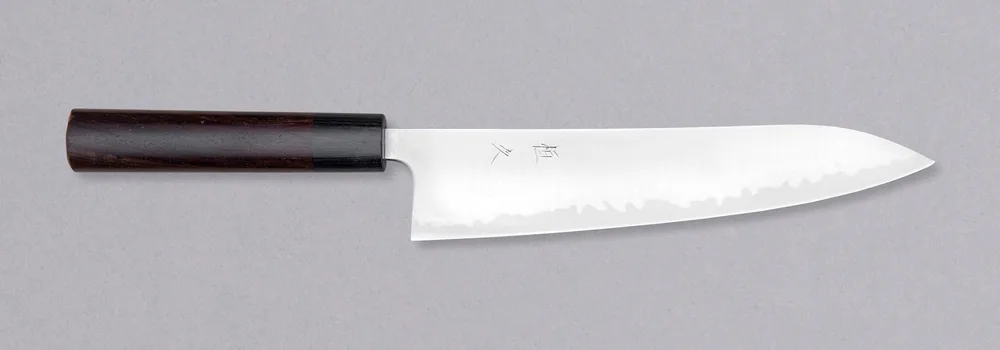
This is the professional-grade option in the lineup. Its core is Aogami Super (Blue Paper Super) carbon steel, regarded by many knife specialists as one of the finest edge-taking steels available in traditional Japanese cutlery, sandwiched between protective outer layers and finished to a high polish, with an oval rosewood Wa handle. Edge retention at this level can be remarkable, but carbon steel demands proper drying and occasional oiling to avoid rust — it rewards cooks who are ready to maintain it properly. Best suited to experienced users or serious home cooks ready to learn carbon steel care.
Japan Check
Made in: Japan (per retailer; Tsunehisa is described as sourcing its knives from Tosa, Seki and Sakai)
Steel: Aogami Super (Blue Paper Super) core, san-mai construction
HRC: not stated by the retailer
Blade Length: 210mm
Checked Against: sharpedgeshop.com
Last Checked: 2026-10-02
Single Bevel or Double Bevel? Where the Gyuto Fits
If you’ve been researching Japanese knives at all, you’ve likely run into the single bevel versus double bevel distinction — and it’s worth clarifying where the Gyuto lands. The Gyuto is, with rare exception, a double bevel knife: ground on both sides (Shun, for example, sharpens to 16 degrees on each side and MAC describes about 15 degrees per side), which means it works in either hand and requires no specialized sharpening technique beyond standard whetstone use.
Single bevel construction — ground on one side only, with a flat or slightly hollow ‘ura’ on the reverse — is reserved almost exclusively for specialized professional knives like the Yanagiba (sashimi slicing) and Deba (fish butchery). A Gyuto isn’t built that way, and that’s by design: an all-purpose knife needs to cut cleanly regardless of which direction you’re working, which is what a bevel on both sides provides.
For a full technical breakdown of how the two constructions differ — including edge angles, sharpening complexity, and which knife shapes fall into each category — Single Bevel vs Double Bevel Japanese Knives: What’s the Real Difference? covers the topic in depth.
Common Mistakes When Buying (and Using) a Gyuto
Even well-researched purchases go sideways when a few common pitfalls get overlooked. A few to watch for:
- Choosing blade length based on what looks impressive rather than what fits the cutting board and the tasks at hand. A 270mm knife on a small board is frustrating to use daily, and most home cooks do not need it.
- Buying a high-carbon steel knife without a plan for maintenance. Carbon steel like Shirogami patinas and can rust if left wet. It’s genuinely excellent steel, but only if you’re willing to wipe the blade dry after every use and sharpen it regularly.
- Assuming a more expensive knife will stay sharp longer without any upkeep. HRC and steel quality affect how long an edge lasts between sharpenings — but they don’t eliminate the need to sharpen. Every Gyuto eventually needs a whetstone, and learning to use one is part of the ownership experience. If you haven’t sharpened Japanese knives before, this guide to sharpening stones for beginners walks through the basics without assuming prior experience.
- Using a Gyuto on hard frozen foods or bones. The thinner geometry that makes a Gyuto so effective on soft ingredients also makes it vulnerable to chipping on hard materials. It’s not a cleaver, and treating it like one shortens its lifespan quickly.
- Storing it loose in a drawer. Even brief contact with other utensils dulls and damages the edge. A magnetic strip or a blade guard is a small investment that meaningfully extends how long the edge stays useful.
None of these are difficult to avoid once you know to look for them.
Care & Maintenance Basics
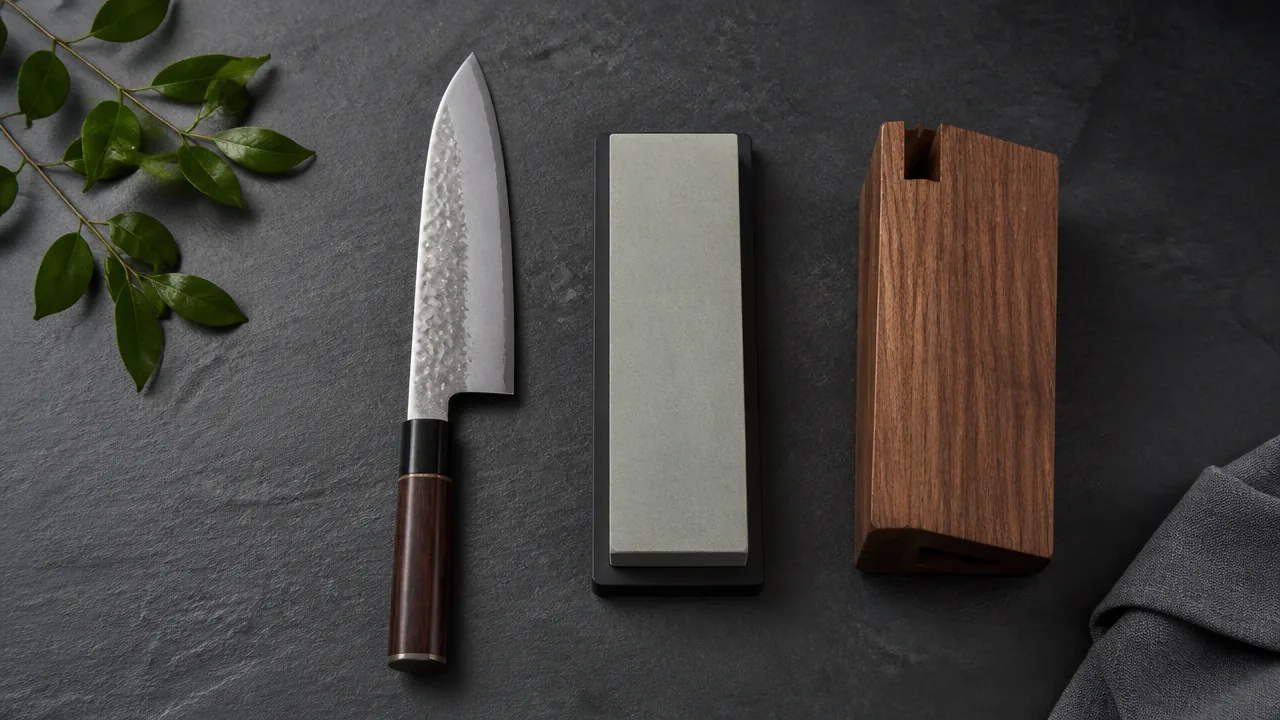
A Gyuto’s edge and finish hold up well over years of use, but only with a few consistent habits. Hand wash and dry the blade immediately after use — even stainless steels like VG-10 and DSR-1K6 can develop spotting if left wet, and carbon steel will rust noticeably faster. Avoid the dishwasher entirely; the heat and detergent are hard on both the edge and the handle material.
Regular honing keeps the edge aligned between sharpenings, but it isn’t a substitute for actual sharpening on a whetstone every few weeks of regular use. If you’re new to sharpening, this guide to sharpening stones for beginners covers grit selection and basic technique. For everything else — storage options, rust prevention, and how to handle chips — How to Store and Maintain a Japanese Knife: Preventing Rust and Chips goes into more detail than fits here.
Frequently Asked Questions
Is a Gyuto knife single or double bevel?
Gyuto knives are almost always double bevel — ground on both sides; Shun, for example, sharpens to 16 degrees on each side and MAC describes about 15 degrees per side. This makes them work equally well in either hand and easier to sharpen than single bevel knives like the Yanagiba or Deba, which are reserved for specialized professional tasks.
What size Gyuto should a beginner buy?
210mm is the standard recommendation for most home cooks. It’s long enough to handle a whole chicken or a loaf of bread in one pass, yet still maneuverable enough for detail work like mincing garlic. Smaller hands or tighter counter space may suit a 180mm blade better, while 240mm is generally better suited to cooks who batch-cook or work with larger cuts of meat regularly.
How much should I spend on my first Gyuto?
A capable entry-level Gyuto in stainless steel typically runs under $80, and that’s a reasonable place to start if you’re new to Japanese knives. Mid-range knives ($80–$200) add better edge retention and often a Damascus-clad VG-10 core. Pro-level knives ($200 and up) in high-carbon steel like Aogami Super are worth considering once you already know you’ll maintain carbon steel properly.
Gyuto vs Santoku: which is better for home cooks?
Neither is objectively better — they suit different cutting styles. A Santoku is shorter, with a rounded tip and flatter edge suited to an up-and-down chopping motion, and tends to be more forgiving for beginners. A Gyuto is longer with a pointed tip and a pronounced belly, favoring a rocking cut and offering more versatility for larger or varied prep work.
How do I maintain a Gyuto knife?
Hand wash and dry the blade immediately after each use, never put it in a dishwasher, and store it on a magnetic strip, in a blade guard, or in a knife block rather than loose in a drawer. Sharpen on a whetstone every few weeks of regular use, and if the knife is carbon steel, apply a light coat of oil before extended storage to prevent rust.
Product images are illustrative renderings based on retailer product photos.
What is the best gyuto for a home cook?
This guide recommends a 210mm gyuto in VG-10 stainless steel for most home cooks, because that length handles the majority of kitchen tasks and the steel lasts for years with basic care. Among the three picks here, that is the Tojiro Zen Gyuto 210mm; the Kai Wasabi Black Gyuto 200mm is the lower-priced option for a first Japanese knife.
Which gyuto steel is easiest to care for?
Stainless steel. Among the picks in this guide, the Kai Wasabi Black uses 6A/1K6 stainless steel at HRC 58±1, a forgiving hardness that is easy to maintain, and the Tojiro Zen has a VG-10 stainless core. The Tsunehisa AS Migaki has an Aogami Super carbon steel core, which needs proper drying and occasional oiling to avoid rust.
Final Thoughts: Which Gyuto Is Right for You?
If there’s one takeaway from everything above, it’s that the ‘best’ Gyuto is the one that matches your current cooking habits and maintenance commitment — not the most impressive spec sheet.
For most home cooks building out a knife collection, a 210mm Gyuto in VG-10 steel with a Western or hybrid handle is a reliable first choice. It’s versatile enough to handle the majority of kitchen tasks, forgiving enough to sharpen without specialized skill, and durable enough to last years with basic care. If your cooking skews heavily toward proteins or you prep in larger volumes, stepping up to 240mm and a mid-range blade makes a practical difference. The pro-level knives are genuinely exceptional tools, but they’re best appreciated by cooks who already understand what they want from a knife and are prepared to maintain them accordingly.
One thing worth remembering: a Gyuto doesn’t replace every knife. If vegetable-forward cooking is your focus, a Nakiri still does that job better. And if you’re still deciding between a Santoku, a Nakiri, and a Gyuto as a primary knife, this comparison of all three lays out the practical differences clearly.
The Gyuto is, at its core, a knife built for cooks who want a single blade that can do most things well. For that role, few knives — Japanese or otherwise — come close to matching it.
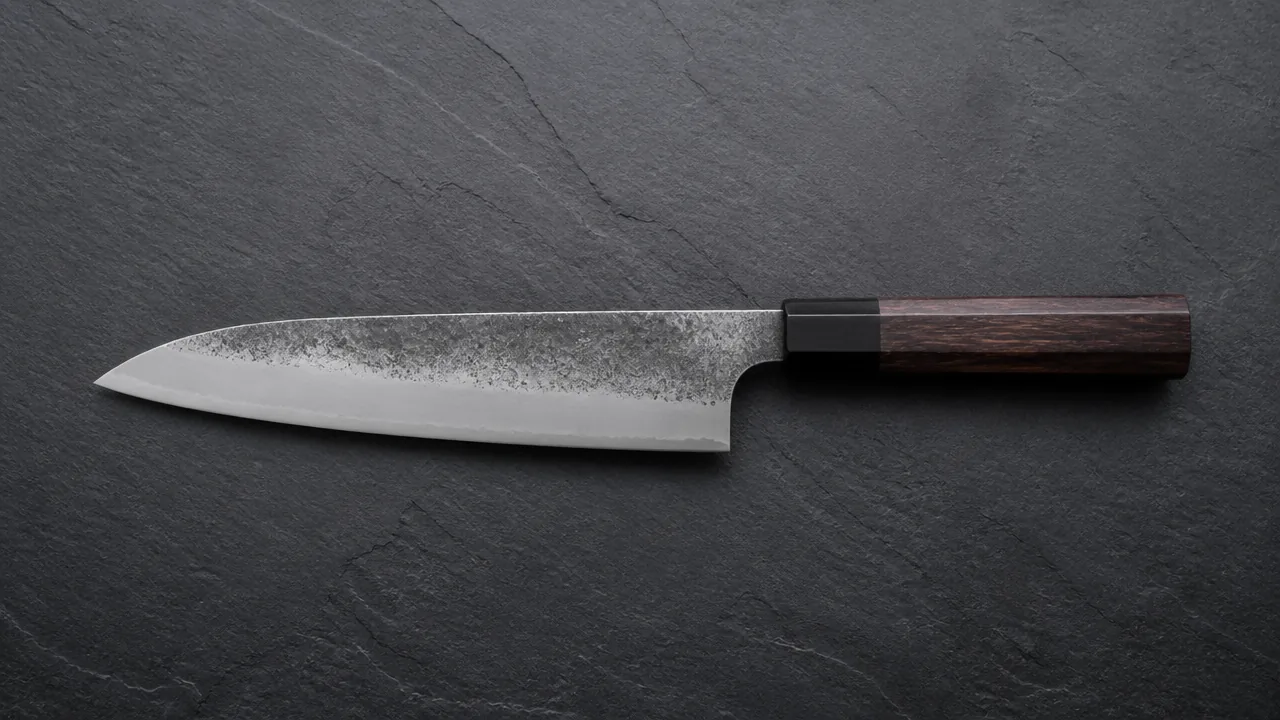
Ready to find your Gyuto? Every model covered above is linked directly to SharpEdge, and the comparison table gives you a quick side-by-side before you decide.